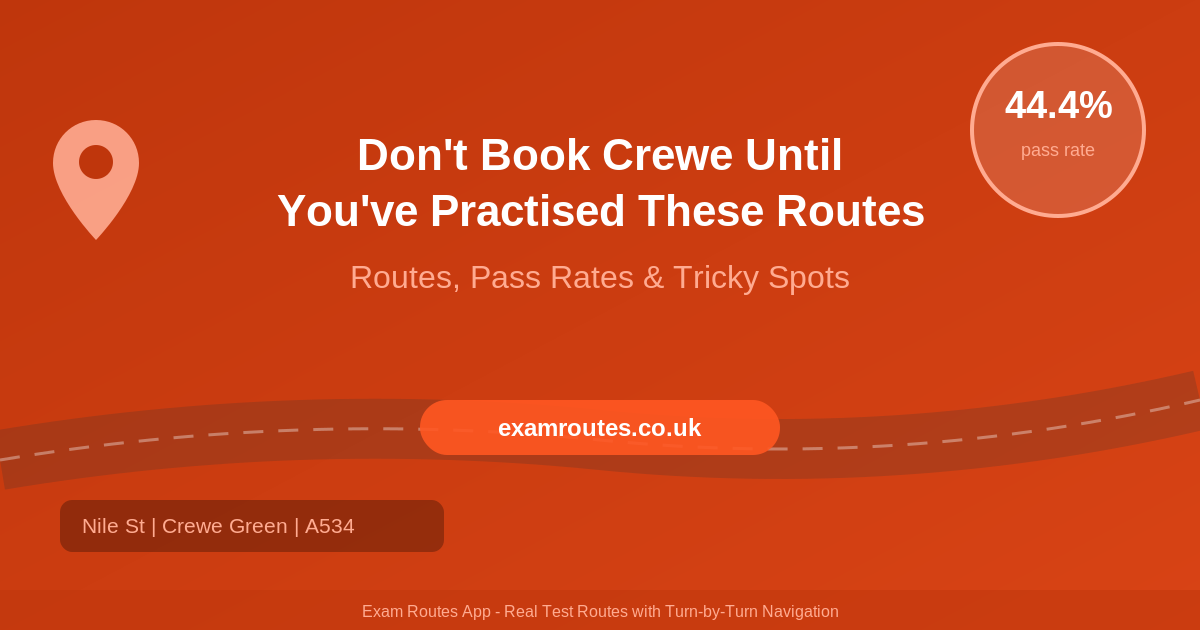
Crewe has one of the lower pass rates in Cheshire, and it is not because the examiners are harsh. It is because the routes squeeze a lot of variety into 40 minutes: tight terraced streets, a set of demanding roundabouts, dual carriageway pace and rural A-roads with changing speed limits. Book without practising that mix and you are relying on luck.
This guide walks through what the Crewe test actually asks of you, the specific roads worth putting hours into, and how to prepare so that test day is a repeat performance rather than a first attempt.
About Crewe Driving Test Centre
Crewe driving test centre is a small building on the corner of Nile Street, tucked into a quiet residential area near the town centre. There is no large car park and limited waiting space, so plan to arrive around ten minutes before your slot and park considerately on the surrounding streets.
Because the centre sits in a residential grid, your test starts immediately with parked cars, side turnings and pedestrians. Many candidates lose their first fault within 90 seconds simply because they are still settling into the car. Do your cockpit drill properly, take a breath, and move off only when you have genuinely checked the blind spot.
Bring your provisional licence, and if you are using your own vehicle make sure it meets the DVSA rules: valid MOT where applicable, legal tyres, working lights, L plates and an additional interior mirror for the examiner.
The Routes You Need to Practise
The DVSA has not published test routes since 2010, so no list is official. What local instructors consistently report at Crewe is a route mix built around the following:
Weston Road and Crewe Road
Residential driving with tight corners, parked vehicles and frequent side junctions. This is where meeting traffic and clearance faults appear. Practise choosing a gap early and holding a steady position rather than swerving late.
Crewe Green Roundabout and Nantwich Road
A busy multi-lane roundabout that demands lane selection on the approach, not on the roundabout itself. Nantwich Road adds signal-controlled junctions, buses and pedestrians. If you only practise one thing before your Crewe test, make it this.
University Way and Jack Mills Way
Dual carriageway pace and complex junctions. Examiners want to see confident joining, correct lane discipline and sensible progress. Under-driving here is a genuine fault risk – undue hesitation on a dual carriageway costs candidates every week.
Middlewich Road and the A530
Speed limit changes and rural hazards: bends, hidden entrances, slow-moving vehicles. The skill being tested is reading the road ahead and adjusting before you need to, not braking when you get there.
Dunwoody Way and the inner relief roads
Multi-lane sections with lane changes, signage to read at speed and roundabouts in quick succession – excellent practice for the independent driving section.
Tricky Spots & Common Challenges
- Railway bridges and narrow approaches. Crewe’s railway heritage means bridges with restricted width and poor forward visibility. Slow early and be prepared to give way.
- Lane choice on approach roundabouts. Signage arrives late for anyone unfamiliar with the layout. Know the exits before you get there, or read the ground markings early.
- Emerging from residential streets onto main roads. Parked cars restrict your view, so you need to creep and look properly rather than take a peek and go.
- Speed limit transitions. Going from 30 to 40 to national speed limit and back again on the town’s edges catches out candidates who drive to memory rather than to signs.
- Pedestrian crossings near the town centre. Several in short succession – look for people approaching the kerb, not just people already on the crossing.
Pass Rates & Statistics
Crewe’s car practical pass rate sits around 44 per cent based on recent data, which places it a few points below the Great Britain average of just under 50 per cent. Cheshire neighbours such as Chester and Widnes generally report higher figures.
The gap is explained by the route mix rather than anything unusual about the centre. When a route includes residential complexity, a demanding roundabout, dual carriageway progress and rural speed changes, there are simply more opportunities to pick up faults. The candidates who pass first time at Crewe are almost always those who have driven each of those environments repeatedly.
Practise Real Test Routes on Your Phone
The Exam Routes App gives you access to real driving test routes with turn-by-turn navigation. Practise at your own pace and build confidence before test day.
Top Tips for Passing at Crewe
- Master Crewe Green Roundabout before anything else. Drive it in both directions, at different times of day, until lane choice is automatic.
- Practise making progress. On University Way and the dual carriageway sections, driving 10mph under the limit with no reason is a fault. Get comfortable at the limit.
- Work on your emerging. The residential grid around the centre demands proper creep-and-look technique. Rushed observation is the single most common serious fault nationally.
- Book a slot you have practised. Crewe’s traffic is very different at 8:30am from 1:30pm. Match your practice to your booking.
- Rehearse manoeuvres on real streets. Not an empty car park. Parked cars and passing traffic change everything.
- Use the sat nav in lessons. Twenty minutes of independent driving goes far better when following spoken directions is already familiar.
- Check the car the day before. Tyres, lights, screenwash. A failed vehicle check ends the test before it starts.
Before You Click ‘Book Test’
Be honest about the five environments above. If you cannot confidently say you have driven all of them in the last month – residential grid, big roundabout, dual carriageway, rural A-road and town centre lights – you are booking too early. A rebooking costs you the fee and weeks of waiting.
How Exam Routes App Can Help
Knowing which roads matter is only half the job; driving them in the shape of a real test is the other half. The Exam Routes App gives you real UK driving test routes with turn-by-turn navigation, so you can practise a full Crewe-style loop from start to finish rather than dipping in and out of unconnected roads.
Use it with your instructor or a supervising driver to rehearse the roundabouts, the dual carriageway joins and the rural stretches in one continuous drive. By the time you sit in the examiner’s passenger seat, the route will feel like something you have already done.
Frequently Asked Questions
What is the pass rate at Crewe driving test centre?
Recent data puts Crewe at around 44 per cent, a few points below the Great Britain average of just under 50 per cent.
Where is Crewe driving test centre?
It is on the corner of Nile Street in a residential area close to Crewe town centre. There is no large car park, so allow time to park nearby.
What roads are used on Crewe driving test routes?
Local instructors commonly report Weston Road, Crewe Road, Nantwich Road, Crewe Green Roundabout, University Way, Jack Mills Way, Middlewich Road and the A530, though the DVSA does not publish official routes.
Is Crewe a hard test centre?
It is harder than average, mostly because the routes pack residential streets, major roundabouts, dual carriageways and rural roads into one test. Prepare across all four and it is very passable.
How long is the driving test at Crewe?
Around 38 to 40 minutes of driving, plus the eyesight check, show me tell me questions and the debrief afterwards.
Get the Edge on Test Day
Practise real driving test routes with turn-by-turn navigation and know every roundabout at Crewe before the examiner asks you to drive it.