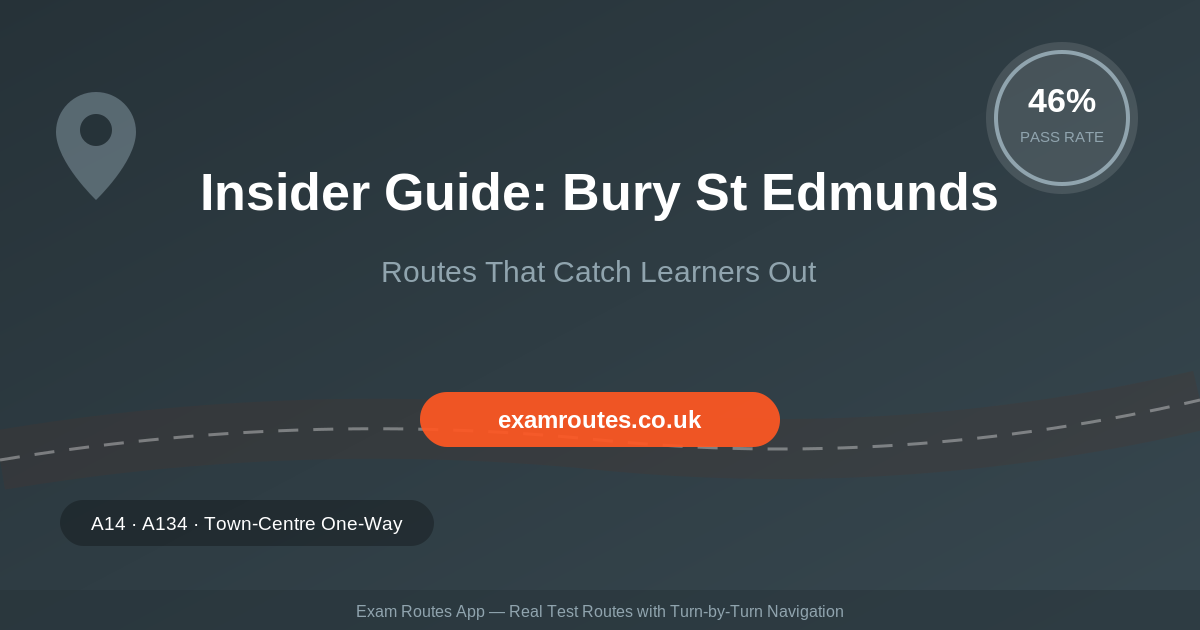
Bury St Edmunds is a deceptive test centre. The town looks gentle — a market town in west Suffolk, historic streets, no motorway boxing it in. Yet the pass rate sits at around 46%, below the Great Britain average of roughly 50%, with about 8,700 tests taken there in the most recent year of data.
The explanation is in the road mix. Routes out of St Andrews Street North combine a genuinely awkward town-centre one-way system with fast rural A-roads and, on some routes, the sliproads of the A14. Very few learners are equally strong at both, and the examiner will find out which half you skipped.
About Bury St Edmunds Test Centre
| Address | St Andrews Street North, Bury St Edmunds, Suffolk, IP33 1TJ |
| Approximate pass rate | Around 46% (below the GB average) |
| Tests per year | Roughly 8,700 |
| Manual vs automatic | Manual pass rate is notably higher than automatic at this centre |
| What to bring | Provisional licence, insured roadworthy car, L plates, extra interior mirror |
The centre sits in the town rather than on an industrial estate, which means parking near it is genuinely tight during the working day. Plan for that. Arrive early, park where you know you can get out again cleanly, and give yourself a calm five minutes before you go in.
The Routes: Two Very Different Halves
The town-centre half
Bury St Edmunds has a compact historic core with one-way sections, narrow streets, loading bays, cycle traffic and pedestrians who cross wherever they please. Routes use Northgate Street, Risbygate Street, Out Westgate and the roads around the town’s main junctions. The demands are slow-speed control, constant scanning and correct lane choice through the one-way system.
The rural half
Within minutes you can be on the A134, A143 or the roads out towards Fornham, Rougham and Great Barton. National speed limit single carriageways, bends with no footway, farm entrances, tractors in season and overtaking decisions. The demands here are the opposite: making proper progress, reading bends, and not sitting at 40 in a 60 because it feels safer.
The A14 sections
Some routes use the A14 dual carriageway junctions around the town. Joining and leaving at speed, lane discipline and merging with heavy goods traffic all come into play.
Residential estates
Moreton Hall, Howard Estate and the streets off Mount Road are the usual manoeuvre territory — parallel parking, bay parking and pulling up on the right.
Tricky Spots & Common Challenges
- The one-way system. Lane choice must be made early. The signs are there but they arrive quickly if you are not looking well ahead.
- Rural progress. Under-driving a 60mph road is a genuine fault. Drive to the conditions, not to your nerves.
- Bends on the A-roads. Position, brake before the bend, and accelerate gently through it. Braking mid-bend is a classic learner error here.
- A14 slip roads. Build speed decisively and check the blind spot properly before merging.
- Cyclists and pedestrians in the town centre. Historic streets mean poor sightlines and unpredictable crossings.
- Market days. Wednesday and Saturday change the traffic pattern in the centre significantly.
Pass Rates & Statistics
At roughly 46%, Bury St Edmunds is a few points under the Great Britain average. The manual pass rate is clearly higher than the automatic rate at this centre, which mirrors a national pattern — automatic candidates tend on average to have taken fewer hours before testing.
Locally the failure pattern is consistent: junction observation in town, and hesitation or under-progress on the rural sections. Those two faults sit at opposite ends of the confidence scale, which is exactly why this centre is harder than it looks.
Practise Real Test Routes on Your Phone
The Exam Routes App gives you access to real driving test routes with turn-by-turn navigation. Practise at your own pace and build confidence before test day.
Top Tips for Passing at Bury St Edmunds
The insider checklist
- Practise the one-way system repeatedly until lane choice is instinctive rather than a decision.
- Do proper rural lessons. National speed limit roads, bends, farm entrances and slow-moving vehicles.
- Get A14 slip road practice in even if you think your route will avoid it.
- Avoid market days for your test slot if you have any flexibility.
- Make junction observations obvious. Historic streets have poor sightlines, so creep and look properly.
- Rehearse all three manoeuvres on the residential estates near the centre.
- Book a mock test that starts at St Andrews Street North so the parking and walk-in are familiar too.
How the Exam Routes App Can Help
The centres that catch learners out are the ones where two different driving styles are tested in the same 40 minutes. Bury St Edmunds is a textbook example, and the fix is exposure: drive both halves until neither feels like the unfamiliar one.
The Exam Routes App gives you real UK driving test routes with turn-by-turn navigation, so you can cover the town-centre one-way system and the rural A-roads with a supervising driver before test day.
Frequently Asked Questions
What is the pass rate at Bury St Edmunds?
Around 46% from roughly 8,700 tests a year, which is below the Great Britain average of about 50%.
Where is the test centre?
St Andrews Street North, Bury St Edmunds, Suffolk, IP33 1TJ — in the town rather than on an out-of-town estate.
What kind of roads are on the routes?
A mix of the historic town-centre one-way system and fast rural A-roads such as the A134 and A143, with A14 sections on some routes.
Why do people fail here?
Mostly junction observation in the town centre and under-progress or poor bend control on the rural sections.
Is parking difficult at the centre?
Yes, town-centre parking is limited during the working day, so arrive early and leave yourself time.
Ready to Pass? Download Exam Routes Now
Stop guessing where the examiner might take you. Exam Routes puts real test routes, turn-by-turn navigation and local hazard notes in your pocket — so nothing on test day is a surprise.