Lincolnshire is one of the most revealing counties in England for anyone studying driving test pass rates. It contains centres that sit near the very top of the national table and one that sits well below the average — and they are all within an hour of each other. The reason has almost nothing to do with the examiners and everything to do with the roads outside each centre’s front door.
This 2026 guide compares Lincoln, Boston, Grimsby, Skegness, Louth and the smaller Lincolnshire centres by pass rate, route character and the faults that catch local learners out. If you are choosing where to book, or you have already booked and want to know what to expect, start here.
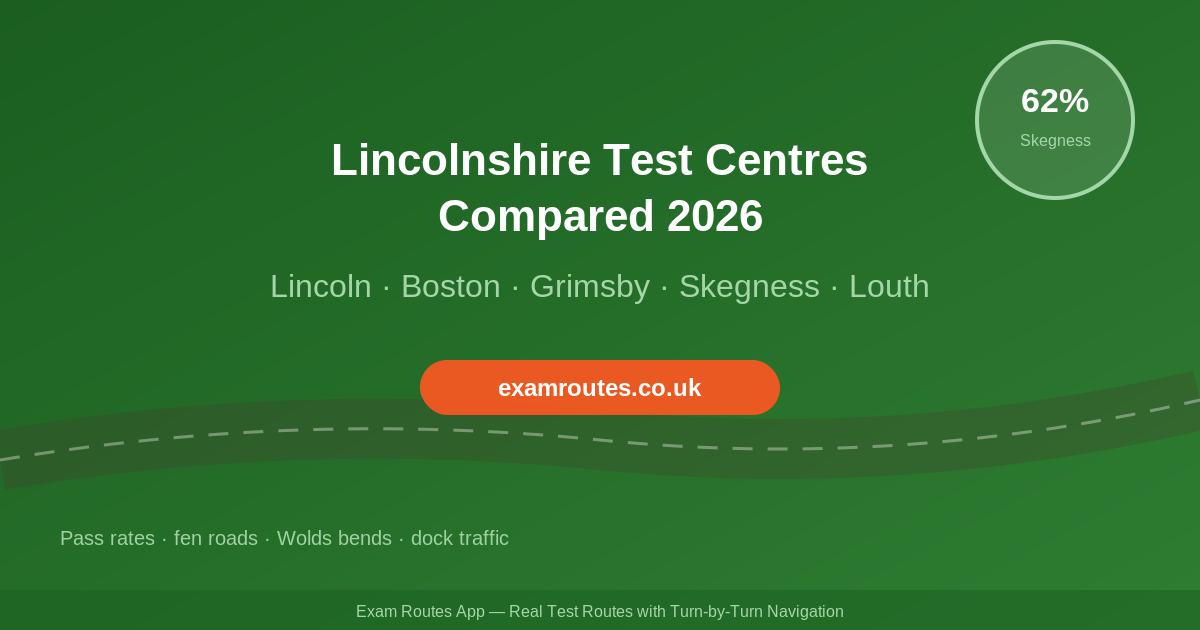
Lincolnshire Pass Rates Compared
The figures below come from recent DVSA test centre data. They shift each quarter, so use them to understand relative difficulty rather than as a fixed ranking. For context, the national car pass rate has been hovering around the 50 per cent mark.
| Test centre | Recent pass rate | Road character | Main challenge |
|---|---|---|---|
| Skegness | around 62% | Coastal town, quiet fringes, fenland | Seasonal tourist traffic |
| Boston | around 58% | Market town, fen roads, level crossings | Narrow fen lanes and drains |
| Louth | around 57% | Small market town, Wolds hills | Bends and gradients on the Wolds |
| Lincoln | around 52% | Historic city, steep hill, ring road | Steep Hill area and one-way system |
| Grimsby (Coldwater) | around 41% | Industrial, docks, dense urban | Heavy goods traffic and junctions |
That is a spread of more than twenty percentage points between Skegness and Grimsby — one of the widest within a single English county. It is not evidence that one set of examiners is generous and another is harsh. It is evidence that a test route through fenland lanes asks different questions from a test route past a fish dock.
Skegness and Boston: Why the East Coast Rates Run High
Skegness routinely appears in national lists of the highest pass rates in the country. The routes leave the centre into a mixture of seaside residential streets and flat, sparsely trafficked roads towards Ingoldmells, Burgh le Marsh and the fen. There are fewer multi-lane roundabouts, fewer bus lanes and far fewer moments where you must force a gap in dense traffic than at an inner-city centre.
That does not make it a soft test. Two things catch learners out. In summer, tourist traffic transforms the town: caravans, unfamiliar drivers, pedestrians stepping off kerbs. And the fen roads carry their own hazards — narrow carriageways with drainage dykes immediately beside them, where poor positioning is genuinely dangerous rather than merely untidy.
Boston is similar in character but adds level crossings, the A16 and A52, and a market-town centre with a one-way system around the Market Place. Boston routes also feature several sharp right-angle bends beside drains, where the correct answer is to slow properly rather than to steer heroically.
Louth and the Lincolnshire Wolds
Louth is the county’s hill test. Routes climb out into the Wolds on roads such as the A16 and the B1200, with national speed limit sections, blind bends and crests where you cannot see the road ahead. Progress is assessed carefully here: driving at 40mph on a clear 60mph road because you are nervous will be marked as undue hesitation, while carrying too much speed into a Wolds bend is a serious fault waiting to happen.
Within the town, Louth has narrow Georgian streets with parked cars on both sides, so meeting traffic and gap judgement appear on most routes.
Practise Real Test Routes on Your Phone
The Exam Routes App gives you access to real driving test routes with turn-by-turn navigation. Practise at your own pace and build confidence before test day.
Lincoln: The City Test
Lincoln sits close to the national average and offers the most varied test in the county. Routes typically use the A46 bypass, the A15 and A158, the ring road, and residential areas such as Birchwood, Bracebridge Heath and North Hykeham. The city centre one-way system and the roads around the cathedral quarter add lane discipline and observation pressure.
Common Lincoln faults are lane selection on the ring-road roundabouts and hesitation when emerging onto the A46. Learners who have only practised on quiet estate roads around the villages tend to find the pace of the bypass sections uncomfortable.
Grimsby (Coldwater): The County’s Hardest Test
Grimsby’s Coldwater centre posts the lowest pass rate in Lincolnshire by a wide margin. The routes are the reason. They run through an industrial and dock landscape with heavy goods vehicles, poor forward visibility around large parked lorries, complex multi-lane junctions on the A180 and A46, and a town-centre network where traffic simply does not leave you a polite gap.
If you are booked at Grimsby, the single most valuable thing you can do is get lesson time in that environment during working hours — not on a quiet Sunday morning. Learners who only ever drive the routes when they are empty are effectively practising a different test.
How to Choose Your Lincolnshire Test Centre
- Do not chase the Skegness pass rate if you live in Grimsby. A long unfamiliar drive to a centre you have never practised at usually costs you more than the statistics gain you.
- Match the centre to your lessons. If your instructor has taught you mostly on fen and country roads, Boston or Louth will feel natural. If you have learned in city traffic, Lincoln is the fairer test of what you actually know.
- Think about the season. Skegness in July is a different test from Skegness in February.
- Check the 2026 booking rules. You can now only move a booked test to one of your three nearest centres, so your initial choice carries more weight than it used to.
How Exam Routes App Can Help
Pass rates tell you which roads are hard. They do not teach you those roads. The Exam Routes App maps real driving test routes for Lincolnshire centres including Lincoln, Boston, Grimsby, Skegness and Louth, with turn-by-turn navigation so you can drive each loop with an instructor or supervising driver. Repeating the Wolds bends out of Louth, or the dock-side junctions at Grimsby, until they feel ordinary is worth more than any statistic.
The Faults That Cost Marks Across the County
Wherever you book in Lincolnshire, the same faults recur: junction observation at rural crossroads, positioning on narrow fen roads, speed selection on national speed limit stretches, and hesitation joining fast A-roads. Work on those four and the difference between a high-scoring coastal centre and a tough industrial one shrinks considerably.
Frequently Asked Questions
Which Lincolnshire test centre has the highest pass rate?
Skegness, at around 62 per cent in recent DVSA data, which puts it among the highest in England. Boston and Louth also sit well above the national average.
Why is the Grimsby pass rate so much lower?
Coldwater routes run through industrial and dock areas with heavy goods traffic, complex multi-lane junctions and dense town-centre driving. The roads are simply more demanding than the county’s rural routes.
Should I travel to Skegness for an easier test?
Usually not. Familiarity with the local roads and being fresh on the day matter more than a few percentage points. Travelling far to an unknown centre often cancels out the statistical advantage.
Are Lincolnshire test routes mostly rural?
It depends on the centre. Boston, Louth and Skegness include substantial rural and fen driving, while Lincoln and Grimsby are predominantly urban with bypass and ring-road sections.
Do level crossings come up on Lincolnshire driving tests?
Yes, particularly around Boston and the fenland routes. Approach at a speed that lets you stop, do not enter unless your exit is clear, and never stop on the crossing itself.
Get the Edge on Test Day
Drive the real routes used at Lincoln, Boston, Grimsby, Skegness and Louth before your test — turn-by-turn, on your phone.