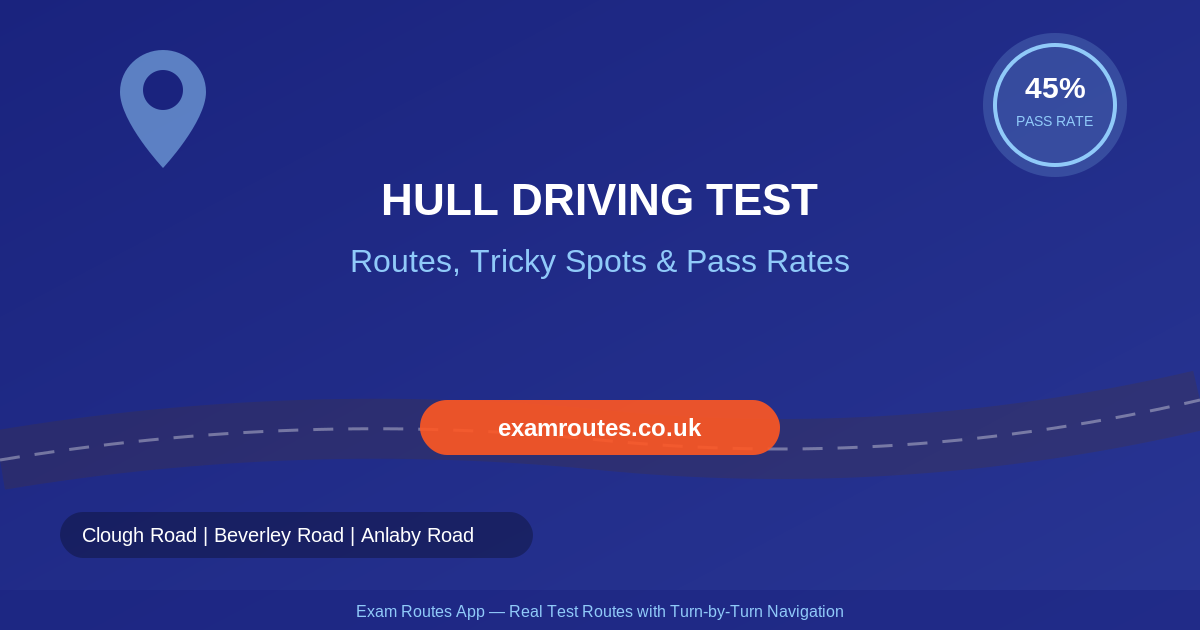
Hull’s driving test centre sits on Reservoir Road, just off Clough Road, and it has a reputation among local instructors for being unforgiving. The routes leave the car park and drop you almost immediately into some of the busiest arterial roads in East Yorkshire, and the pass rate reflects that: recent DVSA figures put Hull in the mid-to-high 40s, below the Great Britain average of roughly 48-49%.
That does not mean Hull is impossible. It means the centre punishes learners who have only practised in quiet estates. Almost every fault recorded here falls into three buckets: observation at junctions, lane discipline on multi-lane roads, and hesitation at busy roundabouts. All three are fixable, but only if you have actually driven the roads before test day rather than meeting them for the first time with an examiner beside you.
This guide walks through the Hull test centre, the roads that appear on nearly every route, the specific spots that catch learners out, and what you should be practising before you book.
About Hull Driving Test Centre
The centre is at Reservoir Road, off Clough Road, Kingston upon Hull, HU6 7PY. It is a short drive north of the city centre and sits close to the junction of Clough Road and Beverley Road, which tells you a lot about the driving you are about to do.
Practical points to know before you arrive:
- Parking — there is limited space on site. Most instructors drop learners and park nearby. Arrive 10 minutes early rather than 25; there is nowhere useful to wait.
- What to bring — your provisional licence, a roadworthy car with valid insurance, MOT and L-plates, and a second interior mirror for the examiner.
- Facilities — a basic waiting room and toilets. Do not plan on getting a coffee there.
- Test types — car tests, both manual and automatic.
Examiners will start with the eyesight check in the car park, then the show me tell me questions, then straight out onto the road. There is no gentle warm-up at Hull. Within 90 seconds you are usually on a main road.
The Routes: Roads You Will Almost Certainly Drive
The DVSA stopped publishing official routes years ago, but the geography around Reservoir Road makes the road network fairly predictable. Examiners have a limited set of directions they can send you in, and these roads come up again and again.
Clough Road (A1079 corridor)
This is the road you meet first and the one you will return to last. Multiple lanes, frequent filter arrows, retail park entrances, and traffic that changes speed constantly. Lane choice here decides a lot of tests.
Beverley Road
Long, busy, and lined with parked cars, side roads, bus stops and pedestrian crossings. This is where meeting oncoming traffic and progress faults appear. Learners either sit too long behind parked cars or push through when there is no room.
Spring Bank West and Anlaby Road
Denser urban driving with tighter junctions, more pedestrians and more cyclists. Observation faults cluster here.
Sutton Road and Leads Road
Faster, more open, with 40mph limits and roundabouts. Examiners use this area to check whether you can make proper progress rather than crawling.
Residential estates off Endike Lane and Greenwood Avenue
This is manoeuvre territory. Reverse bay parking usually happens back at the centre, but pulling up on the right and the parallel park are typically set in a quiet street off one of these roads.
Tricky Spots That Catch Learners Out
1. The Clough Road and Beverley Road junction
Heavy traffic, multiple lanes, and a signal sequence that does not give you long. Learners get stuck in the wrong lane and then make a late, panicked correction. Read the overhead signage early and commit.
2. Retail park entrances on Clough Road
Cars turning in and out without much warning, often with poor signalling. Your following distance matters more than your speed here.
3. Roundabouts on the A1079 approach
Multi-lane, with traffic joining at speed. Hesitation faults are common because learners wait for a gap big enough to park a bus in. Practise judging realistic gaps.
4. Bus lanes on Beverley Road
Check the operating times on the sign. Driving in an active bus lane is a serious fault. Learners who freeze and refuse to use a lane that is legally open also lose marks for hesitation.
5. Parked cars on residential terraces
Streets off Beverley Road and Anlaby Road are narrow with cars both sides. You need to decide early who has priority and show the examiner you have made a decision rather than drifting into a standoff.
6. Cyclists
Hull is one of the flattest cities in the UK and has a high level of everyday cycling. Expect cyclists on almost every route. Rule H2 and H3 of the Highway Code apply, and giving at least 1.5 metres when passing is not optional.
Practise Real Test Routes on Your Phone
The Exam Routes App gives you access to real driving test routes with turn-by-turn navigation. Practise at your own pace and build confidence before test day.
Pass Rates and Statistics
Recent DVSA data places Hull’s car practical pass rate in the mid-40s, with some reporting periods showing figures closer to 45% and others slightly higher. The Great Britain average sits around 48-49%.
A few points worth understanding about that number:
- Urban centres with heavy traffic almost always score below rural ones. Hull is competing on the same statistical table as Highland centres that see a fraction of the traffic.
- First-time candidates pass at a lower rate than retakers almost everywhere, and Hull is no exception.
- The pass rate is not a prediction about you. It is a description of how well-prepared the average candidate at that centre happens to be.
The practical takeaway: at a centre like Hull, the gap between a well-prepared candidate and an average one is wider than it would be at a quiet rural centre, because there are simply more chances to make a mistake.
Seven Tips for Passing at Hull
- Practise Clough Road at the same time of day as your test. The road at 9am is a different road at 2pm. Book a lesson in your test slot.
- Learn your lane choices in advance. Being in the right lane 200 metres early removes most of the stress from Hull’s junctions.
- Fix your following distance. The two-second rule gives you thinking time you cannot get any other way on a road like Beverley Road.
- Rehearse meeting traffic on narrow terraced streets. Decide, signal your intention through your positioning, and move. Standoffs cost marks.
- Check every bus lane sign. Times vary. Read the plate, not the paint.
- Build your roundabout gap judgement. Hull’s roundabouts flow quickly. Practise until you can take a normal gap without a wobble.
- Do your manoeuvres in real streets, not car parks. A parallel park between two cars on a live residential road is a different task to one done on a training pad.
How the Exam Routes App Can Help
The hardest part of preparing for a centre like Hull is that you cannot easily find out which roads actually get used. The Exam Routes App solves that by giving you real driving test routes with turn-by-turn navigation, so you can drive the roads around Reservoir Road, Clough Road and Beverley Road exactly as they appear on test.
You can work through them with your instructor, or with a supervising driver during private practice, and repeat the sections you find hardest until the roads stop being a surprise. On a route network as busy as Hull’s, familiarity is worth more than any last-minute revision.
Frequently Asked Questions
Where is Hull driving test centre?
Reservoir Road, off Clough Road, Kingston upon Hull, HU6 7PY. It is north of the city centre, close to the Clough Road and Beverley Road junction.
What is the pass rate at Hull driving test centre?
Recent DVSA figures place Hull in the mid-40s, below the Great Britain average of roughly 48-49%. Figures move slightly each reporting period.
Is Hull a hard test centre?
It is a demanding urban centre. The routes involve multi-lane arterial roads, busy roundabouts and heavy pedestrian and cycle traffic. It is harder than a rural centre but very manageable if you have practised the actual roads.
Which manoeuvre is most common at Hull?
Reverse bay parking often happens at the test centre itself, with pulling up on the right or the parallel park set in the residential streets off Endike Lane or Beverley Road. All four manoeuvres are in the DVSA pool, so practise every one.
Is there parking at Hull test centre?
Space is limited. Most candidates are dropped off, or park on a nearby side street. Do not arrive too early expecting somewhere to sit.
Should I book somewhere else instead?
Only if you genuinely practise there. Booking a quieter centre you have never driven around is usually worse than booking Hull and preparing properly for it.
Don’t Leave Your Test to Chance
Download the Exam Routes App and drive the real routes before the examiner does. Turn-by-turn navigation, hundreds of UK test centres, practise whenever suits you.