Examiners do not have a secret list of tricks. They have a marking sheet, a set of competences, and a route designed to test each one. At Swansea, the routes are unusually good at exposing four things: hill work, dual carriageway progress, roundabout lane discipline, and observation in dense terraced streets. If you know that in advance, you can prepare for exactly what is being assessed.
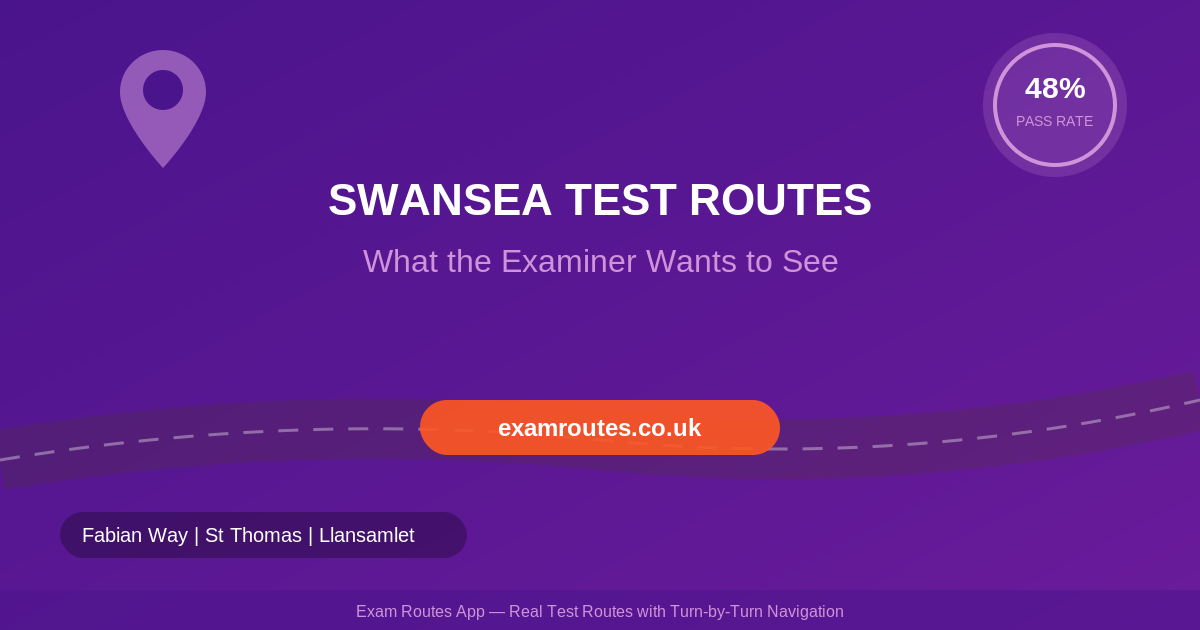
DVSA figures for 2025/26 show Swansea conducted around 12,375 car tests with roughly 5,970 passes — a pass rate of about 48.2%, essentially in line with the national average. Swansea is not an unusually hard centre. It is a fair one that rewards drivers who can handle hills and busy A-roads.
This guide breaks down the Swansea routes by what the examiner is actually watching for on each type of road.
About Swansea Driving Test Centre
The centre is at Burrows Road, off Langdon Road, Kings Dock, St Thomas, Swansea SA1 8QY — in the SA1 waterfront area east of the city centre.
- Parking — on-site space is available but fills up. Arrive with a few minutes in hand, not half an hour.
- What to bring — provisional licence, a test-legal car (MOT if applicable, insurance, L-plates, extra mirror), and your glasses or lenses if you need them to read a plate at 20 metres.
- Test types — car practical, manual and automatic.
- Facilities — waiting area and toilets on site.
The Routes: What the Examiner Is Assessing on Each Road
Fabian Way (A483) — assessing progress and lane discipline
Fabian Way is the fast link between SA1 and the M4 corridor. It is a dual carriageway with a 50mph limit over much of its length, bus lanes in places, and heavy commuter flow. The examiner is checking whether you drive to the limit when it is safe, hold lane one unless overtaking, and change lanes with a full mirror and blind spot routine. Sitting at 40 in a 50 with a clear road is a progress fault.
Kingsway and the city centre — assessing observation and planning
Multiple lanes, bus lanes, pedestrian crossings and cyclists in short succession. The examiner is watching your scanning: are you looking far enough ahead to react early, or reacting late to things you should have seen?
St Thomas and Port Tennant — assessing meeting traffic and hill work
These are the terraced, parked-up, sloping streets Swansea is known for. Roads narrow to a single passable lane and gradients are real. The examiner is assessing whether you give way appropriately, control the car on a hill without rolling back, and move off on a gradient without stalling.
Morriston and Llansamlet — assessing roundabouts
Larger, multi-lane roundabouts with fast approaches. The examiner wants early lane selection, a clear signal plan, and steady speed through the roundabout rather than a stop-start crawl.
Residential streets off Brynmill and Uplands — assessing manoeuvres
Parallel parking and pulling up on the right are commonly set here, often on a slope, which is the extra difficulty.
Tricky Spots at Swansea
1. Hill starts on Port Tennant and St Thomas streets
Swansea has more hills on its test routes than most UK centres. Rolling back more than a car’s length is a serious fault. Practise finding the biting point on a genuine gradient, not a gentle slope.
2. Fabian Way bus lanes
Read the times on the sign. Entering an operational bus lane is a serious fault; refusing to use one that is open is a hesitation fault.
3. The Kingsway layout
The city centre road layout has changed significantly in recent years. If your last practice there was a while ago, drive it again before your test rather than relying on memory.
4. Multi-lane roundabouts at Llansamlet
Traffic arrives at speed and lane markings matter. Choose your lane on the approach, not on the roundabout.
5. Narrow terraced streets with parked cars both sides
You need to identify the passing gap early and either commit or hold back clearly. Drifting into the middle and stopping is what gets marked.
6. Pedestrians near the university and marina
High footfall, and people crossing away from designated crossings. Cover the brake and slow early.
Practise Real Test Routes on Your Phone
The Exam Routes App gives you access to real driving test routes with turn-by-turn navigation. Practise at your own pace and build confidence before test day.
Pass Rates and Statistics
Swansea’s most recent full-year DVSA figures show approximately 48.2% of car tests resulting in a pass, from around 12,375 tests. Earlier periods have shown figures slightly above 49%. Either way, Swansea sits close to the Great Britain average of roughly 48-49%.
That makes Swansea a genuinely average-difficulty centre in statistical terms — but the shape of the difficulty is distinctive. A learner who has trained mostly on flat, wide roads will find Swansea harder than the number suggests. A learner comfortable on hills and dual carriageways will find it easier.
Seven Tips for Passing at Swansea
- Practise hill starts until they are automatic. Both facing uphill and pulling away downhill. Use the handbrake properly.
- Drive Fabian Way at your test time. Peak flow is very different to mid-morning.
- Learn the Llansamlet and Morriston roundabout lanes. Write them down if it helps. Early lane choice removes most of the risk.
- Read every bus lane sign. Times differ between roads in Swansea.
- Rehearse a parallel park on a slope. It is a different task to one on the flat.
- Scan further ahead in the city centre. Most observation faults are really late-scanning faults.
- Do not under-drive. Swansea examiners mark undue hesitation regularly. Making safe progress is a competence, not an optional extra.
How the Exam Routes App Can Help
Swansea’s route network spreads across the waterfront, the city centre, the terraced east side and the northern suburbs. That is a lot of ground to cover on lesson time alone. The Exam Routes App gives you real test routes with turn-by-turn navigation so you can drive the Fabian Way sections, the St Thomas hills and the Llansamlet roundabouts in a structured order, then repeat whichever section you found hardest.
Practising the right roads twice beats practising random roads ten times.
Frequently Asked Questions
Where is Swansea driving test centre?
Burrows Road, off Langdon Road, Kings Dock, St Thomas, Swansea SA1 8QY.
What is the Swansea driving test pass rate?
Around 48.2% in the most recent DVSA reporting, from roughly 12,375 car tests. Earlier periods showed just over 49%.
Are Swansea test routes hilly?
Yes. Streets around St Thomas, Port Tennant and the Uplands have real gradients, and hill starts are a routine part of the test.
Does the Swansea test use dual carriageways?
Fabian Way (A483) features on many routes, including for the independent driving section.
What is the most common reason people fail at Swansea?
Observation at junctions and undue hesitation are the usual leaders, with clutch and hill control faults appearing more often here than at flatter centres.
Don’t Leave Your Test to Chance
Download the Exam Routes App and drive the real routes before the examiner does. Turn-by-turn navigation, hundreds of UK test centres, practise whenever suits you.