Durham Driving Test Routes 2026 – What the Examiner Is Really Looking For
Ask a Durham instructor what makes the local test distinctive and you will usually get the same answer: it is not one dramatic hazard, it is the constant switching. Durham routes move between fast A-road driving, tight historic streets, steep gradients, estate roads and open countryside, often within a couple of minutes of each other. Examiners are not hunting for a single mistake – they are watching whether your standard holds up as the road changes underneath you.
This guide explains what Durham examiners are actually assessing on each part of a typical route in 2026, where the marks tend to go, and how to prepare so that the variety works in your favour rather than against you.
About Durham Driving Test Centre
Practical tests for the Durham area run from the DVSA centre at Whitfield Court, St Johns Road, Meadowfield, Durham, DH7 8XL, on the industrial estate just off the A690 south-west of the city. Some older listings still point to the former Belmont site, so check your booking confirmation carefully before setting off.
Before your slot:
- Parking: the estate has space, but arrive early enough to find a sensible spot and walk in calmly.
- Documents: photocard provisional licence, no exceptions.
- Car: MOT valid where required, no warning lights, legal tyres, clean windscreen and mirrors, plus the additional interior mirror for the examiner.
- Journey time: the A690 into Meadowfield can be slow at peak times. Allow more than the map says.
The Routes: What Examiners Build Them From
The A690 and A167 sections
The A690 is the backbone of most Durham routes, linking the centre to the city and out towards Crook and Sunderland. Along with the A167, it provides dual carriageway driving, slip road joins and exits, and roundabouts at speed. Examiners want to see confident merging, correct lane discipline, mirror use before every change of position, and speed that matches the flow without exceeding the limit.
The city fringe and Belmont / Carrville
Routes frequently work through the estates around Belmont, Carrville and Gilesgate, and along roads such as Sunderland Road and Dragon Lane. Here the assessment shifts to junction observation, planning around parked cars and dealing with pedestrians. Manoeuvres are usually set on these quieter roads.
The hills
Durham is genuinely hilly. Expect at least one uphill start, and expect to approach a junction on a downhill gradient where the temptation is to arrive too fast. Examiners are looking for controlled use of gears and brakes, not just an absence of rolling back.
Rural and semi-rural lanes
Towards Brandon, Langley Moor and the villages west of the city, routes pick up national speed limit roads with bends, hedges and farm entrances. The question being asked is whether you drive to the conditions or to the sign.
What the Examiner Is Really Looking For
- Consistency. The same standard of observation on a quiet estate road as on the A690. Most Durham faults are recorded where candidates relax.
- Planning, not reacting. Looking far enough ahead to slow gradually for a roundabout rather than braking hard at the give-way line.
- Correct speed for the road. On the rural sections, 60 mph is a limit, not a target. Taking a blind bend at the limit is marked as a fault.
- Effective mirror work. Before signalling, before changing speed, before changing position. On dual carriageways examiners watch mirror checks closely.
- Confident, safe progress. Undue hesitation at roundabouts and junctions is one of the most common reasons for failure nationally, and Durham’s roundabouts are prime territory for it.
- Control on gradients. No rolling back, no riding the clutch, no coasting downhill out of gear.
Practise Real Test Routes on Your Phone
The Exam Routes App gives you access to real driving test routes with turn-by-turn navigation. Practise at your own pace and build confidence before test day.
Pass Rates & Statistics
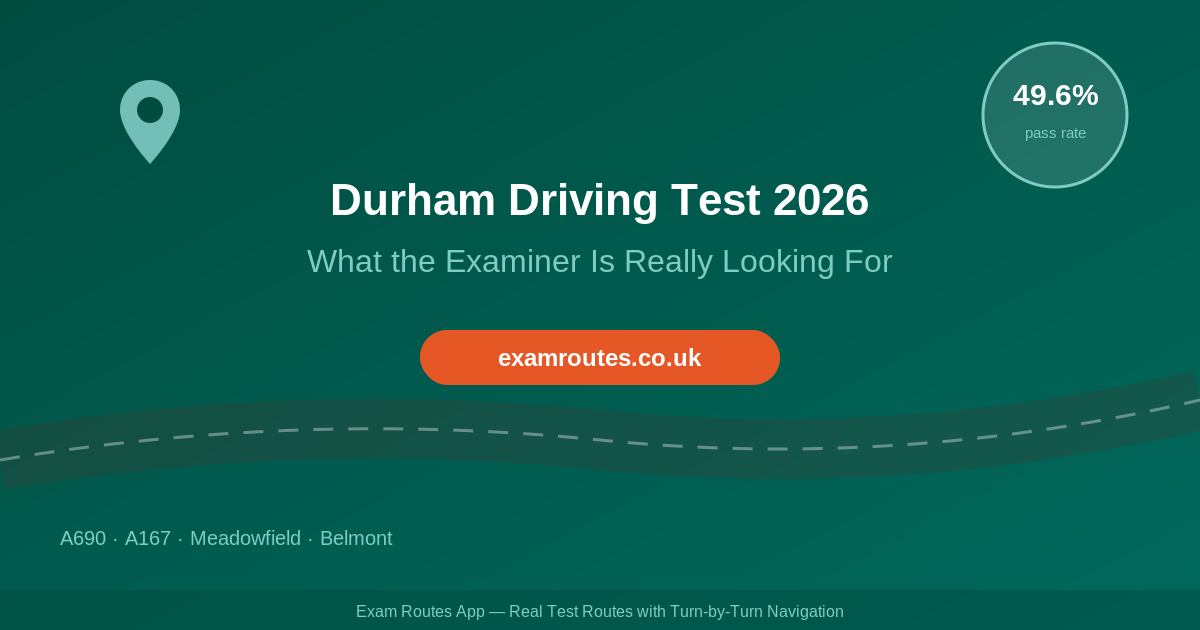
Durham’s car practical pass rate has recently sat at around 49.6%, marginally below the Great Britain average of roughly 50% in the latest full year of DVSA data. In practice that means Durham is a broadly average centre: not a soft option, not a notoriously hard one.
What the number hides is the spread within it. Candidates who have practised the A690 dual carriageway sections and the hill starts perform well above that figure; those who have learned mostly on flat estate roads perform well below it. The pass rate is a description of preparation as much as of the centre.
Top Tips for Passing at Durham
- Spend real time on the A690 and A167. Joining, leaving, lane discipline and roundabout approach at speed.
- Practise hill starts on genuinely steep roads, including behind a parked car where you have to move off and steer at the same time.
- Rehearse downhill junction approaches. Brake early, select the gear, arrive at walking pace.
- Drive the rural lanes west of the city so national speed limit signs stop feeling like an instruction.
- Work on roundabout decisiveness. Look right early, keep rolling if it is clear, commit.
- Do at least one lesson in the rain and one in the dark if your test falls in winter.
- Check which centre address is on your booking before you set off. Meadowfield, not Belmont.
How the Exam Routes App Can Help
Because Durham routes cover so much ground – dual carriageway, city fringe, estates and countryside – the biggest risk is practising one type of road far more than the others. The Exam Routes App maps real test routes with turn-by-turn navigation so you can cover the full mix in the order an examiner is likely to use, and repeat the sections that expose weaknesses.
Use it with a supervising driver as well as an instructor. Extra hours on the actual roads, at different times of day and in different weather, are what turn a borderline candidate into a comfortable one.
Frequently Asked Questions
Where is Durham driving test centre?
Whitfield Court, St Johns Road, Meadowfield, Durham, DH7 8XL, just off the A690. Older listings sometimes still show the former Belmont address, so always check your booking confirmation.
What is the pass rate at Durham?
Around 49.6% in recent DVSA data, which is marginally below the Great Britain average of roughly 50%. It is an average-difficulty centre rather than an easy or hard one.
Will my Durham test include dual carriageway driving?
Very likely. The A690 and A167 feature on the majority of routes, and examiners use them to assess merging, lane discipline and speed management.
Are hill starts common at Durham?
Yes. The city is hilly and most routes include at least one uphill move-off, often on a road with parked cars.
How long is the driving test at Durham?
About 40 minutes for a standard car test, the same as anywhere else in Great Britain, including roughly 20 minutes of independent driving.
Ready to Pass? Download Exam Routes Now
Practise Durham’s real test routes – A690 dual carriageway, city estates and the hills – with turn-by-turn navigation on your phone.