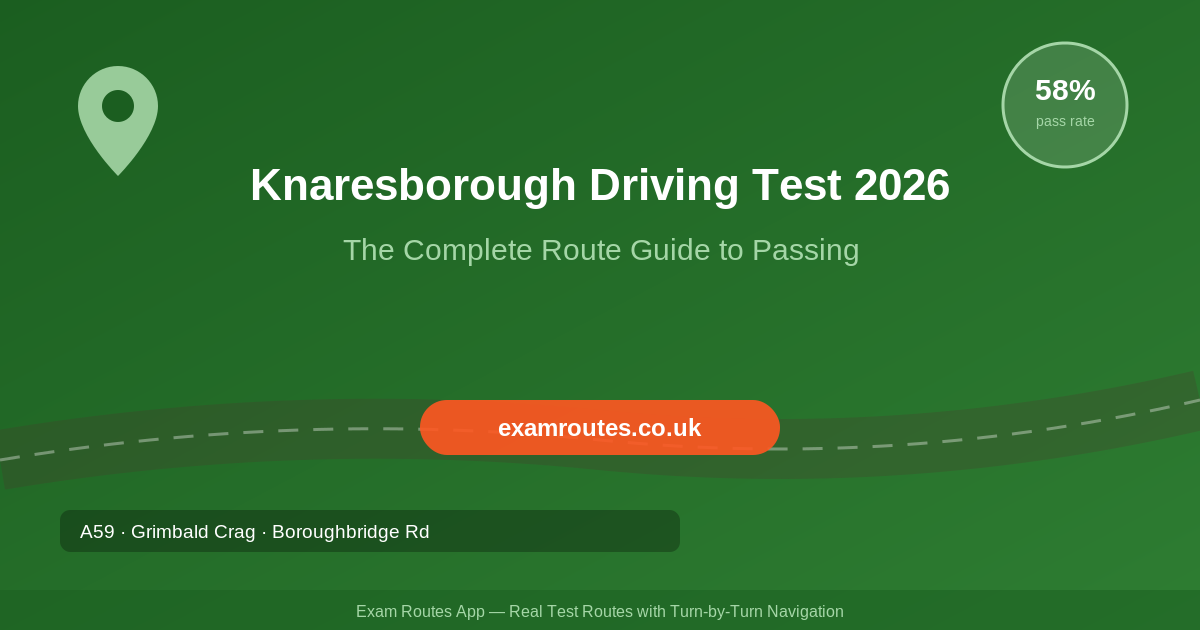
Knaresborough is one of the friendlier names on the North Yorkshire test map, and the numbers back that up. With a car practical pass rate that has recently sat around 58% — comfortably above the national average of roughly 50% — it is a centre where a well-prepared candidate has a genuinely good chance of driving home with a full licence.
That does not make it a soft test. Knaresborough routes mix a compact, historic town centre with fast rural roads and the pull of Harrogate traffic just up the A59. The skills examiners assess here are broad: tight town manoeuvring one minute, national speed limit country roads the next. This guide walks you through the centre, the routes, the challenges and exactly how to prepare for your 2026 test.
About Knaresborough Driving Test Centre
The test centre is based at Grimbald Crag Court on St James Business Park, on the southern edge of Knaresborough (HG5 8QB). It is a modern business-park location with straightforward access, which makes the start of your test noticeably calmer than at an inner-city centre.
- Address area: Grimbald Crag Court, St James Business Park, Knaresborough HG5 8QB
- Parking: on-site business park parking — leave time to find a space at busy slots
- Facilities: waiting area and toilets available
- Bring: provisional licence and booking confirmation; your theory pass details are checked automatically
- Car requirements: taxed, insured for the test, MOT’d if over three years old, L-plates fitted, extra interior mirror for the examiner
The business park setting means the first minute of your test is on quiet estate roads. Use it. Settle your breathing, get your mirrors into your scan pattern and find a comfortable speed before the examiner takes you out onto the main roads.
The Routes: What Knaresborough Examiners Use
Knaresborough routes are built around four distinct road environments, and a typical test will sample most of them:
- The A59 corridor: the main east–west artery linking Knaresborough with Harrogate and towards York. Fast, busy, with roundabouts and slip-style junctions that demand decisive lane choice.
- Knaresborough town centre: narrow, historic streets around High Street and Bond End, with parked cars, one-way sections and pedestrian traffic. Tight and slow, but very easy to pick up faults through hesitation.
- Boroughbridge Road and the northern approaches: a mix of 30mph residential and faster derestricted sections, with junctions that appear quickly after bends.
- Rural lanes towards Farnham, Ferrensby and Scotton: national speed limit country roads with blind bends, hidden dips, no pavements and the occasional tractor or horse rider.
- St James Business Park and nearby estates: where manoeuvres are usually set — bay parking, pulling up on the right, and the reverse park.
Expect around 38–40 minutes of driving, with a 20-minute independent driving section. Because Knaresborough routes swing between 20mph town streets and 60mph lanes, speed management is one of the biggest single differences between a pass and a fail here.
Tricky Spots & Common Challenges
- Bond End junction: where several roads converge near the bottom of the town. Traffic backs up, sightlines are restricted and learners often creep out without a proper second look.
- High Street and the narrow town core: parked cars reduce this to single-file in places. You must judge priority and hold back in a gap rather than committing and then reversing.
- A59 roundabouts: higher approach speeds than town roundabouts. Get your speed and gear sorted early — arriving in third at 40mph leaves you no options.
- Rural bends towards Farnham and Scotton: the classic Knaresborough fault is carrying too much speed into a blind bend. National speed limit means up to 60, not a target.
- Hidden field entrances and mud on the road: genuinely common on the rural sections, especially in autumn. Anticipate reduced grip.
- The railway bridge and river crossings: narrow, with priority give-way markings. Read the signs early and be prepared to stop.
- Harrogate-bound traffic at peak times: the A59 gets heavy from around 8am and again from 4:30pm, which changes the character of the whole route.
Knaresborough’s above-average pass rate is partly a reflection of who tests there — a high proportion of candidates come through local instructors who know the rural sections well. If you are travelling in from elsewhere for a shorter waiting time, put in at least a few hours on the country lanes before test day.
Pass Rates & Statistics
Knaresborough has consistently ranked among the stronger performing centres in North Yorkshire.
| Measure | Knaresborough | National picture |
|---|---|---|
| Approximate car pass rate | ~58% | ~50% |
| Typical reported range | 56–61% | — |
| Route character | Town centre plus rural lanes | Mixed |
| Independent driving | ~20 minutes | ~20 minutes |
It is worth understanding why rural and semi-rural centres tend to score above urban ones. Fewer multi-lane junctions, fewer bus lanes and less dense traffic mean fewer opportunities to commit a serious fault. The trade-off is that rural routes test observation and speed judgement much harder than a city test does.
Practise Real Test Routes on Your Phone
The Exam Routes App gives you access to real driving test routes with turn-by-turn navigation. Practise at your own pace and build confidence before test day.
Top Tips for Passing at Knaresborough
- Treat the national speed limit as a ceiling, not a goal. On the lanes towards Ferrensby and Scotton, 45–50mph is often the correct, safe speed. Examiners mark for appropriateness, not for hitting the number.
- Practise the town centre at a busy time. High Street with cars parked on both sides is the single most useful thing you can rehearse.
- Learn the A59 roundabouts properly. Approach speed, lane choice and observation all need to be settled before you reach the give-way line.
- Get your rural observation habits sharp. Look through bends, watch for gateways, and scan the hedge line for pedestrians and cyclists where there is no pavement.
- Rehearse manoeuvres on the business park. Bay parking in a real business-park layout is different from an empty car park.
- Do not let the good pass rate make you complacent. Nearly four in ten candidates still fail here. Preparation is what moves you into the right half.
- Plan your journey in. If you are coming from Harrogate or Leeds, allow extra time — arriving stressed is a self-inflicted disadvantage.
How the Exam Routes App Can Help
Knaresborough’s mix of tight town streets and open country lanes is exactly the kind of variety that benefits from repeated, structured practice. The Exam Routes App gives you real driving test routes with turn-by-turn navigation so you can drive the actual roads before test day.
- Follow real routes with voice guidance, just like the independent driving section
- Repeat the rural sections until your speed judgement is instinctive
- Practise outside lesson time with a supervising driver to stretch your lesson budget
- Arrive on test day already familiar with the junctions instead of meeting them cold
Frequently Asked Questions
Where is Knaresborough driving test centre?
It is located at Grimbald Crag Court, St James Business Park, Knaresborough, HG5 8QB, on the southern edge of the town. Confirm the exact address on your DVSA booking email.
What is the pass rate at Knaresborough?
Around 58%, with reported figures typically in the 56–61% range. That is comfortably above the national average of roughly 50%.
Is Knaresborough easier than Harrogate?
Harrogate no longer runs practical car tests, so Knaresborough is the nearest practical centre for most Harrogate learners. Its rural routes mean fewer complex multi-lane junctions than a large city centre test.
Will my test include country roads?
Very likely. Rural lanes towards Farnham, Ferrensby and Scotton are a standard feature of Knaresborough routes, so practise national speed limit driving before your test.
How long is the driving test at Knaresborough?
About 40 minutes of driving, including roughly 20 minutes of independent driving, plus eyesight and vehicle safety questions at the start.
Can I practise the test routes myself?
Yes. The DVSA no longer publishes official routes, but the roads examiners use are well known locally. Practising them with a supervising driver or through a route app is completely legitimate and highly effective.
Don’t Leave Your Test to Chance
Stop guessing where the examiner will take you. The Exam Routes App maps real test routes for centres across the UK, so every practice drive counts towards test day.