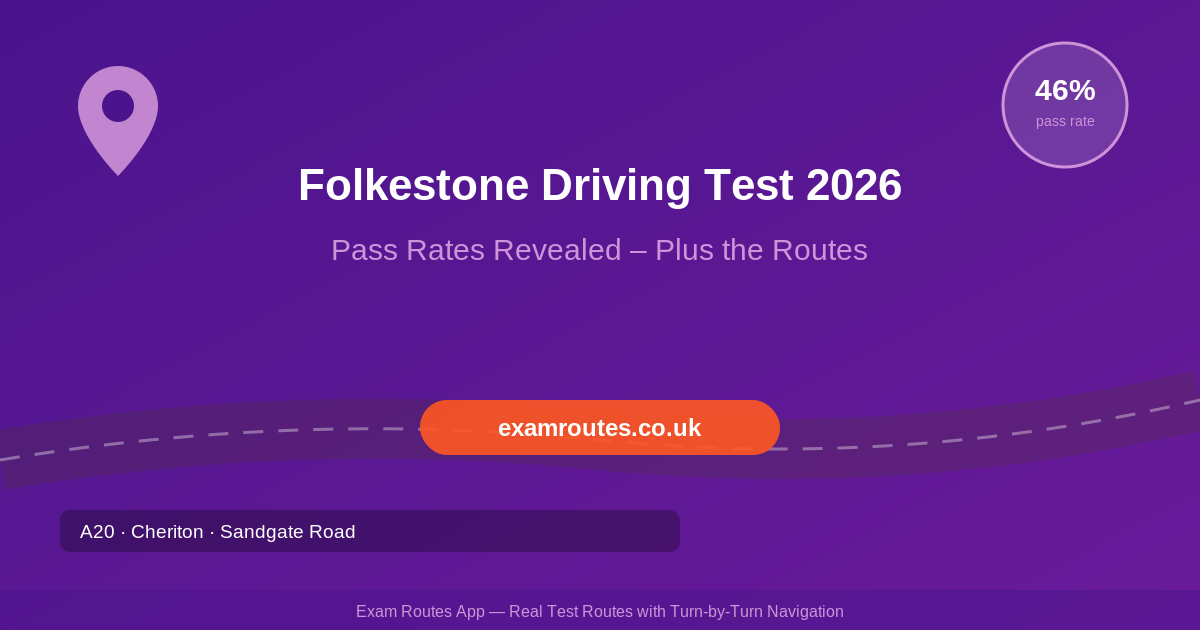
Folkestone has a reputation among Kent instructors as a test centre that does not forgive vague driving. The published car practical pass rate has recently sat in the mid-forties, below the national average of roughly 50%, and the reason becomes obvious the moment you look at a map: within a couple of miles of the centre you have a high-speed dual carriageway, a Channel Tunnel freight corridor full of left-hand-drive lorries, narrow Victorian coastal streets and steep hills down to the harbour.
That variety is the whole story of a Folkestone test. This guide sets out the real pass rate picture, the roads examiners actually use, the specific spots that generate faults, and a preparation plan that targets the things Folkestone punishes.
About Folkestone Driving Test Centre
The practical test centre is on Horn Street in Cheriton, on the western side of Folkestone (CT20 3HJ). The usual approach is to leave the M20 at junction 12 and follow signs for Cheriton along the A20, then turn into Horn Street.
- Location: Horn Street, Cheriton, Folkestone CT20 3HJ
- Parking: limited on-site parking — many candidates park on nearby residential streets, so allow extra time
- Facilities: small waiting room and toilets
- Bring: provisional licence and booking reference
- Car: taxed, insured for the test, MOT valid if over three years old, L-plates and an additional interior mirror fitted
Because parking is tight, arriving ten minutes early is genuinely important here. Circling for a space with the clock ticking is a poor way to start a driving test.
The Routes: Roads You Should Expect
Folkestone routes are unusually diverse for a town of its size. Examiners have four very different environments within easy reach:
- A20 dual carriageway: the defining feature. You go from a 30mph limit to a fast dual carriageway in a short distance, so slip-road merging and lane discipline are tested directly.
- Cheriton and the Channel Tunnel terminal approaches: heavy international freight. Expect large lorries, many of them left-hand drive, with drivers whose blind spots differ from what you are used to.
- Cheriton Road (A2034) and Sandgate Road: busy urban A-roads with frequent speed limit changes, parked cars, bus stops and pedestrian crossings.
- Shorncliffe and the residential grid: narrow, often unmarked streets where two cars cannot pass. Priority judgement and meeting oncoming traffic are assessed constantly.
- Coastal roads and the hills towards Sandgate: steep gradients, tight bends and sea-front traffic in the warmer months.
- Cherry Garden Avenue and the Park Farm area: commonly used for manoeuvres and quieter observation work.
A typical test runs around 38–40 minutes with a 20-minute independent driving section, usually following a sat nav.
Tricky Spots & Common Challenges
- Joining the A20: the transition from town speeds to dual carriageway speeds catches people out. You need to build speed on the slip road and merge decisively — hesitating at the end of a slip road is dangerous and marked accordingly.
- The Cheriton freight zone: lorries turning across your path, wide swings at junctions, and blind spots on the left of left-hand-drive cabs. Hang back and never sit alongside a lorry at a junction.
- Narrow Shorncliffe streets: the single biggest source of faults. Learners nose forward, force a stand-off, then have to reverse. Identify the gap early, signal your intention by slowing, and give way clearly.
- Sandgate Hill and the coastal descents: steep enough that engine braking matters. Select a lower gear before the descent, not halfway down it.
- Speed limit changes on Cheriton Road: the limit shifts more than once. Repeater signs and street lighting are your clues.
- Sea-front and harbour traffic in summer: tourists, pedestrians stepping out, and drivers looking for parking rather than watching the road.
- Roundabouts on the A20 approaches: higher-speed entries where lane choice must be made well before the give-way line.
Folkestone’s below-average pass rate is not because examiners are harsh. It is because a single Folkestone route can ask you to merge onto a 70mph dual carriageway, squeeze past parked cars on a Victorian terrace, and manage a steep coastal hill inside twenty minutes. Preparation has to be equally varied.
Pass Rates & Statistics
| Measure | Folkestone | National picture |
|---|---|---|
| Approximate car pass rate | ~45–50% | ~50% |
| Position vs national average | Slightly below | — |
| Route character | Dual carriageway, freight, coastal, narrow streets | Mixed |
| Typical test length | ~40 minutes | ~40 minutes |
Published figures for Folkestone vary between sources and reporting periods, with numbers commonly quoted between roughly 45% and 50%. Treat any single figure as a guide rather than gospel — pass rates move quarter by quarter, and your own preparation matters far more than the centre average.
Practise Real Test Routes on Your Phone
The Exam Routes App gives you access to real driving test routes with turn-by-turn navigation. Practise at your own pace and build confidence before test day.
Top Tips for Passing at Folkestone
- Practise dual carriageway joining until it is automatic. Build speed on the slip road, check your right-hand mirror and blind spot, and merge into a gap without forcing anyone to brake.
- Learn to read lorries. Give large vehicles room, never sit in their blind spot, and expect wide swings at junctions in the Cheriton area.
- Drill meeting traffic on narrow streets. This is where most Folkestone faults come from. Slow early, pick your gap, and make your intention obvious.
- Get comfortable on hills. Practise hill starts and controlled descents on the Sandgate and Shorncliffe gradients.
- Watch your speed on the A2034. Frequent limit changes mean you need to actively re-check rather than settle into one speed.
- Book a slot that suits you. Summer sea-front traffic and freight peaks both change the difficulty of a route. Ask your instructor which local slots run more smoothly.
- Keep driving after a mistake. Most faults are minors. Candidates who mentally give up after one wobble lose far more marks than the wobble itself cost.
How the Exam Routes App Can Help
Folkestone rewards familiarity more than almost any centre in Kent, simply because the road types are so different from one another. The Exam Routes App maps real driving test routes with turn-by-turn navigation so you can drive each of those environments before the examiner puts you into them.
- Drive real test routes with voice-guided navigation
- Repeat the A20 merges and the narrow Shorncliffe streets until they feel ordinary
- Practise with a supervising driver between lessons to make each lesson count for more
- Turn up on test day recognising the junctions instead of reading them for the first time
Frequently Asked Questions
Where is Folkestone driving test centre?
The practical test centre is at 30 Horn Street, Cheriton, Folkestone CT20 3HJ. Leave the M20 at junction 12, follow the A20 towards Cheriton and turn into Horn Street. Always check your booking confirmation for the current address.
What is the pass rate at Folkestone?
Recent published figures put it around 45–50%, slightly below the national average of roughly 50%. Different sources quote slightly different numbers depending on the reporting period.
Does the Folkestone test include a dual carriageway?
Very often, yes. The A20 is close to the centre and dual carriageway driving is one of the defining features of Folkestone routes, so practise slip-road merging thoroughly.
Why are there so many lorries on the routes?
The Channel Tunnel terminal at Cheriton generates constant international freight traffic. Many of these lorries are left-hand drive, so their blind spots sit differently — keep well back and never linger alongside them.
Is parking available at the test centre?
On-site parking is limited. Many candidates park on nearby residential roads, so arrive with time in hand rather than exactly on your slot time.
How can I practise Folkestone test routes?
The DVSA no longer publishes official routes, but the roads examiners use are well documented locally. Driving them with an instructor or supervising driver, or following mapped routes in a route app, is a legitimate and effective way to prepare.
Ready to Pass? Download Exam Routes Now
Stop guessing where the examiner will take you. The Exam Routes App maps real test routes for centres across the UK, so every practice drive counts towards test day.