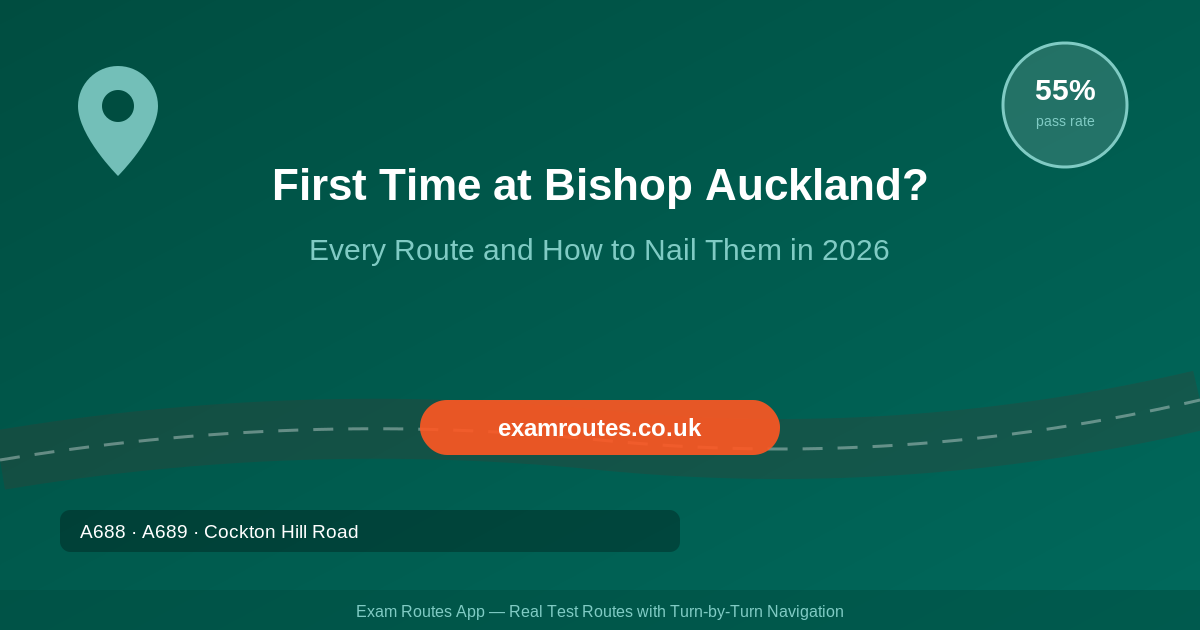
Booking your first practical at Bishop Auckland? You have chosen a County Durham centre with a reputation for being fair rather than fearsome. The routes here are a genuine cross-section of British driving: market town streets, post-war housing estates, fast A-roads linking the Durham Dales to the A1(M), and open countryside towards Weardale and Teesdale.
Because the routes are so varied, first-time candidates often arrive having practised only one type of road — usually the estates near their instructor’s base — and then meet a national speed limit lane for the first time on their actual test. This guide fixes that. Below you will find the centre details, every route type you can expect, the spots that generate faults and a preparation plan for 2026.
About Bishop Auckland Test Centre
Bishop Auckland is a market town in County Durham, and the test centre sits within easy reach of both the town centre and the surrounding A-road network. It is a smaller centre than the big Teesside and Tyneside sites, which means a calmer waiting room and, usually, a more relaxed start to the test.
- Location: Bishop Auckland, County Durham — check your DVSA booking email for the exact address
- Parking: plan to arrive early; local parking can be limited at busy times
- Facilities: waiting area and toilets
- Bring: your provisional licence and booking confirmation
- Car: taxed, insured for the test, MOT’d if over three years old, L-plates displayed and an extra interior mirror fitted for the examiner
Before you drive off, the examiner will ask you to read a number plate from 20 metres and will ask one "tell me" question at the roadside plus one "show me" question while you are driving. Get those out of the way confidently and you will settle much faster.
The Routes: Every Road Type You Can Expect
A Bishop Auckland route will typically sample four environments:
- Cockton Hill Road and the town approaches: busy local roads with parked cars, side turnings, pedestrian crossings and buses. Constant observation demands.
- Newgate Street and the town centre: the commercial heart of Bishop Auckland, with one-way sections, loading vehicles and pedestrians stepping out between parked cars.
- The A688 towards Spennymoor and Barnard Castle: a faster A-road with roundabouts, overtaking opportunities and junctions that arrive quickly after bends.
- The A689 corridor: linking towards Crook and the west — another fast route where speed judgement and lane discipline are assessed.
- Housing estates at Woodhouse Close, Henknowle and Coundon: where manoeuvres are usually set. Narrow roads, parked cars on both sides, and plenty of junction practice.
- Rural lanes towards West Auckland, St Helen Auckland and the Dales: national speed limit roads with blind bends, no pavements, farm entrances and occasional agricultural traffic.
Expect roughly 38–40 minutes behind the wheel, including a 20-minute independent driving section. Around four in five candidates follow a sat nav for that section; the rest follow traffic signs.
Tricky Spots & Common Challenges
- Cockton Hill Road parked cars: the road narrows in places to a single usable lane. Learners commit too early, meet oncoming traffic and end up in a stand-off. Hold back in a gap.
- Town centre one-way sections: lane markings and signs need reading early. Getting into the wrong lane in a one-way system is a classic first-time-candidate error.
- A688 roundabouts: approach speeds are higher than in town. Sort out speed, gear and lane before the give-way line, not on it.
- Rural bends towards the Dales: the national speed limit sign means up to 60mph. On a single-track lane with hedges, the appropriate speed may be 35. Examiners mark for judgement, not for hitting the limit.
- Farm entrances and mud: genuinely common on the western lanes, especially in autumn and winter. Reduced grip and slow-moving vehicles pulling out.
- Hills and gradients: County Durham is not flat. Hill starts and controlled descents both appear regularly.
- Emerging at estate junctions: restricted sightlines mean you must creep and look properly. "Failed to look properly at a junction" remains the most common serious fault nationally, and Bishop Auckland’s estates are where it happens here.
The most common feedback from Bishop Auckland examiners is about progress. On the A688 and A689, driving at 40mph in a 60 limit because you feel nervous is marked as undue hesitation. Drive at a speed that is safe for the conditions — which on a clear, dry A-road usually means the limit.
Pass Rates & Statistics
| Measure | Bishop Auckland | National picture |
|---|---|---|
| Centre type | Smaller market town centre | — |
| Route character | Town, estates, A-roads, rural lanes | Mixed |
| National car pass rate 2026 | — | ~50% |
| Most common serious fault | Junction observation | Junction observation |
Smaller County Durham and North East centres have historically tended to sit at or a little above the national average, largely because they have fewer of the multi-lane urban junctions that generate serious faults. That said, pass rates move every quarter, so treat centre averages as background context rather than a prediction of your own result. What you can control is preparation.
Practise Real Test Routes on Your Phone
The Exam Routes App gives you access to real driving test routes with turn-by-turn navigation. Practise at your own pace and build confidence before test day.
Top Tips for Nailing Your First Test at Bishop Auckland
- Practise all four road types, not just estates. Make sure at least a third of your practice hours are on the A688, the A689 and the rural lanes.
- Fix your junction routine. Approach, mirrors, gear, look right, look left, look right again, and only then move. Rehearse it until you do it without thinking.
- Make proper progress. If the road is clear and the limit is 60, driving at 40 will cost you. Build confidence at higher speeds before test day.
- Get the parked-car judgement right. On Cockton Hill Road, decide early whether you are going or giving way, and make that decision visible through your speed.
- Learn your show me, tell me answers. They are published by the DVSA and there are only a couple of dozen. There is no excuse for losing a fault here.
- Practise the manoeuvres in real estate roads. Bay parking in an empty supermarket car park is not the same as pulling up on the right on a residential street with cars behind you.
- Book your test for a time you have practised. A 10am route and a 4pm route are different tests because of traffic and, in winter, light levels.
How the Exam Routes App Can Help
Because Bishop Auckland routes span everything from a 20mph town street to a 60mph country lane, the single most useful thing you can do is drive the actual roads before test day. The Exam Routes App maps real driving test routes with turn-by-turn navigation so you can do exactly that.
- Follow real test routes with voice guidance, mirroring the independent driving section
- Repeat the A-road sections until making proper progress feels natural
- Practise with a supervising driver between lessons so your paid hours go further
- Recognise the junctions on test day rather than meeting them for the first time
Frequently Asked Questions
Where is Bishop Auckland driving test centre?
The centre is in Bishop Auckland, County Durham. Always use the address on your DVSA booking confirmation, as test centre details can change.
Is Bishop Auckland a good test centre for first-timers?
Many local instructors think so. It is a smaller centre with fewer complex multi-lane junctions than the big Tyneside and Teesside sites, though the rural sections mean speed judgement is tested properly.
Will my test include country roads?
Very likely. Lanes towards West Auckland, St Helen Auckland and the Dales are a standard part of Bishop Auckland routes, so practise national speed limit driving before your test.
What is the most common reason people fail here?
The same as nationally: failing to look properly at junctions. The estate roads around Woodhouse Close and Coundon have restricted sightlines, which is exactly where this fault occurs.
How long does the practical test take?
About 40 minutes of driving, including roughly 20 minutes of independent driving, plus the eyesight check and vehicle safety questions beforehand.
Can I use my own car for the test?
Yes, provided it meets DVSA requirements: taxed, insured for the test, MOT valid if over three years old, no warning lights showing, L-plates fitted and an additional interior mirror for the examiner.
Get the Edge on Test Day
Stop guessing where the examiner will take you. The Exam Routes App maps real test routes for centres across the UK, so every practice drive counts towards test day.