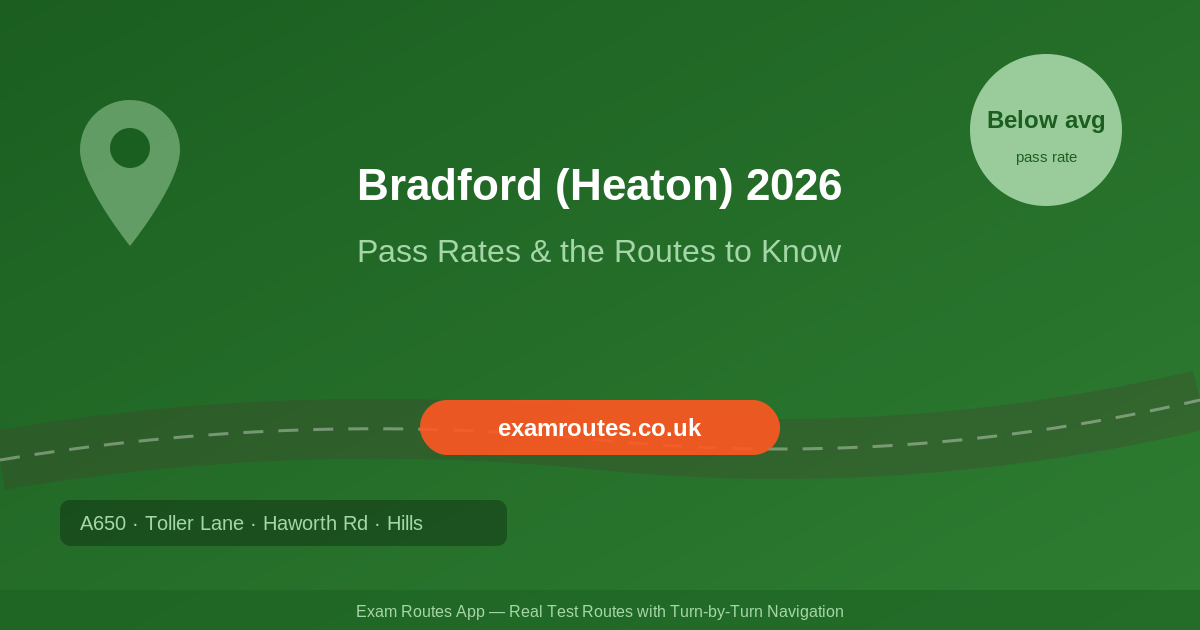
Bradford is built on hills, and no test centre in the city lets you forget it. At Heaton, on the north-western side, the gradients are part of the assessment rather than an incidental feature. Hill starts are not a set-piece you might get asked to demonstrate — they happen naturally at half the junctions on the route. Add narrow terraced streets with parking on both sides, a busy A-road corridor and steady pedestrian traffic, and you have a test centre that rewards genuine vehicle control over polished theory.
Here is what to expect at Bradford Heaton in 2026: the honest pass rate picture, the roads that appear repeatedly, the specific spots where candidates lose marks, and how to prepare.
About Bradford (Heaton) Driving Test Centre
Heaton serves the north and west of Bradford — Heaton itself, Manningham, Frizinghall, Girlington, Daisy Hill, Allerton and the approaches to Shipley and Saltaire. It is the smaller of Bradford’s two car test centres, with Thornbury covering the east. Check your booking confirmation carefully: candidates booking “Bradford” without noticing which centre is a recurring problem, and the two sites are on opposite sides of the city.
- Parking: limited on-site and constrained on surrounding streets. Arrive early.
- Car requirements: standard DVSA rules — valid MOT, insurance covering the test, legal tyres and plates, working lights, an extra interior mirror for the examiner and secure L-plates.
- Weather: worth taking seriously here. Bradford sits high, and in winter the hill routes can be genuinely slippery. Tests are only cancelled when the DVSA judges conditions unsafe, so on a cold morning practise on hills before, not after, your test date.
The Routes: Roads You Should Expect
A650 Manningham Lane / Keighley Road
The main artery north out of the city. Multi-lane in sections, heavy with buses, frequent side junctions and traffic signals. Examiners use it to assess progress, lane discipline and junction observation at pace.
Toller Lane and Duckworth Lane
Busy local distributor roads with shops, bus stops, pedestrian crossings and hospital traffic. Duckworth Lane in particular carries a constant flow of vehicles associated with Bradford Royal Infirmary, which means unpredictable stopping, reversing and pedestrian movement.
Haworth Road and the western climbs
Where Bradford’s gradients bite. Steep, sometimes narrow, with junctions positioned on slopes. This is the classic hill-start territory of a Heaton route.
Heaton and Frizinghall residential streets
Terraced housing with cars parked continuously along both kerbs. Effective road width often allows only one vehicle. Constant meeting situations, constant judgement.
Shipley and Saltaire fringe
If your route runs north you may reach faster roads towards Shipley, including sections where the limit rises and the traffic thins — a useful contrast the examiner can use to assess whether you adjust your driving to conditions.
Tricky Spots & Common Challenges
- Junctions on gradients. Emerging uphill from a side road onto a busy main road means holding the car, judging a gap, and moving away cleanly all at once. Practise this specific combination until it is boring.
- Duckworth Lane hospital traffic. Vehicles pulling out of car parks, ambulances, taxis stopping abruptly. Anticipation is everything.
- Toller Lane parked-car pinch points. Repeated give-and-take. Hesitating at every gap is marked; forcing through one that is not yours is marked more heavily.
- Manningham Lane multi-lane sections. Lane choice must be made early, and bus lane markings need reading rather than guessing.
- Blind summits and crests. Bradford’s topography creates junctions and crossings you cannot see over until you are on them. Reduce speed on the approach.
- Pedestrian crossings on busy shopping stretches. Frequent, and often used by people stepping out from between parked vehicles.
- Winter surfaces. Wet leaves, ice on shaded hill roads and standing water on poorly drained sections all change stopping distances.
Pass Rates & Statistics
Bradford’s centres, like most large northern urban centres, generally sit below the UK national average. West Yorkshire as a region tends to run a little below the national figure, and the reasons are the same ones you experience on the route: dense junction spacing, heavy on-street parking, mixed traffic and challenging gradients.
Two things are worth holding on to:
- Centre pass rate is not your pass rate. Candidates who have completed sufficient lessons and had private practice pass at far higher rates than the headline figure at any centre.
- The marking standard is national. An examiner at Heaton applies the same DL25 criteria as one in rural Scotland. The difference is the environment, not the judgement.
Check the DVSA’s most recent published data for the current figure, since it is revised each reporting period and older numbers circulate widely online.
Practise Real Test Routes on Your Phone
The Exam Routes App gives you access to real driving test routes with turn-by-turn navigation. Practise at your own pace and build confidence before test day.
Top Tips for Passing at Bradford (Heaton)
- Overtrain hill starts. Not five, not ten — do them until you can hold the car on the clutch without thinking on the steepest junction you can find on Haworth Road.
- Practise meeting traffic on terraced streets. Learn to read which gap is yours from 50 metres back rather than deciding at the last moment.
- Drive Duckworth Lane at a busy time. Mid-morning on a weekday, when hospital traffic is at its heaviest, is the honest version of that road.
- Get comfortable on the A650. Progress at the limit when it is safe, correct lane, early signals. Timid driving here is a common fault source.
- Check your clutch and handbrake before test day. A worn clutch that struggles on a Bradford hill is a mechanical problem you do not want to discover on test.
- Look further ahead than feels necessary. Crests and bends hide hazards. Slowing early costs you nothing; arriving too fast costs you the test.
- Know which Bradford centre you booked. Heaton and Thornbury are separate sites with different route areas.
How the Exam Routes App Can Help
Route familiarity matters more in hilly, tightly built areas than almost anywhere else, because the difficulty is in specific places rather than spread evenly. The Exam Routes App gives you real driving test routes with turn-by-turn navigation so you can drive Bradford’s climbs, its terraced streets and its main-road junctions in advance, in the order an examiner is likely to take them.
When you have already made a hill start at that junction, on that gradient, with that sightline, the version you do on test day is simply a repeat.
Frequently Asked Questions
What is the pass rate at Bradford Heaton?
It typically sits below the UK national average, in line with other large urban centres in West Yorkshire. Check the DVSA’s latest published figures for the current number, as it is revised each reporting period.
Are hill starts common on a Bradford Heaton test?
Yes. The area’s gradients mean hill starts occur naturally at junctions rather than only as a set exercise. Practise them on genuinely steep roads before your test.
What is the difference between Bradford Heaton and Bradford Thornbury?
They are separate car test centres on different sides of the city with different route areas. Heaton covers the north and west, Thornbury the east. Check which one is on your booking confirmation.
Which roads should I practise first for Heaton?
The A650 Manningham Lane and Keighley Road corridor, Toller Lane, Duckworth Lane, Haworth Road and the terraced residential streets around Heaton and Frizinghall.
Does bad weather affect tests at Bradford?
It can. The DVSA cancels tests when conditions are unsafe, and Bradford’s hills are more affected by ice than lower-lying areas. If a test is cancelled for weather you are offered a new date at no extra cost.
Don’t Leave Your Bradford Test to Chance
Practise the real Heaton test routes — hills, terraced streets and all — with turn-by-turn navigation from the Exam Routes App.