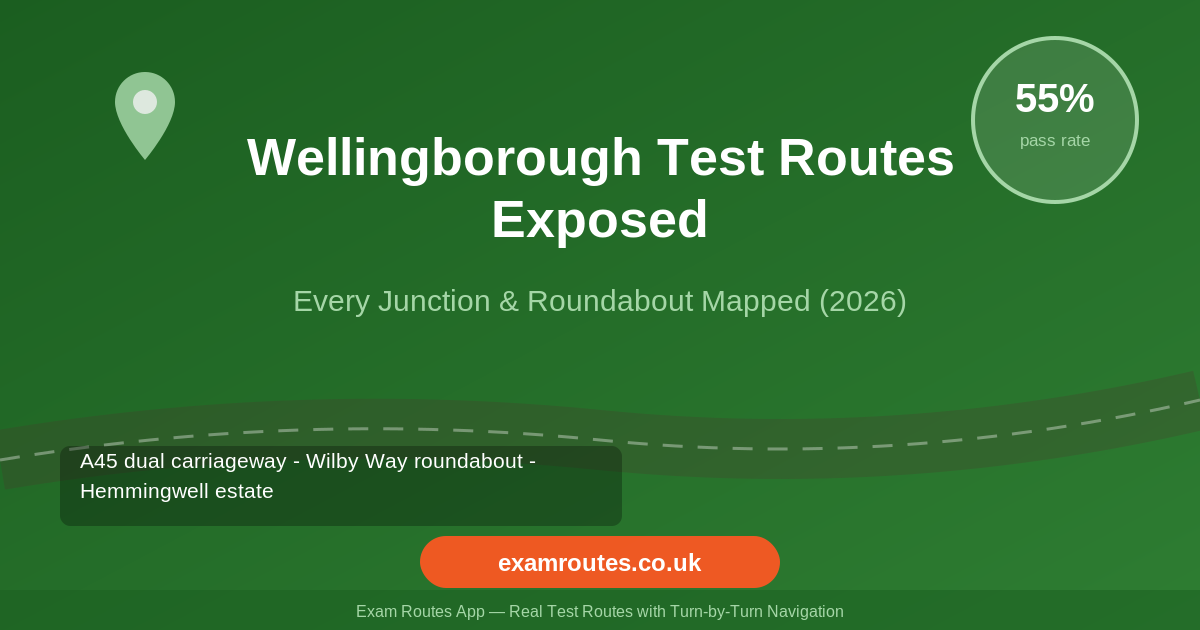
Wellingborough is one of the quieter test centres in Northamptonshire, and its pass rate reflects that. At roughly 55%, it sits comfortably above the national average of around 48–49%, which makes it a genuinely appealing option for learners across north Northamptonshire. But do not mistake a friendly pass rate for an easy test. Wellingborough routes have a habit of throwing you straight from tight terraced streets onto a 70mph dual carriageway within a few minutes, and that gear change in mindset is where most candidates come unstuck.
This guide maps the Wellingborough test area turn by turn — the address and parking, the roads examiners use most, every junction and roundabout that reliably generates faults, how the local pass rate compares, and the practical tips that actually move the needle on test day. If you want the shorter overview first, our Wellingborough driving test routes guide covers the basics.
Key Takeaways
- Wellingborough’s pass rate is around 55%, above the national average of roughly 48–49%.
- The A45 dual carriageway and Wilby Way roundabout appear on a large share of routes.
- Expect a mix of 30mph residential estates, 60mph country lanes and 70mph dual carriageway.
- Hemmingwell, Queensway and Redwell estates are used for manoeuvres and quiet-road turns.
- Practising the surrounding villages — Wollaston, Great Doddington, Finedon — is time well spent.
About Wellingborough Driving Test Centre
The test centre operates from Glamis Hall, Goldsmith Road, Wellingborough, Northamptonshire, NN8 3RU, on the eastern side of town in the Hemmingwell area. It is a community-hall site rather than a purpose-built DVSA office, so the waiting area is modest and the car park is shared.
Practical points worth knowing:
- Parking: spaces at Glamis Hall are limited and fill up quickly when several tests start at once. Most instructors park on Goldsmith Road or nearby side streets and walk in. Arrive 10 minutes early so you are not hunting for a space with five minutes to spare.
- Facilities: there is a small waiting area and a toilet. There is no cafe, so bring water.
- What to bring: your provisional photocard licence and a car that meets DVSA requirements — valid MOT, L-plates, a working extra interior mirror for the examiner, and no warning lights on the dashboard.
- Getting there: Goldsmith Road sits off Northampton Road. If you are driving in from the A45, allow extra time at the Wilby Way and Great Doddington junctions during the morning peak.
The Routes: Roads You Are Likely to Drive
The DVSA no longer publishes official test routes, and examiners choose the route on the day. That said, geography does not change, and Wellingborough routes reliably draw on the same pool of roads.
Residential and estate roads
Almost every test starts and ends in the Hemmingwell area. Expect Goldsmith Road, Shakespeare Road, Nest Farm Road and the surrounding estate streets. Further out, examiners often use the Queensway and Redwell estates for quiet-road work and manoeuvres. These roads are narrow, heavily parked and full of side-road junctions, so they are where the reverse bay park, pull-up on the right and parallel park usually happen.
Main urban roads
Northampton Road, London Road, Irthlingborough Road and Doddington Road are the arteries that link the estates to the ring roads. These are busy 30mph roads with bus stops, pedestrian crossings and plenty of parked cars to pass.
The A509 and A45
The A509 runs south from Wellingborough towards the A45, and the A45 dual carriageway is a fixture of the longer routes. You may well be asked to join it, hold a lane at 70mph, and leave it again — often via the enormous Wilby Way roundabout. This is the single most important stretch to practise.
Country roads and villages
Head east or north and you reach Great Doddington, Wollaston, Finedon and the lanes towards Isham and Sywell. National speed limit country roads with blind bends, hidden dips and the occasional tractor are common on longer routes.
Tricky Spots & Common Challenges at Wellingborough
- Wilby Way roundabout (A45/A509). Multiple lanes, high approach speeds and lane markings that demand you commit early. Learners routinely arrive in the wrong lane, then either change late or hesitate. Read the signs on the approach, pick your lane before you are on the roundabout, and keep your speed up as you exit.
- Joining the A45. The slip roads are short. You need to build speed decisively while checking your right-hand mirror and blind spot. Emerging at 40mph into 70mph traffic is a classic “failure to make progress” fault here.
- London Road and the town-centre approaches. Parked cars on both sides, oncoming traffic and delivery vans mean constant give-and-take. Examiners want to see you decide early who has priority rather than creeping forward and stopping.
- Doddington Road / Irthlingborough Road junctions. Busy T-junctions where the sight lines are partly blocked by parked vehicles. Creep, look properly, and do not pull out on a glance.
- Great Doddington hill. The descent and climb between Wellingborough and Great Doddington catches out learners who forget to select an appropriate gear before the bend, then coast down.
- Narrow village streets in Wollaston and Finedon. Stone-walled lanes with almost no room to pass. Anticipation, not bravery, is what is being marked.
- The Hemmingwell estate on return. After 35 minutes of concentration, tired candidates relax on the way back and pick up observation faults on the final few junctions. The test is not over until the handbrake is on outside Glamis Hall.
Practise Real Test Routes on Your Phone
The Exam Routes App gives you access to real driving test routes with turn-by-turn navigation. Practise at your own pace and build confidence before test day.
Pass Rates & Statistics
Wellingborough’s car practical pass rate sits at approximately 55%, against a national average of roughly 48–49% in the most recent full year of DVSA data. That puts it among the stronger centres in the East Midlands region.
Why the healthy figure? Three reasons stand out:
- Route variety without route hostility. Wellingborough has dual carriageway, country roads and residential streets, but relatively few of the multi-lane urban gyratories that drag city pass rates down.
- Lower test volume. Smaller centres tend to see a higher proportion of well-prepared local candidates rather than learners travelling in to grab a cancellation.
- Predictable traffic. Outside the school run and the A45 peak, the town moves reasonably freely.
For comparison, nearby Northampton sits around 51% and Kettering around 47%. If you have flexibility on where to book, Wellingborough is a reasonable choice — but only if you have actually practised its roads. A better pass rate at an unfamiliar centre is worth nothing.
Top Tips for Passing at Wellingborough
- Practise the A45 until it is boring. Join it, hold 70mph, change lanes, leave it. Do this at least half a dozen times before test day so that the speed stops feeling like an event.
- Learn Wilby Way roundabout in both directions. Approach it from the A509 and from the A45. Know which lane you need before the signs appear.
- Master the Hemmingwell and Queensway estates. Your manoeuvre will almost certainly happen on roads like these. Practise reverse bay parking in a real, slightly awkward space rather than an empty car park.
- Do a country-road session. Drive the lanes towards Wollaston and Great Doddington. Practise adjusting speed for bends without braking mid-corner.
- Book a slot that suits you. Mid-morning (roughly 10:30–11:30) usually avoids both the school run and the lunchtime A45 build-up.
- Say the road names in your head. Independent driving at Wellingborough often uses road signs rather than the sat nav. Knowing that Rushden, Northampton and Kettering are the signed destinations makes following them far easier.
- Keep making progress. Wellingborough’s biggest single fault category is undue hesitation at junctions and roundabouts. If the gap is safe, take it.
How the Exam Routes App Can Help
Knowing the roads is the difference between reacting and anticipating. The Exam Routes App gives you real driving test routes around Wellingborough with turn-by-turn navigation, so you can drive them with your instructor or with a supervising driver during private practice. Instead of guessing what the examiner might use, you can spend your practice hours on the roads that genuinely come up — the A45 slip roads, Wilby Way, the estate streets where your manoeuvre will happen, and the country lanes towards Wollaston.
Frequently Asked Questions
What is the pass rate at Wellingborough driving test centre?
Wellingborough’s car practical pass rate is around 55%, comfortably above the national average of roughly 48–49%.
Where is Wellingborough driving test centre?
Glamis Hall, Goldsmith Road, Wellingborough, Northamptonshire, NN8 3RU, in the Hemmingwell area on the east side of town.
Does the Wellingborough test go on the A45?
Frequently, yes. Many longer routes join the A45 dual carriageway and use the Wilby Way roundabout, so practise joining, holding 70mph and leaving safely.
Is Wellingborough an easy test centre?
It has a friendlier pass rate than most, but the routes mix 30mph estates, 60mph country lanes and 70mph dual carriageway. It rewards preparation rather than luck.
How long is the wait for a test at Wellingborough?
Waiting times fluctuate through the year. Check the DVSA booking service for live availability, and consider a nearby centre such as Northampton or Kettering if you need a date sooner.
Ready to Pass at Wellingborough?
Download the Exam Routes App and practise the real routes around Wellingborough with turn-by-turn navigation. Walk into Glamis Hall knowing the roads instead of guessing them.