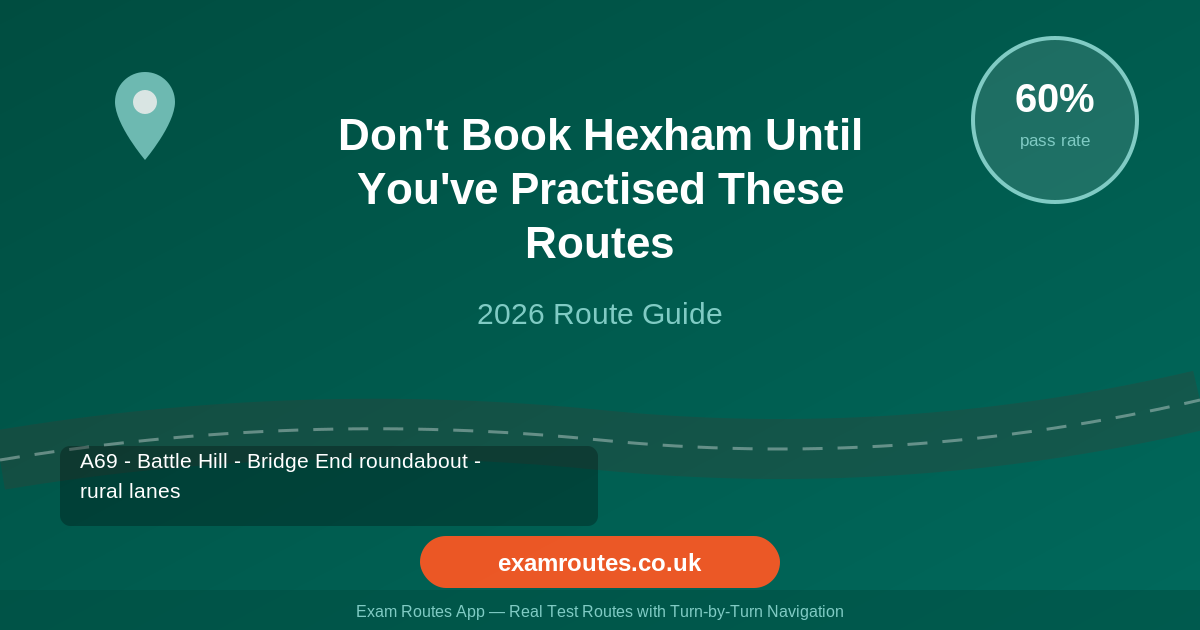
Hexham has one of the healthiest pass rates in the north east of England. At roughly 60%, it is a full ten points above the national average of around 48–49%, and learners across Northumberland and the Tyne Valley travel in specifically to test here. That reputation is deserved — but it comes with a catch. Hexham is a market town built on a hillside, and the combination of steep gradients, narrow historic streets and a fast A69 makes it a very different test from a flat suburban centre.
Before you book Hexham on the strength of that pass rate, read this. Here is what the routes actually involve in 2026: where the centre is, which roads examiners use, the hills and junctions that catch learners out, what the pass rate really means, and the practice you need to do first. For a shorter overview, see our Hexham driving test routes and tips guide.
Key Takeaways
- Hexham’s pass rate is around 60%, one of the highest in the north east.
- The A69 features on most longer routes – joining and leaving it safely is essential.
- Steep hills mean hill starts and gear selection are tested in real conditions, not on a flat estate road.
- Narrow streets around Gilesgate and Priestpopple demand confident meeting of oncoming traffic.
- Rural roads towards Acomb, Wall and Corbridge appear regularly on longer routes.
About Hexham Driving Test Centre
The centre is at St Andrews House, Haugh Lane, Hexham, Northumberland, NE46 3EW, on the lower ground close to the River Tyne and the Haugh Lane industrial area — a short drive from the town centre and the railway station.
What to know before you arrive:
- Parking: there is limited parking on site and on Haugh Lane itself. It is an industrial estate road, so watch for vans and lorries reversing. Arrive early rather than circling.
- Facilities: basic waiting facilities. Nothing on site for food, though the town centre is only minutes away.
- What to bring: your provisional photocard licence, and a test-legal car — valid MOT, L-plates front and rear, an additional interior mirror for the examiner, and a clean dashboard with no warning lights.
- Local knowledge: the immediate area is flat, but the moment you head towards the town centre you start climbing. Do not let the flat start lull you.
The Routes: Roads You Are Likely to Drive
Official DVSA route lists were withdrawn years ago, and the examiner decides the route on the day. What does not change is the road network, and at Hexham that network is unusually distinctive.
The climb into town
From Haugh Lane, most routes head up towards the town via Haugh Lane, Alemouth Road or Bridge End. The pull up into Hexham is genuine — expect to select second gear and hold it, and to be marked on whether you can move off uphill without rolling back.
Town-centre streets
Priestpopple, Battle Hill, Gilesgate and Hencotes form the historic core. These are narrow, often with parked cars, buses and pedestrians, and several have priority arrangements you must read quickly. Battle Hill is exactly what it sounds like.
The A69
The A69 runs east–west past the town and is the fast element of most longer routes. Sections are dual carriageway and sections are single carriageway with overtaking lanes, and both appear. Joining from the Hexham roundabouts and leaving at Bridge End or Corbridge is standard.
Residential estates
Tyne Green, the estates off Corbridge Road, and the streets around Whetstone Bridge Road and Eastwood Grange are used for quiet-road work and manoeuvres. Several are on slopes, which makes the reverse bay park and pull-up on the right noticeably harder than on level ground.
Rural roads
Head north or south and you are quickly onto national speed limit country roads towards Acomb, Wall, Hexham Racecourse and the B6305 towards Allendale. Blind bends, dry stone walls, sheep and farm traffic are all part of the picture.
Tricky Spots & Common Challenges at Hexham
- Battle Hill and the town-centre gradient. Stopping on a hill in traffic and moving off again is not a training-yard exercise here; it is unavoidable. Handbrake, bite point, then release — and do it smoothly with a queue behind you.
- Bridge End roundabout. The junction where the A69, A6079 and the road into Hexham meet. Traffic arrives quickly, lane discipline matters, and hesitating causes a queue behind you within seconds.
- Joining the A69. The slip roads reward decisive acceleration. Merging too slowly is one of the most common serious faults recorded on Tyne Valley routes.
- Narrow streets around Gilesgate and Hencotes. You will meet oncoming traffic with parked cars on your side. The examiner is watching whether you identify who has priority early and hold back in a sensible position, rather than nosing forward and blocking the road.
- Corbridge Road and the run to Corbridge. A mix of 30, 40 and 60mph limits in quick succession. Speed-limit changes here catch out learners who stop reading the signs.
- Rural bends towards Acomb and Wall. High hedges and stone walls hide what is coming. Approach speed and road position — not steering skill — is what gets marked.
- Sloped manoeuvres. Reverse bay parking on a gradient requires clutch control most learners have never practised. Find a sloped car park before test day.
Practise Real Test Routes on Your Phone
The Exam Routes App gives you access to real driving test routes with turn-by-turn navigation. Practise at your own pace and build confidence before test day.
Pass Rates & Statistics
Hexham’s car practical pass rate is around 60%, against a national average of roughly 48–49%. It is consistently one of the better-performing centres in Northumberland and the wider north east.
The reasons are much the same as at other small rural centres:
- Lower traffic density. Fewer multi-lane junctions and fewer complex urban gyratories than a city centre test.
- Well-prepared local candidates. Most people testing at Hexham have learned on Hexham’s roads.
- Fewer opportunities for the chaotic. Rural routes present hazards, but they are hazards you can see coming.
A word of caution. A 60% pass rate does not mean a soft test. The marking standard is identical at every DVSA centre in Great Britain — an examiner in Hexham applies the same DL25 criteria as one in central London. What differs is the road environment. If you have never driven a hill start in traffic or a 60mph country lane, Hexham will find that out quickly.
Compare it with nearby centres: Gosforth and the Newcastle centres run considerably lower, which is why some learners travel out to the Tyne Valley. If you do, budget for practice hours on Hexham’s roads first.
Top Tips for Passing at Hexham
- Practise hill starts until they are automatic. Not on a gentle incline — on Battle Hill or an equivalent gradient, with a car behind you.
- Drive the A69 in both directions. Join it, hold your lane, cope with an overtaking lane ending, and leave it. Do it in rain if you can.
- Work on meeting traffic. Hexham’s narrow streets test give-and-take more than almost any other skill. Practise identifying the obstruction, planning your gap and holding back.
- Find a sloped car park. Reverse bay parking on a slope is a different manoeuvre. Do not meet it for the first time on test day.
- Learn the speed-limit changes on Corbridge Road. Know where each limit starts so you are adjusting before the sign, not after it.
- Do a rural session at dusk. Northumberland lanes in low light demand earlier planning and a headlight decision. It builds exactly the anticipation examiners reward.
- Do not treat the pass rate as a cushion. Prepare as though it were 40%, and the 60% will look after itself.
How the Exam Routes App Can Help
Hexham’s difficulty is not complexity — it is unfamiliarity. Hills, narrow historic streets and fast rural roads all need to be driven before they feel normal. The Exam Routes App gives you real test routes around Hexham with turn-by-turn navigation, so you can spend your practice hours on the exact roads examiners use rather than the ones that happen to be near your house. Drive them with your instructor, or with a supervising driver during private practice, until the gradients stop being an event.
Frequently Asked Questions
What is the pass rate at Hexham driving test centre?
Hexham’s car practical pass rate is around 60%, one of the highest in the north east and roughly ten points above the national average.
Where is Hexham driving test centre?
St Andrews House, Haugh Lane, Hexham, Northumberland, NE46 3EW, close to the River Tyne on the lower ground below the town centre.
Will my Hexham test go on the A69?
Very likely on a longer route. Practise joining, holding a lane and leaving the A69, including the sections where an overtaking lane ends.
Are hill starts common on the Hexham test?
Yes. The town is built on a hillside, so stopping and moving off on a gradient happens naturally rather than as a set exercise.
Is it worth travelling to Hexham for a higher pass rate?
Only if you practise there first. The marking standard is identical everywhere, so an unfamiliar road network cancels out any statistical advantage.
Get the Edge on Test Day
Download the Exam Routes App and practise real Hexham test routes with turn-by-turn navigation – hills, A69 slip roads and all.