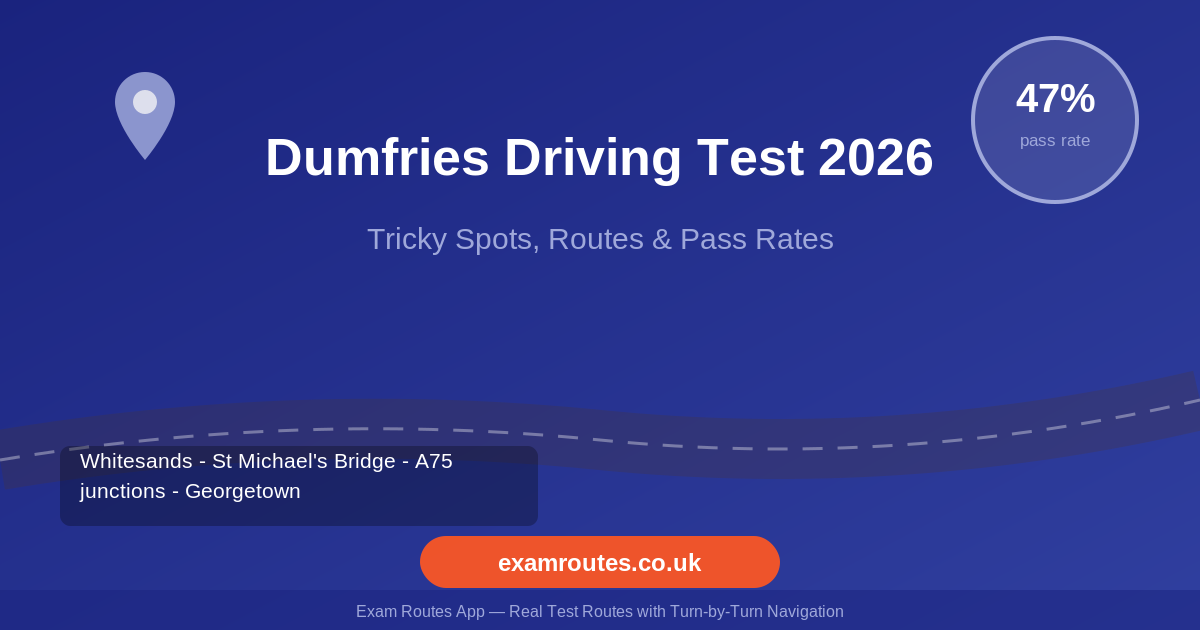
Dumfries is the main practical test centre for a huge slice of south west Scotland, serving learners from Annan and Lockerbie across to Castle Douglas and Thornhill. Its pass rate sits at roughly 47%, marginally below the national average of around 48–49% — which is unusual for a market town centre, and tells you something important. Dumfries is not a sleepy rural test. It has a genuinely busy river-crossing town centre, three trunk roads converging on it, and a set of junctions that punish anyone who has only practised on quiet estate streets.
This 2026 guide covers the test centre itself, the roads examiners use, the specific junctions that generate faults, how the pass rate compares with neighbouring centres, and how to prepare.
Key Takeaways
- Dumfries has a pass rate of around 47%, just below the national average of roughly 48-49%.
- The town-centre river crossings and the Whitesands one-way area are the hardest sections.
- The A75, A76 and A701 all feed into routes, giving fast roads alongside town driving.
- Manoeuvres usually happen in Georgetown, Nunholm, Heathhall or Locharbriggs.
- Typical waiting times have been around 11 weeks – check the DVSA booking service for live dates.
About Dumfries Driving Test Centre
The centre is at 161 Brooms Road, Dumfries, DG1 2SH, on the eastern side of town not far from the Crichton and the A701 corridor.
Practical points:
- Parking: parking around Brooms Road is workable but not generous, and it gets busier when several tests start together. Aim to arrive 10–15 minutes early.
- Facilities: a small waiting area. Nothing on site for food or drink, though the town centre is a short drive away.
- What to bring: your provisional photocard licence, plus a car that meets DVSA requirements — valid MOT, L-plates front and rear, an additional interior mirror for the examiner, no dashboard warning lights, and a tread depth comfortably above the legal minimum.
- Waiting times: recent figures have hovered around 11 weeks. That fluctuates, so check the official booking service rather than relying on a number you read anywhere — including here.
The Routes: Roads You Are Likely to Drive
The DVSA stopped publishing official route lists, and the examiner selects the route on the day. The road network, though, is fixed, and Dumfries routes draw from a fairly predictable set.
Town centre and the river
The River Nith splits the town, and the crossings are where routes get interesting. St Michael’s Bridge, Buccleuch Street Bridge and the Whitesands riverside stretch bring together one-way sections, bus lanes, pedestrian crossings and parking manoeuvres in a small area.
Main approach roads
Annan Road, Lockerbie Road, Glasgow Road, English Street and Brooms Road itself are the arteries. Expect 30mph limits with frequent side junctions, bus stops and parked cars.
Trunk roads
The A75 (the Euroroute towards Stranraer and Gretna), the A76 north towards Kilmarnock and the A701 all touch the test area. Longer routes may include a national speed limit section with overtaking traffic, including a fair share of HGVs heading for the ferry ports.
Residential areas
Georgetown, Nunholm, Summerhill, Heathhall and Locharbriggs supply the quieter roads used for manoeuvres and for the reverse bay park, pull-up on the right and parallel park.
Tricky Spots & Common Challenges at Dumfries
- The Whitesands. A riverside road with parking, buses, pedestrians and a road layout that has changed more than once over the years. Read the markings, keep your speed down and watch for cars pulling out of spaces.
- St Michael’s Bridge and Buccleuch Street Bridge. Narrow crossings feeding straight into junctions on the far side. You need to know your lane before you are on the bridge, not after it.
- English Street and the town-centre one-way sections. Bus lanes and loading restrictions catch out drivers who are watching traffic rather than signs.
- The A75 junctions. Emerging onto a fast trunk road with lorries approaching demands decisive acceleration and accurate judgement of gaps. Hesitation here is the classic Dumfries fault.
- Annan Road and Lockerbie Road junctions. Busy T-junctions with sight lines partly blocked by parked cars and street furniture. Creep and look properly.
- The Locharbriggs and Heathhall approaches. Speed limits step down from 60 to 40 to 30 in short order. Learners routinely arrive at the 30 sign still doing 40.
- Rural lanes towards Cargenbridge and Bankend. National speed limit roads with blind bends, farm entrances and mud on the road after harvest. Approach speed is what gets marked, not bravery.
Practise Real Test Routes on Your Phone
The Exam Routes App gives you access to real driving test routes with turn-by-turn navigation. Practise at your own pace and build confidence before test day.
Pass Rates & Statistics
Dumfries records a car practical pass rate of approximately 47%, against a national average of roughly 48–49%. That is close to the middle of the pack, and considerably lower than the very high figures posted by the small Highland and island centres.
Why is a market town sitting below the average?
- It is a regional hub, not a village. Dumfries handles the traffic of a town of around 33,000 plus a wide rural catchment, and the town centre reflects that.
- Trunk road exposure. The A75 carries heavy freight. Emerging into it is a real test of judgement.
- Wide catchment. Candidates travel in from a large area, and some are driving town roads that are not their day-to-day environment.
For context, Castle Douglas and Stranraer sit further west with quieter road networks, and Cumnock lies north into Ayrshire. Booking further afield to chase a number is usually a false economy — the marking standard is identical at every centre, so all you really gain is unfamiliar roads.
Top Tips for Passing at Dumfries
- Drive the town centre repeatedly. The Whitesands and both bridges should feel routine before test day. Do them at different times of day.
- Practise emerging onto the A75. Get comfortable with accelerating firmly and judging gaps against traffic doing 60mph.
- Learn where the speed limits change. Especially on the Locharbriggs, Annan Road and Glasgow Road approaches. Adjust before the sign.
- Do your manoeuvres in real streets. Georgetown and Nunholm have the kind of parked-up residential roads examiners actually use — not an empty supermarket car park.
- Book a slot that avoids the peaks. Mid-morning, roughly 10:30–11:30, dodges both the school run and the lunchtime town-centre congestion.
- Practise in the rain. South west Scotland is wet. Wet roads change your stopping distances and your view of the Whitesands markings.
- Keep making progress. Undue hesitation at junctions is one of the most commonly recorded faults nationally, and Dumfries’s trunk-road junctions are exactly where it shows up.
How the Exam Routes App Can Help
The difference between a nervous Dumfries test and a confident one is almost entirely familiarity — knowing which lane you need before the bridge, knowing where the 30 starts, knowing what the Whitesands looks like on a busy Saturday. The Exam Routes App gives you real driving test routes around Dumfries with turn-by-turn navigation, so you can spend your practice hours on the roads that genuinely come up. Drive them with your instructor, or with a supervising driver during private practice, until they stop feeling like a test.
Frequently Asked Questions
What is the pass rate at Dumfries driving test centre?
Dumfries has a car practical pass rate of around 47%, slightly below the national average of roughly 48-49%.
Where is Dumfries driving test centre?
161 Brooms Road, Dumfries, DG1 2SH, on the eastern side of town.
How long is the wait for a test at Dumfries?
Recent waiting times have been around 11 weeks, but this changes throughout the year. Check the DVSA booking service for live availability.
Does the Dumfries test use the A75?
Longer routes often touch the A75 or another trunk road, so practise emerging into fast-moving traffic including HGVs.
Which areas are used for manoeuvres at Dumfries?
Quieter residential streets in areas such as Georgetown, Nunholm, Summerhill, Heathhall and Locharbriggs are commonly used.
Ready to Pass at Dumfries?
Download the Exam Routes App and practise real Dumfries test routes with turn-by-turn navigation – bridges, trunk roads and all.