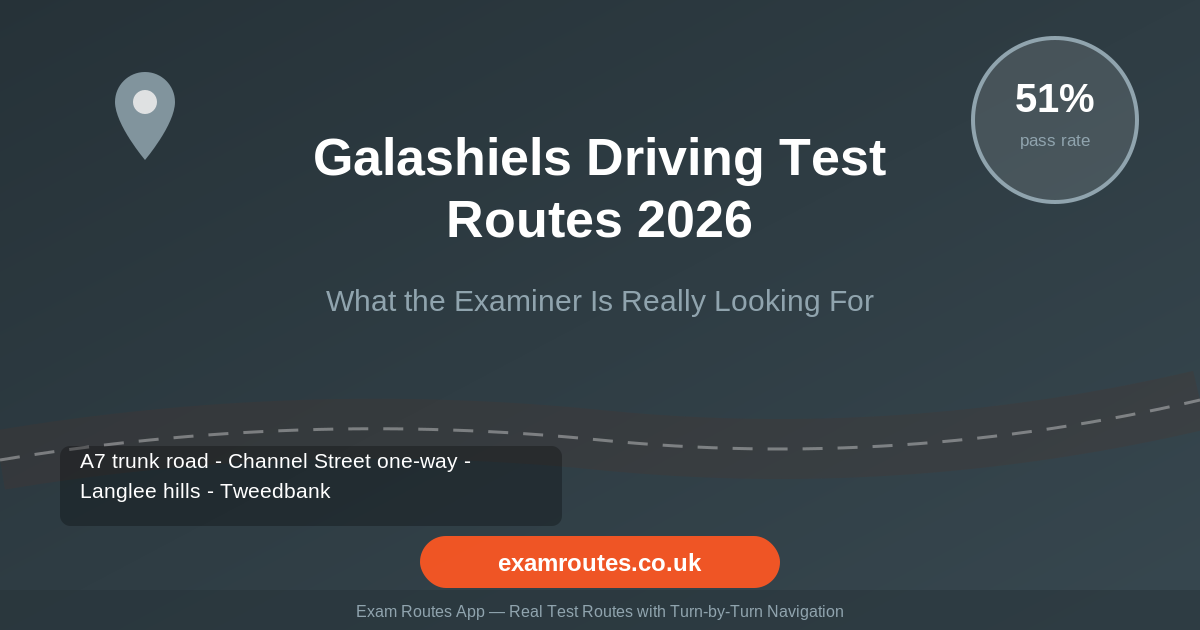
Galashiels is the main practical test centre for the Scottish Borders, and its pass rate of around 51% puts it comfortably above the national average of roughly 48–49%. That is encouraging — but it also means a lot of candidates arrive assuming the test will be gentle. It is not. Galashiels routes take you from a tight town centre one-way system straight onto the A7, a fast trunk road carrying everything from commuters to timber lorries, and back again onto steep residential streets.
This guide focuses on a different question from the usual route list: what is the examiner actually assessing on each part of a Galashiels route, and how do you show it? Our earlier Galashiels pass rates and routes guide covers the basics if you want those first.
Key Takeaways
- Galashiels has a pass rate of around 51%, slightly above the national average.
- The A7 gives you fast-road driving; the town centre gives you lane discipline and observation.
- Steep streets around Gala Hill and Langlee mean hill starts happen naturally.
- Examiners are marking planning and observation far more than steering precision.
- Recent waiting times have been around 10 weeks – always check live DVSA availability.
About Galashiels Driving Test Centre
The centre is at 1 Croft Street, Galashiels, Scottish Borders, TD1 3BH, close to the town centre and within easy reach of the Borders Railway station and Tweedbank.
- Parking: town-centre parking near Croft Street is limited and often time-restricted. Arrive early enough to park properly rather than rushing.
- Facilities: a modest waiting area. Shops and cafes are a short walk away in the town centre.
- What to bring: provisional photocard licence and a test-legal car — valid MOT, L-plates, extra interior mirror for the examiner, and no warning lights showing.
- Waiting times: recently around 10 weeks, though this moves through the year.
What the Examiner Is Looking For — Section by Section
1. The town-centre one-way system
Channel Street, Bank Street, High Street and Ladhope Vale form a compact core with one-way sections, bus stops and pedestrians crossing between parked cars.
What is being marked: lane discipline and forward planning. The examiner wants to see you read the road markings and choose your lane early, not correct at the last second. Signalling too late — or signalling when nobody benefits — is recorded here too.
2. The A7
The A7 runs through Galashiels and heads north towards Edinburgh via Stow and south towards Selkirk and Hawick. Longer routes almost always include a stretch.
What is being marked: making progress and position. Examiners want appropriate speed for the limit and conditions, sensible following distance, and confident emerging from junctions onto a road where traffic is moving at 60mph. Sitting at 45 in a national speed limit section because you feel safer is a fault, not caution.
3. The steep residential streets
Galashiels climbs. The streets around Gala Hill, Langlee, Wheatlands Road and Balmoral Avenue have real gradients.
What is being marked: vehicle control. Moving off uphill without rolling back, choosing the right gear on a climb, and not coasting on the way down. Coasting — clutch down or out of gear on a descent — is a specific recorded fault and one of the easiest to pick up here.
4. Tweedbank and the A6091
Routes often run out towards Tweedbank, the railway terminus and the A6091 link to Melrose.
What is being marked: roundabout technique and lane choice at speed. The link road roundabouts require you to settle your lane on approach and maintain progress through.
5. Rural roads towards Melrose and Selkirk
What is being marked: anticipation. Blind bends, hedges, farm entrances and the possibility of a slow-moving vehicle around the next corner. Examiners want to see you adjusting speed before the hazard, not braking in the middle of the bend.
6. The manoeuvre
Usually done in a quieter residential street or a car park within a few minutes of the centre.
What is being marked: control, accuracy and — crucially — observation. Most manoeuvre faults are not about ending up crooked; they are about not looking around often enough while reversing.
Practise Real Test Routes on Your Phone
The Exam Routes App gives you access to real driving test routes with turn-by-turn navigation. Practise at your own pace and build confidence before test day.
Pass Rates & Statistics
Galashiels records a car practical pass rate of about 51%, against a national average of roughly 48–49%. It is a modest advantage rather than a dramatic one.
What actually drives it:
- Moderate traffic volume. Busy enough to be a real test, but without the multi-lane gyratories that pull city figures down.
- Local candidates. Most people testing here learned here, and familiarity is worth several percentage points anywhere in the UK.
- Route variety that is teachable. Town, trunk road, hills and country lanes — all present, all practisable.
Nearby, Kelso, Hawick and Peebles serve the rest of the Borders. Remember that the DL25 marking standard is identical at every DVSA centre in Great Britain — a difference in pass rate reflects the roads and the candidates, not the examiners.
Top Tips for Passing at Galashiels
- Drive the A7 in both directions, at least three times. Include emerging onto it from a side road. That single junction type accounts for a lot of Borders test faults.
- Walk the one-way system. Ten minutes on foot around Channel Street and Bank Street makes the lane markings make sense before you drive them.
- Practise hill starts in Langlee. On a real gradient, with traffic behind you.
- Stay in gear downhill. Make not-coasting a habit rather than a rule you remember under pressure.
- Do a Tweedbank roundabout session. Approach, lane choice, exit, all at road speed.
- Practise rural bends towards Melrose. Focus on adjusting speed on the approach, not mid-corner.
- Rehearse observations out loud. Saying “mirror, signal, position, speed, look” while you drive turns the routine into a habit the examiner can see.
How the Exam Routes App Can Help
Examiners are assessing habits, and habits are built by repetition on the right roads. The Exam Routes App gives you real Galashiels test routes with turn-by-turn navigation, so your practice hours go on the A7 junctions, the one-way system and the hill starts that actually appear on test day — rather than wherever happens to be convenient. Use it with your instructor, or with a supervising driver during private practice.
Frequently Asked Questions
What is the pass rate at Galashiels driving test centre?
Galashiels has a car practical pass rate of around 51%, slightly above the national average of roughly 48-49%.
Where is Galashiels driving test centre?
1 Croft Street, Galashiels, Scottish Borders, TD1 3BH, close to the town centre.
Will my test go on the A7?
Very likely on a longer route. Practise driving it in both directions and emerging onto it from side roads.
What faults are most common at Galashiels?
Late lane choice in the one-way system, undue hesitation emerging onto the A7, coasting downhill, and insufficient observation during the manoeuvre.
How long is the wait for a test at Galashiels?
Recent waits have been around 10 weeks, though this varies. Check the DVSA booking service for live availability.
Get the Edge on Test Day
Download the Exam Routes App and practise real Galashiels test routes with turn-by-turn navigation – the A7, the one-way system and the hills.