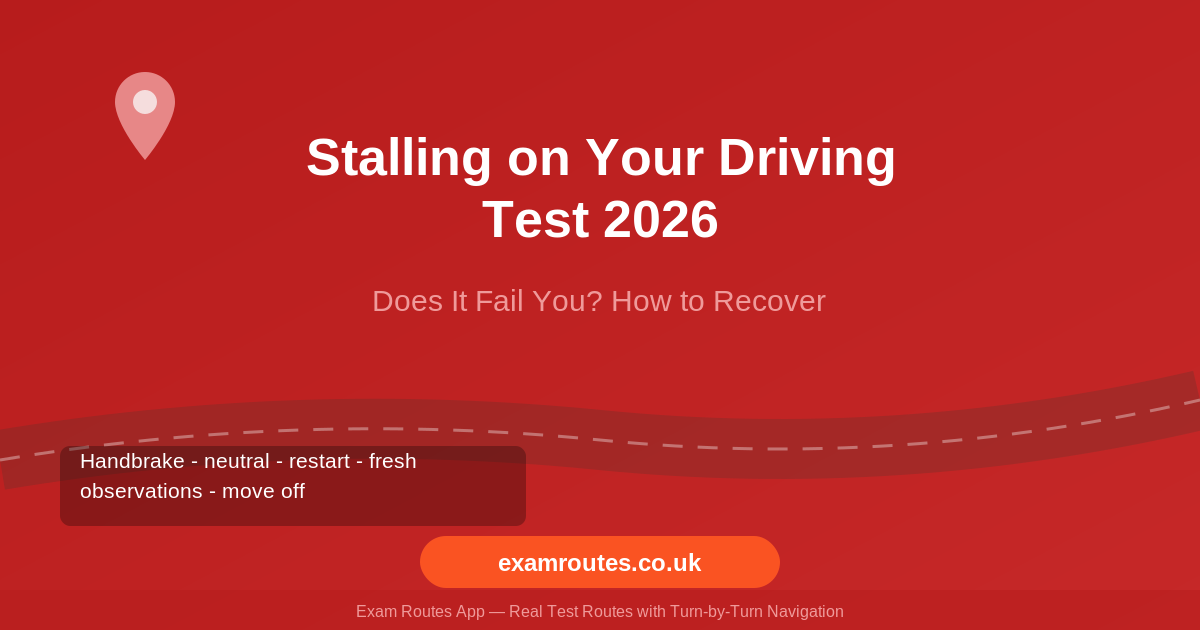
It is the single most feared moment on a manual driving test. You lift the clutch, the engine shudders, and the car dies — usually at a busy junction with a queue behind you. The panic that follows costs far more tests than the stall itself ever does.
Here is the reality: a stall is not an automatic fail. Most stalls are recorded as a driving fault, sometimes as nothing at all. What decides your result is where it happens, whether it created danger, and — above all — how you recover.
Key Takeaways
- A stall on its own is usually recorded as a driving fault, not a serious one.
- There is no fixed number of stalls that fails you – it depends on where and why.
- A stall becomes serious or dangerous if it puts you or others at risk.
- You are allowed up to 15 driving faults in total; a single serious or dangerous fault ends the test.
- Recovery matters more than the stall: handbrake on, gear to neutral, restart calmly, full observations.
How Stalling Is Actually Marked
UK practical tests are recorded on the DL25 marking sheet, and every fault falls into one of three categories:
- Driving fault (a “minor”). Not potentially dangerous, but not correct either. You can accumulate up to 15 and still pass.
- Serious fault. Potentially dangerous, or a habitual driving fault repeated so often it becomes a pattern. One of these ends your test as a fail.
- Dangerous fault. Actual danger caused to you, the examiner, the public or property. Also an immediate fail.
A stall in a quiet residential street, recovered calmly, will typically be marked as a driving fault under “control — clutch” or “move off — control”. In some cases, if it is momentary and causes nobody any inconvenience, the examiner may not record anything at all.
Our guide to how many driving faults you are allowed in 2026 explains the full marking structure.
When a Stall Becomes Serious
The category changes when the stall creates risk. Common examples:
- Stalling on a roundabout or in the middle of a junction. You are now blocking a live traffic lane. This is far more likely to be marked serious.
- Stalling while emerging into a gap. If you pull out in front of a car and then stall, the other driver has to brake for you. That is a genuine hazard.
- Stalling on a level crossing. Always treated extremely seriously.
- Rolling back significantly after a stall on a hill. Especially with a vehicle close behind.
- Repeated stalling. One stall is a moment. Five stalls is a pattern, and a habitual driving fault can be escalated to a serious fault because it shows the control is not there.
- Panicking after the stall. Restarting in gear, lurching forward, or moving off without checking mirrors and blind spots. The recovery causes the fail more often than the stall does.
Practise Real Test Routes on Your Phone
The Exam Routes App gives you access to real driving test routes with turn-by-turn navigation. Practise at your own pace and build confidence before test day.
How to Recover From a Stall Properly
There is a correct sequence, and it takes about four seconds once you have practised it:
- Apply the handbrake. This stops any risk of rolling and takes your foot pressure out of the equation.
- Put the gear lever into neutral. Do not restart the engine in gear.
- Restart the engine. Clutch down, turn the key or press the button.
- Select first gear.
- Do your full observations again. Mirrors, blind spot, and a proper look at what has changed while you were stationary — because it will have.
- Move off when it is safe. Not when you feel embarrassed. The car behind can wait five more seconds.
The most common recovery error is skipping step five. Learners are so keen to get moving again that they pull away on the observations they made before the stall — which are now out of date. That is what turns a driving fault into a serious one.
Why Learners Stall — and How to Stop
Lifting the clutch too fast
The classic cause. The bite point needs finding gently and holding briefly. Practise moving off on a flat road until you can do it without looking at your feet.
Not enough gas
Especially on a hill or with a cold engine. A small, steady amount of accelerator before you lift the clutch does most of the work.
Wrong gear
Trying to move off in second or third, or dropping into first at too high a speed. Also common when pulling away from a roundabout in a rush.
Braking to a stop without the clutch
The engine dies as you slow. Clutch down before you get to walking pace.
Nerves
Tense legs make smooth clutch control almost impossible. This is the real cause behind a large share of test-day stalls in learners who never stall in lessons. Our guide to building driving confidence before your test covers this directly.
What About Automatic Cars?
Automatics do not stall in the conventional sense, which is one reason automatic-only tests appeal to nervous learners. Bear in mind that passing in an automatic gives you an automatic-only licence — you cannot then drive a manual without taking another test. That is a bigger trade-off than a stall.
Five Practical Fixes Before Test Day
- Practise stalling deliberately. With your instructor, in a safe place, stall the car on purpose and run the recovery routine. Doing it five times removes almost all the fear.
- Do hill starts until they are boring. On a real gradient, with traffic.
- Practise moving off from behind a parked car. The angle start is where clutch control and observation combine, and it is a frequent stall point.
- Warm the car up. A cold engine on a frosty morning is more stall-prone.
- Slow your breathing at junctions. One long exhale before you move off relaxes your left leg more than any technique tip.
How the Exam Routes App Can Help
Most test-day stalls happen at the same handful of places — a steep junction, a busy roundabout exit, an awkward emerge onto a fast road. The Exam Routes App gives you real driving test routes with turn-by-turn navigation, so you can find those pressure points on your local routes and practise them until the clutch work is automatic. Familiar roads make for relaxed legs, and relaxed legs do not stall.
Frequently Asked Questions
Does stalling fail your driving test?
Not on its own. A stall is usually recorded as a driving fault. It becomes a serious or dangerous fault if it creates risk – for example stalling in the middle of a junction, or moving off afterwards without fresh observations.
How many times can you stall on a driving test?
There is no fixed number. You are allowed up to 15 driving faults in total. Repeated stalling can be escalated to a serious fault because it shows a lack of vehicle control.
What should you do immediately after stalling?
Handbrake on, gear into neutral, restart the engine, select first gear, take full fresh observations including mirrors and blind spot, then move off when it is safe.
Why do I only stall on test day?
Nerves tighten the muscles in your legs, which makes smooth clutch control much harder. Practising the recovery routine and the specific junctions you will drive reduces it substantially.
Can you stall an automatic car on a driving test?
Automatics do not stall in the same way. Remember that passing in an automatic gives you an automatic-only licence, so you would need another test to drive a manual.
Don’t Leave Your Test to Chance
Download the Exam Routes App and practise the real junctions and hills where stalls actually happen – with turn-by-turn navigation on genuine test routes.