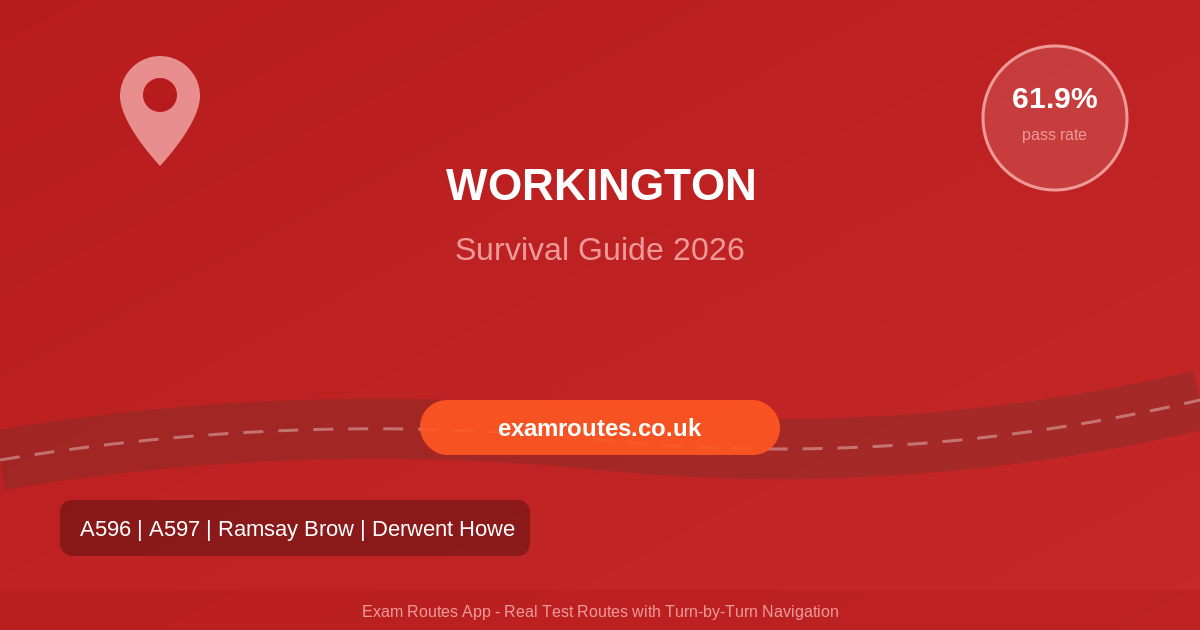
Workington has quietly become one of the best places in England to take a driving test. In the DVSA year to March 2026 it passed 61.9% of car tests — 11.8 points above the 50.1% national average — after sitting at just 48.3% the year before. That is one of the biggest year-on-year improvements at any centre in Great Britain. This survival guide covers the routes, the pass rates, the hills that catch people out, and the mistakes that account for most of the fails that still happen.
About Workington Test Centre
Workington sits on the west Cumbrian coast, with the A596 running north towards Maryport, the A597 south towards Whitehaven and the A66 heading east to Cockermouth, Keswick and eventually the M6. The town itself is compact but far from flat, and that mixture — coastal A-roads, a steep old town, retail park roundabouts and quick access to open country — is what makes its test routes more varied than the size of the place suggests.
Practical points for the day:
- Get there early. Parking near the centre is manageable, but the surrounding roads get busy at school and shift-change times.
- Bring your photocard licence and a car that meets DVSA rules: legal tyres, working lights, no dashboard warning lights, an additional interior mirror for the examiner and L plates front and rear.
- Check the weather seriously. West Cumbria gets driving rain and strong coastal wind. Tests are rarely cancelled for either, so practise in both.
- Availability is tight. DVSA data shows only 0.2% of slots in the 24-week booking window still free — Workington fills up almost completely.
The Routes: What a Workington Test Is Made Of
Official route lists are no longer published, but the road network narrows things considerably.
The town centre and Ramsay Brow area. Workington’s older core has genuine gradients, tight junctions and one-way sections. Hill starts here are not a formality — you will need proper clutch and handbrake control, and you may need to hold position on a slope with a car close behind.
Derwent Howe and the retail park roundabouts. A run of roundabouts and signalled junctions serving the retail estate, with lane markings, buses and a lot of turning traffic. Lane discipline and correct signalling on exit are the recurring themes.
The A596 / A597 corridors. Faster A-roads with 40, 50 and national speed limit sections, roundabouts and junctions onto side roads. Progress matters here: driving 40 in a national limit stretch with a clear road behind you is a fault.
The residential estates. Salterbeck, Moorclose, Northside and Seaton give the examiner narrow roads, parked cars, 20mph zones, side-road junctions and space to set manoeuvres.
The outskirts. Great Clifton, Stainburn and the lanes towards Distington and Harrington bring bends, gradients, farm entrances and shorter sightlines. Country-road judgement is part of the assessment at Workington in a way it simply is not at an inner-city centre.
Tricky Spots and Mistakes to Avoid
- Ramsay Brow and the town’s hills. Rolling back on a hill start is one of the most common serious faults here. Practise on a real gradient, with traffic behind you, not on a gentle slope in an empty street.
- Calva Bridge and the river crossings. Narrow approaches with junctions immediately after. Learners get their positioning right and then forget to plan the turn that follows.
- Derwent Howe roundabouts. Multiple entries and exits close together. Choose your lane early, signal your exit, and do not drift across lanes on the roundabout itself.
- The A596 junctions. Emerging onto a fast A-road needs a proper gap and decisive acceleration. Half-committing is the classic fail.
- 20mph residential zones. Several Workington estates are 20mph and the repeater signs are small. Twenty-eight in a 20 is a fault every time.
- Wet, wind-swept coastal roads. Standing water near the coast and crosswinds on exposed stretches both change how the car behaves. Adjust speed and separation distance visibly — examiners want to see you responding to conditions.
- Country lanes towards Great Clifton. Blind bends, hedges and the occasional tractor. Slow before the bend, position sensibly, and never assume the lane ahead is empty.
Practise Real Test Routes on Your Phone
The Exam Routes App gives you access to real driving test routes with turn-by-turn navigation. Practise at your own pace and build confidence before test day.
Pass Rates and Statistics
Workington’s DVSA figures, year to March 2026:
- Pass rate: 61.9% — 11.8 points above the 50.1% national average
- Tests conducted: 2,998, of which 1,857 passed
- Most recent published month (March 2026): 64.6%
- Average wait: 10.9 weeks as of July 2026, against 12.8 weeks nationally
- Slots still free in the booking window: 0.2%
The jump is what stands out. Workington ran at 48.3% in 2024-25, 54.6% in 2023-24 and 57.7% in 2022-23. Going from 48.3% to 61.9% in a single year is dramatic, and monthly rates through the last published year held between 53.5% and 68.1% — so the improvement looks steady rather than a one-month blip.
Around west Cumbria: Barrow-in-Furness leads at 69.6% with only a 4.4-week wait, Newton Stewart is at 65.8% but with a 19.6-week wait, Kendal (Oxenholme Road) at 65.1%, Dumfries 53.9% and Castle Douglas 53.4%. Workington’s combination of a strong rate and a shorter-than-average wait makes it one of the better bookings in the region — if you can find a slot at all.
Top Tips for Passing at Workington
- Master hill starts properly. This is the number one local skill. Find a real gradient, add a car behind you, and repeat until it is automatic.
- Make progress on the A-roads. If the limit is 60 and conditions allow, drive close to it. Undue hesitation costs more tests here than speeding does.
- Learn the roundabout lanes at Derwent Howe. By sign and marking, not by memory of where you happened to end up last time.
- Get your 20mph zones right. Check for repeaters when you enter an estate and set your speed deliberately.
- Practise in rain and wind. A coastal test in January is a different exam to a still day in June.
- Book the moment you see a slot. With 0.2% availability, hesitation is expensive in a different way.
- Do a full-length rehearsal. Town hills, retail roundabouts, A-road, estate, country lane — in one drive. That is the shape of the real thing.
How the Exam Routes App Can Help
Knowing that Workington has hills is not the same as having driven them under test conditions. The Exam Routes App maps real driving test routes with turn-by-turn navigation on your phone, so your practice hours go on the exact gradients, roundabouts and country stretches examiners use. Drive the route with your instructor or a supervising driver, repeat the hill starts until they stop being an event, and turn up knowing what is round the next corner.
Frequently Asked Questions
What is the pass rate at Workington driving test centre?
61.9% for the DVSA year to March 2026, from 2,998 car tests — 11.8 points above the 50.1% national average, and a large jump from 48.3% the previous year.
How long is the wait for a test at Workington?
Around 10.9 weeks on the July 2026 DVSA figures, slightly quicker than the 12.8-week national average. Availability is very tight — only 0.2% of slots in the 24-week window were free.
Are there hill starts on the Workington test?
Very likely. The older parts of town, including the Ramsay Brow area, have real gradients, and examiners use them. Practise holding the car on a slope and moving off smoothly with traffic behind you.
Should I book Workington or Barrow-in-Furness?
Barrow has a higher pass rate (69.6%) and a shorter wait (4.4 weeks), but it is around 60km away over slow roads. Book the centre whose routes you can realistically practise — the travel rarely pays for itself otherwise.
Which manoeuvres come up at Workington?
All four are in play. Residential estates suit a pull-up on the right or a parallel park, while retail park car parks make bay parking likely. Practise all four rather than assuming.
Ready to Pass? Download Exam Routes Now
Real test routes, turn-by-turn navigation and the roads examiners actually use — all on your phone with the Exam Routes App.