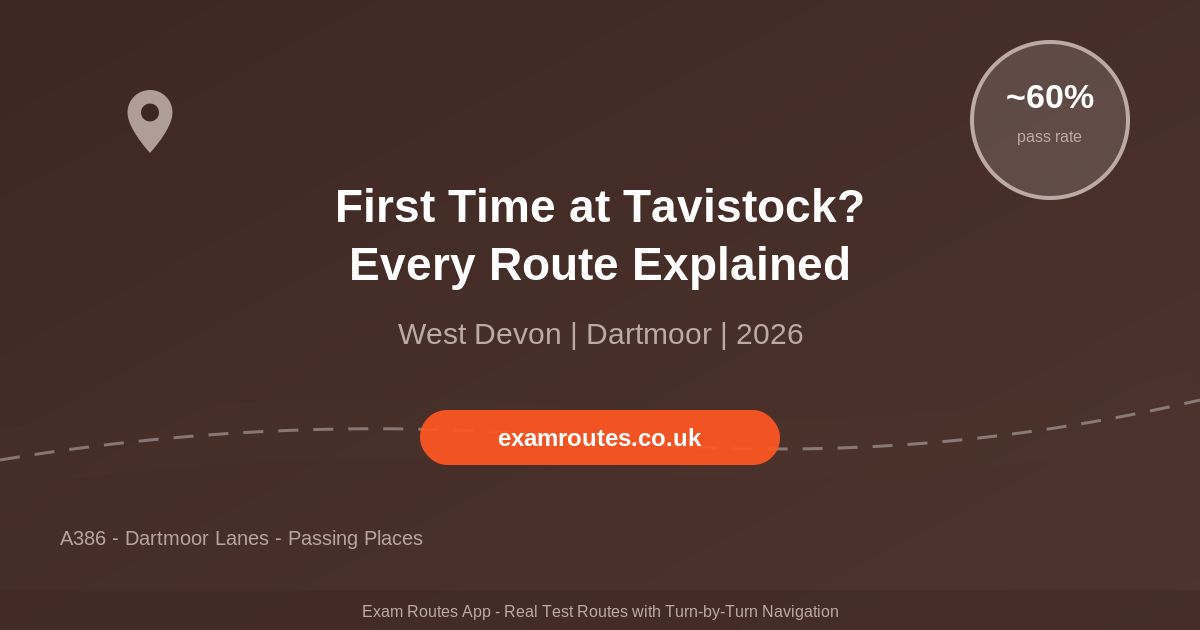
If your test is booked at Tavistock, you are taking your practical on the edge of Dartmoor — and that shapes everything about it. This is not a centre where you will spend forty minutes crawling through traffic lights. It is a centre where you need to handle open moorland roads, narrow lanes with granite walls, cattle grids, livestock, and a compact market town centre that gets tight and busy on market days.
This guide covers what to expect at Tavistock in 2026: the roads examiners use, where candidates most often lose marks, what the local pass rate really tells you, and how to prepare so nothing on the route is a surprise.
About Tavistock Driving Test Centre
Tavistock’s centre serves west Devon and the western edge of Dartmoor, taking candidates from Tavistock, Gunnislake, Yelverton, Lifton, Mary Tavy and the surrounding villages, plus learners travelling out from Plymouth looking for a quieter test environment. It is a small operation with limited slots, so book early and check the address on your DVSA confirmation email.
Arrive around ten minutes before your slot. Bring your provisional licence. If you are using your own car, check the tyres carefully — the lanes around here are hard on rubber — and make sure lights, wipers and washers all work, because a fault found on the day can end your test before it starts.
The Routes: Roads You Can Expect
The DVSA stopped publishing official test routes years ago, but the geography narrows the options considerably.
- The A386 towards Yelverton and Okehampton — the main road in the area, with fast open stretches, long climbs and sweeping bends.
- The A390 towards Gunnislake and the Tamar valley — steeper, twistier and narrower, with some genuinely demanding gradients.
- Tavistock town centre — one-way sections, pedestrian crossings, delivery vehicles and awkward parking, especially near the Pannier Market.
- Residential streets around Whitchurch and the Callington Road area — manoeuvre territory, usually on a slope.
- Moorland roads towards Merrivale and Princetown — unfenced, with sheep and Dartmoor ponies on the carriageway, cattle grids and no white lines.
- Country lanes with passing places — where reversing to a passing place and courteous priority decisions get tested for real.
Tricky Spots and Common Challenges
Unfenced moorland roads. Livestock genuinely wander onto the road. The examiner is watching whether you slow down, give a wide berth, and avoid sudden braking or swerving. Treat every pony as capable of stepping out in front of you.
Cattle grids. Approach in a straight line, at a sensible speed, without braking on the grid itself. They are slippery when wet.
Narrow lanes with high banks. Devon hedge banks kill visibility. You need to read the road for passing places ahead, plan where you will pull in, and be prepared to reverse — calmly and under control.
Steep gradients on the Gunnislake road. Hill starts and downhill junction approaches both feature. Coasting downhill in neutral or with the clutch down is an easy fault to pick up.
Tavistock town centre on a market day. Delivery vans, reversing traffic, pedestrians stepping out. Your observation and speed control need to be sharp.
Weather off the moor. Fog, driving rain and low cloud roll in fast. If it happens on your test, the test usually goes ahead unless conditions are genuinely unsafe — so practise in poor visibility rather than avoiding it.
Pass Rates and Statistics
Small rural centres in Devon and Cornwall tend to record pass rates above the national average, and Tavistock is no exception — recent DVSA data has put it comfortably above the UK figure of roughly 50 percent. Lower traffic volumes, fewer complex signalled junctions and fewer multi-lane roundabouts all help.
But the rural profile cuts both ways. Faults at Tavistock cluster in places you would not see in a city: speed on unfamiliar bends, position on narrow roads, observation at junctions with restricted views, and control when meeting oncoming traffic in a lane with nowhere obvious to go. A learner who has only driven in Plymouth can find those genuinely difficult.
Practise Real Test Routes on Your Phone
The Exam Routes App gives you access to real driving test routes with turn-by-turn navigation. Practise at your own pace and build confidence before test day.
Top Tips for Passing at Tavistock
- Practise on the moor before test day. If your first encounter with an unfenced road is on your test, that is one variable too many.
- Learn to reverse to a passing place under control. Slowly, with proper observation, and without mounting the verge.
- Adjust your speed to what you can see. On a lane with high banks, the national speed limit is a limit, not a target. Driving too fast for the conditions is a fault even if you are under the limit.
- Get comfortable on the A386 at 50 to 60mph. Making appropriate progress matters as much as not speeding.
- Practise hill starts on the Gunnislake gradients. They are steeper than most learners are used to.
- Do a mock test in poor weather. Dartmoor weather is part of the test environment here.
- Plan your junction approach. Where you cannot see, get to a position where you can, then look properly — twice.
How the Exam Routes App Can Help
Rural test routes are the hardest ones to guess at, because there are only a handful of roads and every one of them has a specific character. The Exam Routes App gives you real driving test routes with turn-by-turn navigation, so you can drive the moorland sections, the Tamar valley climbs and the town centre one-ways before your test rather than after it. Practise them with your instructor, then repeat them with a supervising driver until the passing places and blind bends feel familiar.
Frequently Asked Questions
Is Tavistock an easy driving test centre?
It has a higher pass rate than the national average, but ‘easy’ is the wrong word. The traffic is lighter, yet the moorland roads, narrow lanes and steep gradients demand skills city learners rarely practise.
Will there be animals on the road during my test?
Quite possibly. Dartmoor’s roads are unfenced in places and sheep, cattle and ponies do stray onto them. Slow down, give plenty of room and avoid harsh braking or swerving.
What happens if I meet a car in a single-track lane?
Assess who is closest to a passing place and act decisively. Reversing under control to a passing place is a normal part of driving here and is not a fault – doing it badly, or refusing to move at all, is.
Do I need to worry about cattle grids?
Only enough to take them properly. Approach straight, at a moderate speed, and do not brake while you are on the grid, especially in the wet.
Can I book Tavistock if I live in Plymouth?
Yes, and plenty of learners do. Just make sure you actually practise the moorland and lane driving beforehand rather than relying on the pass rate.
First Time at Tavistock? Practise the Real Routes
Moorland roads, passing places and Tamar valley hills – practise them all with turn-by-turn navigation in the Exam Routes App before test day.