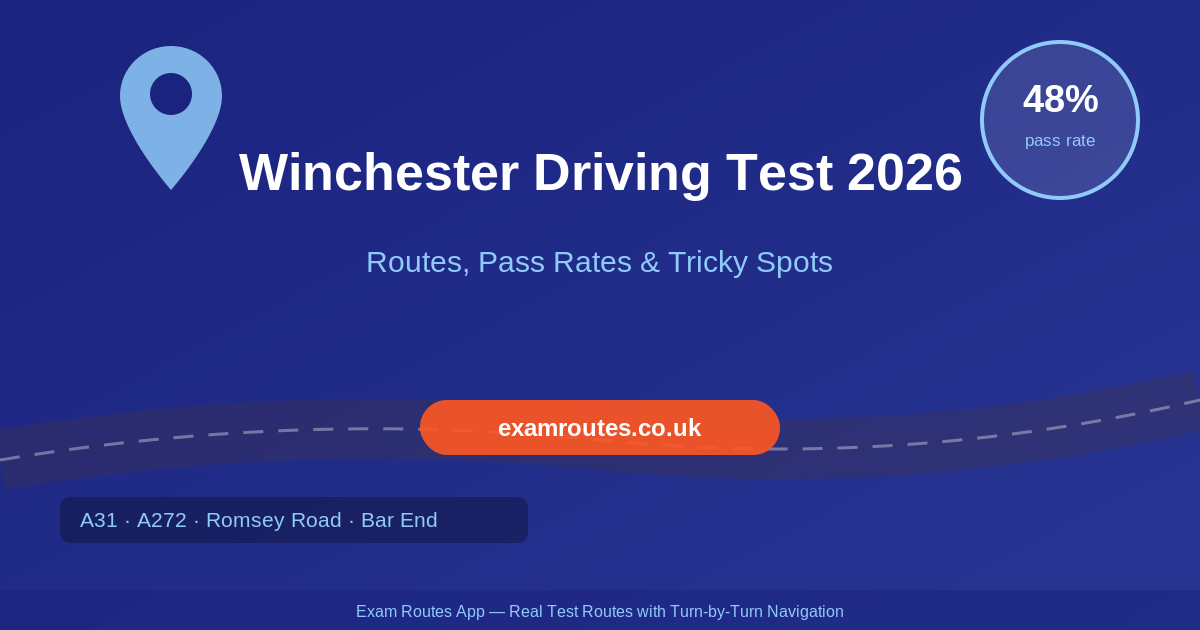
Winchester is one of those test centres that looks gentle on paper and turns out to be anything but. Cathedral-city traffic, narrow medieval streets, a one-way system that funnels you the wrong way if you hesitate, and then a sudden jump onto fast open roads on the edge of the South Downs – all inside about 38 minutes of driving. The pass rate at Winchester sits at roughly 48% in recent DVSA data, a shade under the national average of around 50%, and most of the gap comes down to two things: road position on the narrow stuff, and confidence when the speed limit climbs.
This guide covers what the Winchester test centre is actually like, the roads that show up on nearly every route, the specific junctions that generate faults, and how to build a practice plan that mirrors what you will be asked to do on the day.
About Winchester Driving Test Centre
The Winchester driving test centre is on Christchurch Road, Winchester, SO23 9SY, in a residential pocket to the south-west of the city centre. It is a small centre – there is no big waiting room and no car park set aside for candidates, so plan your arrival carefully.
Bring your provisional photocard licence and a car that meets the DVSA rules – taxed, insured for the test, roadworthy tyres, a working speedometer and an additional interior mirror for the examiner. If you are using your instructor’s car, they will have this covered.
The Routes: Roads Winchester Examiners Use
The DVSA no longer publishes official route lists, but the geography of Winchester means examiners have a limited pool of roads to work with. Almost every route draws on the same corridors.
The immediate residential network
The first three or four minutes are nearly always spent in the streets around the centre – Christchurch Road, Ranelagh Road, Edgar Road, St Cross Road. These are narrow, parked heavily on both sides, and full of give-and-take situations where you must decide who goes first. Examiners use this early section to see whether you can hold a sensible position and make a decision without freezing.
Romsey Road and the western approach
The A3090 Romsey Road climbs out of the city past the hospital and towards Standon and Hursley. It is a busy route with bus stops, pedestrian crossings, a hospital entrance that produces unpredictable turning traffic, and speed limits that step from 30 to 40 to national. The transition from a built-up 30 to open road is one of the most common places to pick up an undue-hesitation fault at Winchester.
Badger Farm, Oliver’s Battery and Stanmore
These estates on the western edge supply most of the manoeuvre locations and a lot of the junction practice. Expect T-junctions with restricted views, mini-roundabouts, parked-car chicanes and 20mph zones. Badger Farm Road and the roads around the retail park are used constantly.
Andover Road, Worthy Road and the north
Heading north, the B3420 Andover Road and Worthy Road take you towards Kings Worthy and Abbotts Barton. This side of the route brings faster residential distributor roads, a run of roundabouts and, on longer routes, a stretch of the A34 or A272 for the independent-driving section.
Bar End, Chesil Street and the eastern edge
The Bar End area – near the park and ride and the leisure centre – gives examiners a set of larger roundabouts, a dual carriageway feel on the A31 approach, and quick access back into the city via Chesil Street. Water Lane and the St Giles Hill area supply steep hills for hill starts.
Practise Real Test Routes on Your Phone
The Exam Routes App gives you access to real driving test routes with turn-by-turn navigation. Practise at your own pace and build confidence before test day.
Tricky Spots & Common Challenges at Winchester
1. The city one-way system
Jewry Street, Sussex Street, City Road and St George’s Street form a one-way loop with multiple lanes, bus gates and short slots to change lane. The classic Winchester fault is committing to the wrong lane late and then straddling the line to correct it. Read the road markings at least two junctions ahead.
2. St Cross Road and Southgate Street
Narrow, tree-lined, parked on both sides and busy with cyclists and pedestrians heading to the college. You will meet oncoming traffic here and you will have to decide whether to hold back or push on. Neither answer is always right – the fault is being indecisive.
3. Romsey Road hospital junction
Traffic turning into and out of the Royal Hampshire County Hospital is constant and often hesitant. Ambulances use this stretch regularly. Keep your following distance generous and be ready to give way to an emergency vehicle properly – without stopping in a stupid place.
4. The A31 / A34 slip roads
On longer routes you may be taken onto a dual carriageway with a proper slip road. Learners who have only practised in the city often join too slowly and force other traffic to brake. Build speed on the slip and merge at the same pace as the traffic already there.
5. Steep hills around St Giles Hill and Chesil Street
Winchester is built on hills. A hill start on a real gradient is very different from a flat car park. Practise moving off uphill with the handbrake, on a road where somebody is waiting behind you.
6. The Bar End and Easton Lane roundabouts
Multi-lane, fast approach, and a lot of drivers who change lanes on the roundabout itself. Choose your lane early, signal properly on the exit and keep looking right on approach.
Pass Rates & Statistics
Winchester’s pass rate of roughly 48% puts it a couple of points below the national picture. Nearby Hampshire centres vary noticeably – some suburban and coastal centres run higher, while dense urban centres run lower. It is worth remembering what a pass rate actually measures: it reflects the mix of candidates as much as the difficulty of the roads. A centre used heavily by well-prepared learners on their second attempt will look different from one used by first-timers.
The practical takeaway is not “avoid Winchester”. It is that Winchester rewards drivers who are comfortable with narrow roads, decisive at give-and-take, and confident when the limit rises. If that describes you after a few lessons on the right roads, the pass rate is largely irrelevant.
Top Tips for Passing at Winchester
- Drive the one-way system until it is boring. Do it in daylight, at rush hour, and on a quiet Sunday. Lane choice should be automatic.
- Practise meeting traffic on St Cross Road and Edgar Road. Learn where the gaps are so you can commit rather than dither.
- Get real hill starts in. St Giles Hill, Magdalen Hill and the roads off Chesil Street are the genuine article.
- Do at least two sessions on Romsey Road, including the speed-limit changes in both directions.
- Rehearse joining a dual carriageway from a slip road so it does not surprise you.
- Use the sat nav in practice, not just on the day. Independent driving is about following instructions while still driving properly.
- Book a slot outside the school run if you can. Winchester’s narrow streets are far calmer between 10am and 2pm.
How the Exam Routes App Can Help
Knowing the roads is the single biggest advantage you can give yourself at a centre like Winchester, where the difficulty is local rather than general. The Exam Routes App lets you load real test routes for UK test centres and drive them with turn-by-turn navigation, so your practice sessions cover the junctions and roundabouts you are actually likely to meet – not a random loop of your own neighbourhood. You can repeat a route as many times as you like, at different times of day, until the decision points stop feeling like decisions.
Frequently Asked Questions
Where is the Winchester driving test centre?
It is at 60 Christchurch Road, Winchester, Hampshire, SO23 9SY, in a residential area south-west of the city centre. There is no dedicated candidate car park, so allow time to park legally nearby.
What is the pass rate at Winchester?
Around 48% in recent DVSA figures, slightly below the national average of roughly 50%. Pass rates shift each quarter, so treat any single number as a guide rather than a verdict.
Do Winchester test routes go on the motorway?
Learner drivers cannot be taken onto a motorway on the practical test. You may be taken onto a dual carriageway such as the A31 or a fast section of the A272, which is a very different thing but still needs practice.
Which manoeuvre will I get at Winchester?
One of the four DVSA manoeuvres, chosen by the examiner: reverse bay park, forward bay park with a reverse exit, parallel park at the side of the road, or pull up on the right and reverse. Practise all four.
Is Winchester a hard test centre?
It is technically demanding rather than aggressive. The narrow city streets, one-way system and hills mean you need good observation and decisive give-and-take. Learners who have only practised on wide suburban roads tend to struggle.
Ready to Pass? Download Exam Routes Now
Load real driving test routes, follow them with turn-by-turn navigation and turn unfamiliar junctions into familiar ones before your Winchester test.