If you have booked your practical test at Greenham, you are testing from one of the quieter-looking test centres in Berkshire that hides some genuinely demanding roads. The centre sits on New Greenham Park, the former RAF Greenham Common airbase on the southern edge of Newbury, and within a few minutes of leaving it you can be on a 70 mph dual carriageway, a 20 mph residential street, or a single-track lane with hedges on both sides.
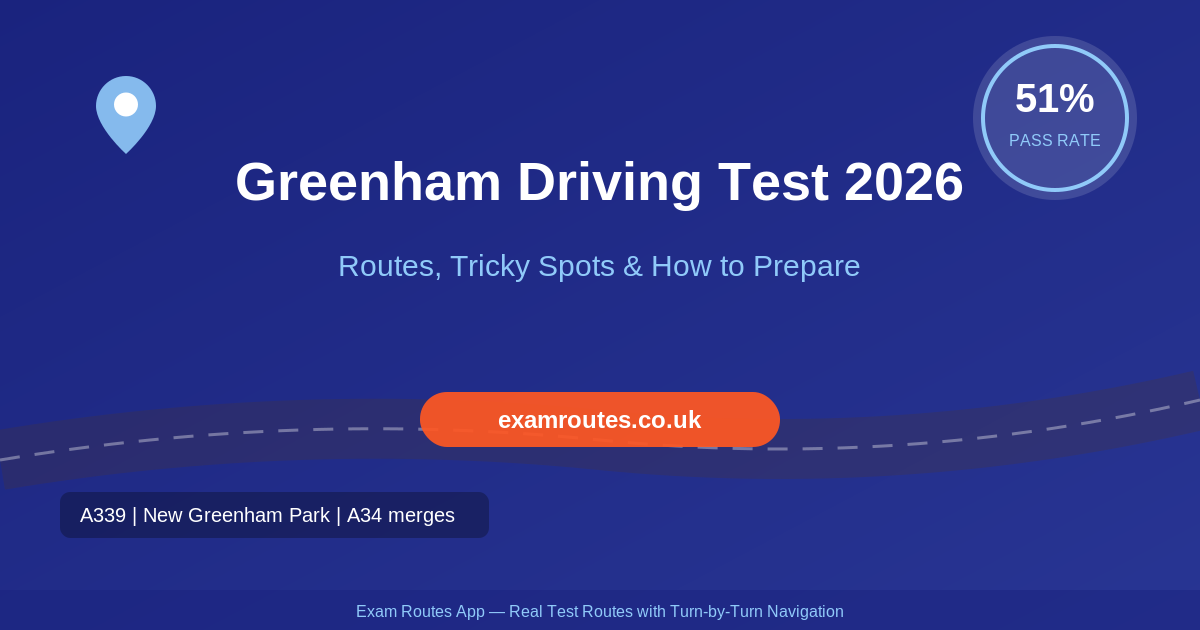
That variety is exactly why Greenham catches learners out. The centre records a pass rate of around 51%, which is a shade above the UK average of roughly 48-49%, but the spread between candidates who have practised the local roads and those who have not is enormous. This guide walks you through the centre itself, the roads that appear again and again, the spots that generate the most faults, and a practical plan for getting ready.
About Greenham Driving Test Centre
Address: Off Buckner Croke Way, Venture West Business Park, New Greenham Park, Newbury, Berkshire, RG19 6HX
Greenham is a business-park centre, so it looks and feels different from a high-street test centre. There is parking on site, but it is shared with other units on the estate, so arrive with fifteen minutes to spare rather than rolling up at the last second. The waiting area is small and there are toilets available, but there is no café, so bring water and anything you need to keep your blood sugar steady.
What to bring: your provisional driving licence (the photocard), your theory test pass certificate number if you have it to hand, and a car that is taxed, insured for the test, has a valid MOT if it is over three years old, and carries L plates plus a rear-view mirror for the examiner. If you are using an instructor’s car, they will have this covered, but it is still worth checking the tyres and lights the day before.
The estate roads themselves are wide and quiet, which means the first ninety seconds of your test are easy. Do not let that lull you. The examiner uses that time to get a feel for your basic control, and the moment you reach the estate exit the difficulty ramps up sharply.
The Routes: Roads You Should Expect
The DVSA no longer publishes official test routes, but the geography around New Greenham Park makes the road mix highly predictable. Examiners need to assess you on a spread of road types within roughly forty minutes, and around Greenham that means the following.
The A339
The A339 is the spine of almost every Greenham route. It runs from the Newbury bypass down past Greenham and on towards Basingstoke, and it changes character constantly. You will meet national speed limit sections, 50 mph restrictions, slip roads, and a chain of roundabouts. The most common faults here are hesitation at roundabout entries and being slow to build speed on a slip road, both of which the examiner marks as undue hesitation or poor use of speed.
Newbury town and the retail parks
Routes frequently drop into Newbury itself, taking in London Road, Bartholomew Street, Northbrook Street and the retail parks off the A339. This is where you meet bus lanes, loading bays, pedestrian crossings and a lot of parked cars. Town-centre driving in Newbury is stop-start and requires constant mirror work.
Thatcham and Bath Road
The A4 Bath Road corridor towards Thatcham gives examiners a fast, straight A-road with turns off into residential estates. Expect to be asked to turn right across oncoming traffic at least once here.
Rural lanes towards Wash Common, Greenham village and Crookham
South and west of the centre the roads narrow quickly. These lanes have blind bends, passing places, mud, and occasionally horses. They are ideal for testing your ability to meet oncoming traffic, hold back, and manage speed for the conditions rather than for the sign.
The A34
Some routes touch the A34, which is a genuine 70 mph dual carriageway. Joining it demands a confident merge, matching the speed of traffic already on the carriageway and a proper blind spot check. Nervous learners tend to join too slowly and force traffic behind them to brake.
Tricky Spots & Common Challenges
- Robin Hood roundabout and the A339 junctions. Multi-lane approaches with lane markings that require you to commit early. Read the signs on approach, choose your lane, and stay in it. Late lane changes on a roundabout are a serious fault.
- Merging onto the A339 and A34. Build speed on the slip road so you can join at the speed of traffic. Check the blind spot, do not stop at the end of the slip road unless you truly have to.
- Narrow lanes south of Greenham Common. Meeting a tractor or a delivery van on a lane with hedges either side is a real possibility. Slow early, find a gap, and make eye contact. Reversing calmly into a passing place is acceptable; panicking and edging forward is not.
- The 20 mph zones in Newbury. Several residential streets are now 20 mph. Drifting to 26 mph because the road feels wide is one of the easiest serious faults to pick up.
- Pedestrian crossings on Northbrook Street and around the retail parks. Shoppers step out. Cover the brake and scan the pavements.
- Cyclists on the Kennet and Avon canal-side roads. Newbury has a lot of cycle traffic. Give at least 1.5 metres when passing, and wait if you cannot.
- Independent driving with the sat nav. Around 80% of tests use a sat nav for a twenty-minute independent section. Greenham routes often use it on the A339, where missing a junction is easy. Remember: going the wrong way is not a fault. Panicking and swerving is.
Practise Real Test Routes on Your Phone
The Exam Routes App gives you access to real driving test routes with turn-by-turn navigation. Practise at your own pace and build confidence before test day.
Pass Rates & Statistics
Greenham’s pass rate sits at roughly 51%, against a UK average of around 48-49% in the most recent DVSA figures. That puts it comfortably in the middle of the table: not one of the notoriously hard urban centres, but not a soft option either.
For context, nearby Berkshire and Hampshire centres run from the high 40s to the high 50s, with Basingstoke around 57% and Reading closer to 49%. What that spread really tells you is not that one centre is “easy” but that road environment matters. Centres with more rural mileage and fewer complex urban junctions tend to record higher pass rates.
Worth knowing: pass rates are averages across every candidate, including people taking their fourth or fifth attempt and people who booked a test long before they were ready. A well-prepared first-time candidate at Greenham has a far better than 51% chance.
Top Tips for Passing at Greenham
- Practise the A339 in both directions at different times of day. It behaves completely differently at 9am and at 2pm. Get comfortable with the merges when it is busy.
- Learn the roundabout lane discipline before test day. Sit as a passenger and talk through which lane you would take on each approach. Lane choice is a decision you should make before you reach the give-way line, not on it.
- Get real rural lane experience. Book at least two lessons that are mostly single-track roads. Practise meeting traffic, reversing into a passing place and reading blind bends.
- Master the 20 mph zones. Use a gear that keeps the car under control at low speed and glance at your speedometer regularly.
- Rehearse joining the A34. One or two confident merges in practice removes most of the fear.
- Do a mock test from the actual centre. Ask your instructor to run a full forty-minute mock starting and finishing on Buckner Croke Way. The routine of pulling out of that estate matters more than you would think.
- Book a mid-morning slot if you can. Roughly 10am to 11am avoids both the school run and the lunchtime retail-park rush.
How Exam Routes App Can Help
The hardest part of preparing for Greenham is simply knowing where to practise. The Exam Routes App maps real driving test routes used around UK test centres and gives you turn-by-turn navigation so you can drive them yourself with your instructor or a supervising driver.
Instead of driving the same three streets near your house, you can spend your practice hours on the A339 merges, the Newbury town-centre crossings and the lanes towards Wash Common, which is where the marks are actually won and lost. Seeing a junction for the sixth time rather than the first is the single biggest confidence advantage you can give yourself.
Frequently Asked Questions
Where is Greenham driving test centre?
It is at Off Buckner Croke Way, Venture West Business Park, New Greenham Park, Newbury, Berkshire, RG19 6HX — on the former Greenham Common airbase site south of Newbury.
What is the pass rate at Greenham?
Around 51%, slightly above the UK average of roughly 48-49%.
Is Greenham a hard test centre?
It is moderately difficult. The estate roads are gentle but routes quickly reach the A339, fast merges and narrow rural lanes, so you need genuine variety in your practice.
Will I go on the A34 during my Greenham test?
It is possible on some routes. Not every candidate gets it, but you should be able to join and leave a 70 mph dual carriageway confidently before you book.
Is there parking at Greenham test centre?
Yes, there is parking on the business park, but it is shared with other units. Arrive around fifteen minutes early so you are not hunting for a space.
Can I practise the real Greenham test routes?
Yes. The DVSA does not publish routes, but the roads are well known locally, and the Exam Routes App gives you route guidance with turn-by-turn navigation so you can practise them properly.
Final Thoughts
Greenham rewards drivers who have done their mileage on real roads rather than in a car park. The centre itself is easy to reach and calm to start from, but the routes will test your speed management, your roundabout lane discipline and your nerve on narrow lanes. Put the practice in on those three things and the pass rate stops being a statistic and starts being a formality.
Get the Edge on Test Day
Stop guessing where the examiner will take you. Download the Exam Routes App and practise the roads that matter, as many times as you need.