Bala is one of the smallest driving test centres in Wales, and one of the most misunderstood. Learners often assume that a rural Snowdonia town with a population under two thousand must be an easy place to take a test. In practice, Bala asks you to do things that learners from big cities rarely practise: reading unmarked single-track lanes, judging passing places, handling long uphill and downhill gradients, and dealing with tourist traffic that has no idea where it is going.
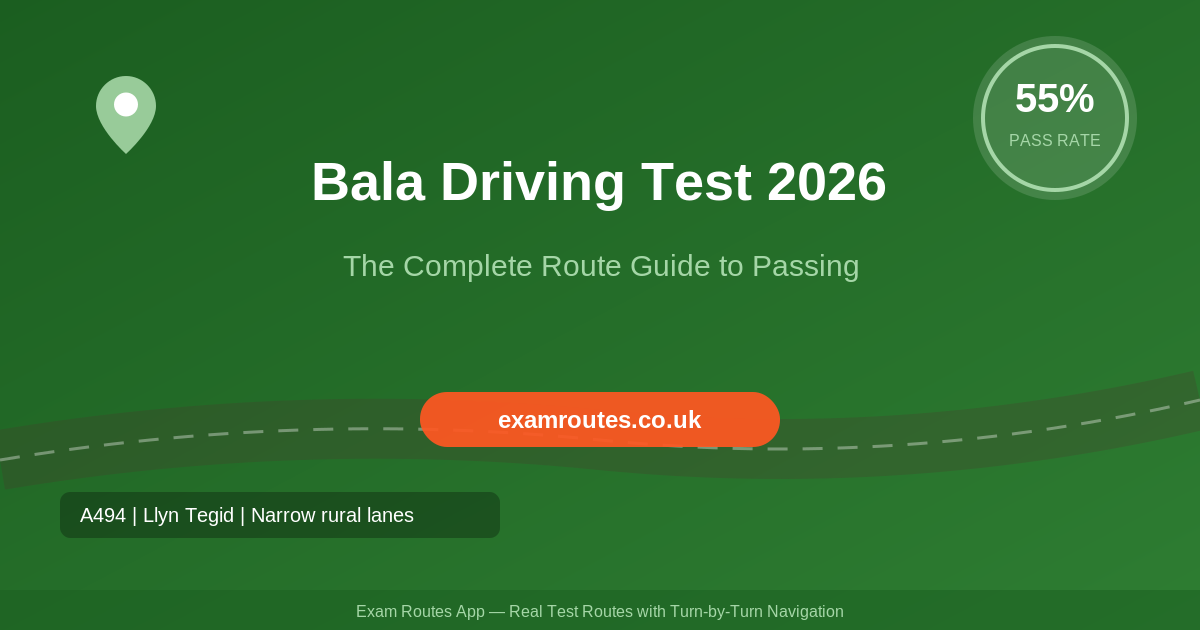
The centre records a pass rate of around 55%, comfortably above the UK average of roughly 48-49%. That is a genuine advantage, but only if you have practised the right roads. This is the complete guide to passing at Bala in 2026.
About Bala Driving Test Centre
Address: Unit 4, Penllyn Workshops, Bala, Gwynedd, LL23 7SP
Bala test centre operates from a small unit on the Penllyn Workshops estate on the edge of town. It is not a large DVSA building with a formal waiting room, so expect something closer to a portacabin-and-desk setup. Facilities are limited and test slots are less frequent than at bigger centres, which is one reason waiting times here can be shorter than in the cities but availability can be patchy.
Parking: there is space on the estate. Arrive early, park considerately and give yourself a few minutes to settle. If you are travelling in from Dolgellau, Corwen or Wrexham, allow extra time in summer — the A494 fills up with caravans and campervans heading to the lake.
Bring: your photocard provisional licence and a roadworthy, insured, L-plated car. If you are hiring your instructor’s car, confirm the booking the week before, because instructor availability in a town this size is thin.
The Routes: What to Expect Around Bala
The DVSA does not publish official routes, but the road network around Bala is simple enough that the ingredients of your test are easy to predict. There are essentially four directions out of town, and your route will use two or three of them.
The A494 towards Corwen and Llandrillo
This is the main artery east out of Bala. It is a fast, flowing A-road with long sweeping bends, national speed limit sections and regular slower-moving traffic. Examiners use it to check that you can make progress appropriately, overtake safely where it is genuinely safe, and drop your speed for villages such as Llandrillo without braking harshly at the last moment.
The A494 towards Dolgellau and the lake road
Heading south-west the A494 runs alongside Llyn Tegid (Bala Lake), the largest natural lake in Wales. This stretch is scenic and, in summer, busy. There are laybys, walkers, cyclists and drivers who brake without warning to admire the view. On the far side of the lake the B4403 through Llanuwchllyn gives you proper narrow-road driving.
The A4212 towards Trawsfynydd
North-west out of town, the A4212 is a wide, well-engineered road built for the old power station traffic. It has long straights and good visibility, and it is where examiners check whether you can hold a steady national speed limit where it is safe to do so. Learners who crawl along at 40 mph on a clear 60 mph road will collect a fault for undue hesitation.
Bala town and the residential streets
The High Street (Stryd Fawr), Arenig Street, Plassey Street and the residential roads off them provide the urban element: parked cars on both sides, priority-give-way pinch points, pedestrians and occasional deliveries blocking the carriageway.
Rural lanes towards Frongoch, Sarnau and Rhos-y-gwaliau
These are the true test. Single-track roads with grass down the middle, blind summits, gates, sheep and passing places roughly every two hundred metres.
Tricky Spots & Common Challenges
- Single-track lanes and passing places. Knowing which vehicle should give way, and reversing calmly when it is you, is the number one skill at Bala. Reverse smoothly, keep looking behind you, and do not mount the verge.
- Blind bends and summits on the lake road. You must be able to stop within the distance you can see to be clear. In practice that means slowing before the bend, not in it.
- Making progress on the A4212 and A494. Rural learners are often too cautious. If the road is clear, dry and national speed limit, driving at 42 mph is a fault.
- Tourist traffic in summer. Caravans, motorhomes, cyclists in groups and drivers stopping suddenly for photographs. Expect the unexpected between May and September.
- Livestock and farm vehicles. Sheep on the road is normal here. Slow right down, do not sound the horn aggressively, and pass wide and slow.
- Steep gradients. Hill starts on a real hill, and controlled descents where you should be using engine braking rather than riding the brakes.
- Wet and mud. Field entrances leave mud on the road all year round. Reduce speed for the surface, not just for the sign.
- Welsh-language road signs. Signs are bilingual, and place names appear in Welsh first. Know that Y Bala, Dolgellau and Y Trallwng may be how your destination is written.
Practise Real Test Routes on Your Phone
The Exam Routes App gives you access to real driving test routes with turn-by-turn navigation. Practise at your own pace and build confidence before test day.
Pass Rates & Statistics
Bala’s pass rate of roughly 55% puts it above the UK average of around 48-49%. That is typical of small rural Welsh centres, where routes contain fewer complex multi-lane junctions and less heavy traffic than a city test.
Do not read that as “easy”, though. Rural centres also have far fewer test slots, so a fail can mean a long wait for a rebooking. The practical consequence is that at Bala it is worth being genuinely ready rather than taking a speculative early test.
Local tip: if you learn in Wrexham, Chester or Shrewsbury and travel to Bala hoping for an easier pass, you may find the opposite. City learners routinely struggle with single-track lanes, passing places and making progress at national speed limit.
Top Tips for Passing at Bala
- Spend at least three lessons purely on single-track lanes. Practise meeting traffic, choosing whether to hold back or proceed, and reversing to a passing place.
- Learn to make progress. Get comfortable driving at the speed limit when conditions allow. Ask your instructor to specifically coach speed on the A4212.
- Practise hill starts on a real gradient, not a gentle slope. Bala has plenty of both.
- Drive the lake road in summer conditions if your test is between May and September, so tourist traffic is not a shock.
- Get used to the sat nav section. Rural junctions can be poorly signed and the sat nav may announce a turn late. Trust the road markings and signs first, the sat nav second.
- Check your car’s tyres and washers. Rural roads mean mud and spray; a dirty windscreen on test day is avoidable.
- Book early in the day. Traffic through Bala builds from late morning, especially in the holidays.
How Exam Routes App Can Help
Rural test centres are the hardest to prepare for, because there is no obvious “practice loop” and local instructors’ time is limited. The Exam Routes App maps real test routes with turn-by-turn navigation, so you can drive the actual roads examiners use with a supervising driver instead of guessing.
For Bala that means practising the A494 towards Llandrillo, the lakeside stretch, the A4212 straights and the lanes towards Frongoch as a structured session rather than a wander. Repetition on those specific roads is what turns a nervous rural learner into a confident one.
Frequently Asked Questions
Where is Bala driving test centre?
Unit 4, Penllyn Workshops, Bala, Gwynedd, LL23 7SP, on the edge of the town.
What is the pass rate at Bala?
Around 55%, above the UK average of roughly 48-49%.
Are there many test slots at Bala?
No. It is a small centre with limited availability, so book as far ahead as you can and treat a cancellation as valuable.
Will I have to reverse into a passing place?
You may well have to, if you meet oncoming traffic on a single-track lane. It is not a set manoeuvre, but the examiner will expect you to handle it safely and calmly.
Do I need to speak Welsh to take my test at Bala?
No. Tests are available in English, and Welsh-language tests can be requested when you book. Road signs are bilingual.
Is Bala easier than a city test centre?
The pass rate is higher, but the skills are different. If you have never driven single-track lanes or held a national speed limit on an open road, Bala will be harder for you, not easier.
Final Thoughts
Bala is a fair test centre with a friendly pass rate and genuinely beautiful test routes — but it demands rural driving skills that many learners simply have not built. Put your hours into narrow lanes, gradients and confident progress on open A-roads, and that 55% starts looking very achievable.
Don’t Leave Your Test to Chance
Stop guessing where the examiner will take you. Download the Exam Routes App and practise the roads that matter, as many times as you need.