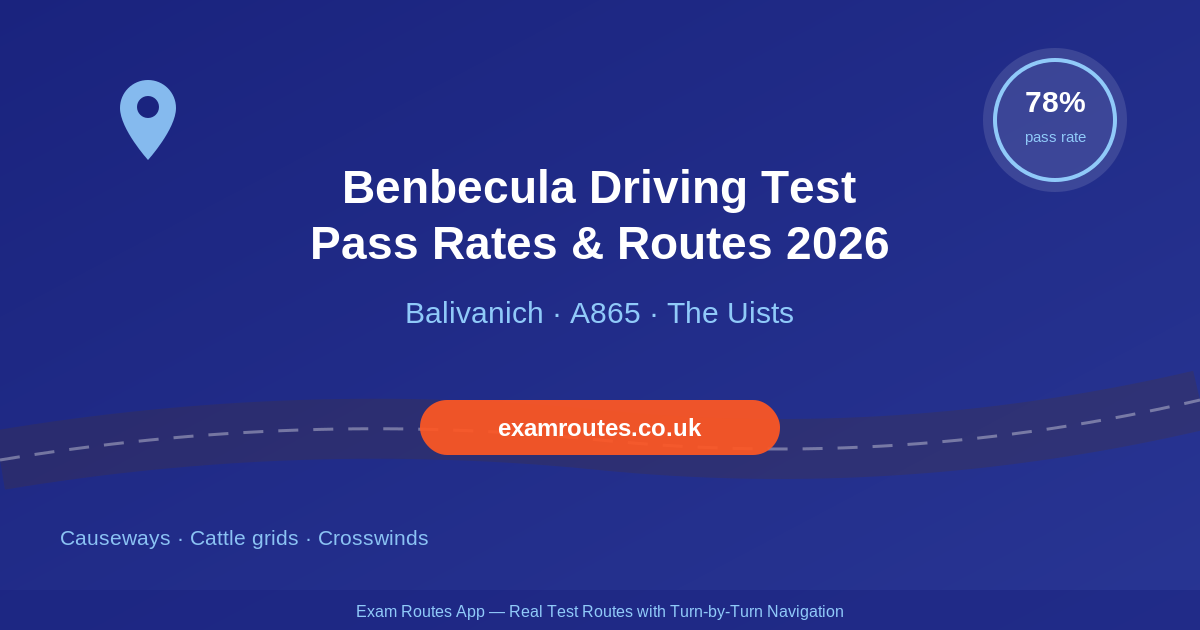
Benbecula sits in the middle of the Uists, joined to North Uist and South Uist by causeways, with the A865 running the length of it like a spine. It is flat, it is open, it is largely treeless, and it has one of the highest driving test pass rates in the United Kingdom. Learners hear that last part and assume the test is a formality. It is not.
What Benbecula actually asks of you is a very particular skill set: causeway crossings in crosswinds, single-track sections with passing places, cattle grids, livestock loose on the carriageway, junctions with enormous visibility where the temptation is to stop looking properly, and long stretches of national speed limit road where inexperienced drivers either creep or drift. Examiners at Balivanich see the same faults repeatedly, and almost none of them are about car control.
This guide covers the centre, the roads, the spots that catch people out, what the published pass rate really means, and how to prepare properly for a 2026 test in the Uists.
About Benbecula Test Centre
Benbecula practical driving tests are conducted at Balivanich, Isle of Benbecula, HS7 5LA, in the Western Isles — the settlement that also hosts the island’s airport. There is on-site parking, which is more than can be said for several other island centres, but this is still a venue that examiners travel to rather than a permanently staffed DVSA office.
- Finding it: from North Uist head south on the A865 across the causeway; from South Uist head north on the same road. Balivanich is signposted once you are on the island.
- Test volumes are small. Around a hundred car tests a year is typical, so slots appear in blocks when examiners visit. Book early and check for cancellations.
- Arrive with time in hand. Livestock, a tractor or a single slow vehicle can add ten minutes to a journey that has no alternative route.
- Bring your provisional licence and make sure the car is roadworthy, taxed, insured for the test and fitted with an extra interior mirror.
- Sunday services are limited across the Uists and many facilities close. Plan food, fuel and practice sessions around that.
The Routes: Roads You Should Expect
The A865 spine road
The main road through the Uists and the backbone of every Benbecula test route. It runs north to the causeway to Grimsay and North Uist, and south across the causeway to South Uist. It is mostly two-lane, it is fast, and it carries everything — local traffic, delivery lorries, tourists and agricultural vehicles. Examiners use it to check that you make appropriate progress and keep your positioning consistent over long distances.
The causeways
Crossing to North Uist or South Uist means a narrow, exposed run over water with no verge to speak of. In a westerly you will feel the car being pushed. The examiner is watching whether you adjust speed and grip, hold your lane and resist the urge to over-correct.
The B892 loop round west Benbecula
The road out past Nunton, Culla and the airport is narrower, more twisting and more likely to be single-track with passing places. It also has the highest concentration of cattle grids and croft entrances on the island.
Balivanich village
Balivanich provides the built-up element: a 30mph limit, parked cars, the airport terminal traffic, the school run, and a couple of junctions where visibility is more restricted than anywhere else on the island. Expect your manoeuvres here.
Tricky Spots and Common Challenges
- Crosswinds on the causeways. A gust can move a small car noticeably. Ease off before the exposed section rather than mid-crossing, and keep both hands on the wheel.
- Cattle grids. Cross them straight and slow. Braking hard on a grid, particularly in the wet, unsettles the car and looks like poor planning.
- Loose livestock. Sheep and cattle on the road are routine in the Uists, not an occasional novelty. Slow early, pass wide, and never assume an animal has seen you.
- Open junctions. Some junctions on the A865 have visibility for half a mile in each direction. The trap is that learners glance instead of looking, because it feels obviously clear. Examiners mark the observation, not the outcome.
- Low sun. Flat, treeless landscape plus a low winter sun equals long periods of severe glare. Clean windscreen, working sun visor and a slower speed.
- Single-track passing places on the B892. Same rules as everywhere: pull into the one on your left, stop opposite the one on your right, give way early.
- Salt spray and standing water. Roads close to the machair take a battering. Standing water at speed is a genuine aquaplaning risk on an exposed island road.
Practise Real Test Routes on Your Phone
The Exam Routes App gives you access to real driving test routes with turn-by-turn navigation. Practise at your own pace and build confidence before test day.
Pass Rates and Statistics
Benbecula regularly records a car pass rate around 78%, against a UK national average of roughly 48–50%. In recent DVSA data the centre conducted a little over a hundred practical car tests in a financial year, which is enough to be more meaningful than the truly tiny island centres but still far too few to compare directly with a city site running thousands.
Why so high? Three reasons, none of which are about lenient examining:
- Traffic density. Fewer vehicles means fewer situations in which a learner has to make a high-pressure judgement call.
- Simple layouts. No multi-lane roundabouts, no bus lanes, no complex one-way systems.
- Experience before booking. Island learners often accumulate a lot of supervised road time before they sit a test, simply because driving is the only practical way to get anywhere.
Same standard, different roads
The DVSA marking criteria at Balivanich are identical to those at Glasgow Shieldhall or Birmingham South Yardley. A serious or dangerous fault fails you in exactly the same way. The difference is the environment, not the examiner.
Top Tips for Passing at Benbecula
- Practise the causeways in wind. Not just on a still day. If you have never felt the car move on the crossing, test day is a bad time to find out.
- Force yourself to do full observation at open junctions. Head turn, both directions, twice. Make it visible.
- Drive the B892 loop several times. It contains most of the single-track and cattle-grid work.
- Get comfortable at 60mph on the A865 where it is safe and clear. Persistent under-driving is a fault.
- Do your manoeuvres on real Balivanich streets, with parked cars, rather than an empty stretch of the airport road.
- Plan around the weather. Autumn and winter gales genuinely affect what is sensible, and occasionally whether examiners can travel at all.
- Watch your speed through the 30s. After twenty minutes at national speed limit, 30mph feels absurdly slow. It is still 30.
How the Exam Routes App Can Help
Rural and island test centres are the hardest places in Britain to get useful route practice. There is rarely a local driving school with a decade of notes on the area, and the roads that matter are often a long way from where you take your lessons. That is exactly the gap the Exam Routes App fills.
- Real test routes mapped from the roads examiners actually use, not guesswork.
- Turn-by-turn navigation so you can drive a route with a parent or instructor without anyone needing to read directions off a screen.
- Offline access — useful when you are somewhere with patchy mobile signal.
- Coverage across the UK, so if you move test centre or take a cancellation elsewhere, the routes come with you.
Repetition is what turns a tricky junction into a non-event. Drive the route once and it feels unfamiliar. Drive it five times and your brain stops spending attention on where am I going? and starts spending it on observation, planning and speed — which is what the examiner is marking.
Frequently Asked Questions
Where is the Benbecula driving test centre?
Practical tests are conducted at Balivanich, Isle of Benbecula, HS7 5LA, in the Western Isles. There is parking on site, and examiners travel to the island to run blocks of tests.
What is the pass rate at Benbecula?
Recent DVSA data puts it around 78%, well above the national average of roughly 48–50%. The centre conducts only around a hundred car tests a year, so the figure reflects light traffic and simple road layouts rather than an easier standard.
What roads are used on the Benbecula driving test?
Mainly the A865 spine road north and south, including the causeways to North Uist and South Uist, the B892 loop around west Benbecula past the airport, and the streets of Balivanich.
Are there single-track roads on the Benbecula test?
Yes. Sections of the B892 and several side roads are single-track with passing places, so you need to be confident giving way, stopping opposite a passing place and, if necessary, reversing.
How far in advance should I book a test at Benbecula?
As early as possible. Examiners visit periodically rather than being permanently based on the island, so slots appear in clusters and fill quickly. Checking regularly for cancellations is worthwhile.
Ready to Pass? Download Exam Routes Now
Stop guessing which roads will come up. Practise the real routes, learn the tricky junctions and walk into your test knowing what is coming.