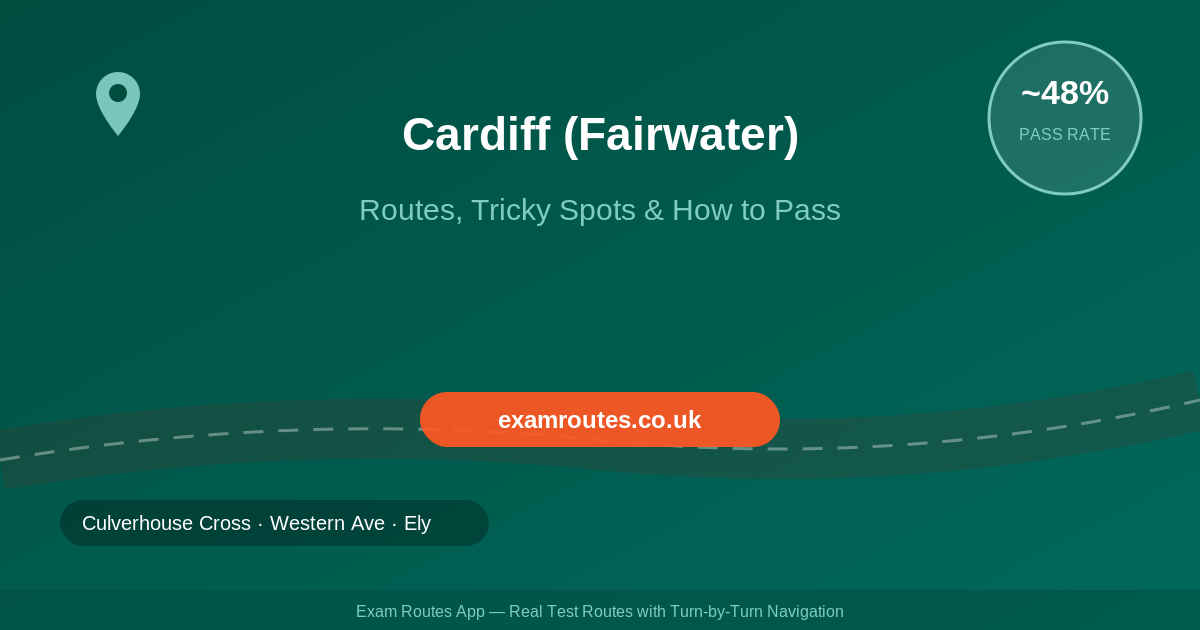
Cardiff has two car test centres, and Fairwater is the western one — a small centre on Norbury Road serving Ely, Llandaff, Pentrebane, Canton and the villages out towards St Fagans. Learners often prefer it to the Llanishen centre because the residential streets feel calmer, but that impression only holds until you meet Culverhouse Cross.
This 2026 guide covers the roads examiners genuinely use from Norbury Road, the two or three junctions that account for most of the serious faults, honest pass rate context and a practical plan for the weeks before your test.
About Cardiff (Fairwater) Driving Test Centre
Test type: Category B (car) practical test
Typical pass rate: approximately 48% — check GOV.UK for the current DVSA figure
The centre is a modest building on Norbury Road in Fairwater, a residential area west of Cardiff city centre. Parking is on-street and the surrounding roads are narrow, so arrive with enough time to find a sensible space.
Facilities are basic — a waiting area and toilets. Around ten minutes early is right.
Bring your photocard licence. Welsh test centres follow exactly the same DVSA rules as the rest of Great Britain, and examiners may conduct the test in Welsh if you request it when booking.
The Routes: Roads You Can Expect at Cardiff (Fairwater)
Fairwater routes typically start on quiet residential roads, build up through Ely and Canton, and often include at least one visit to a large multi-lane roundabout. Expect roughly half urban 30mph, a quarter residential and a quarter faster A-road and roundabout work.
- Norbury Road, Fairwater Road and St Fagans Road: the start and finish. Narrow, with parked cars and pedestrians.
- Cowbridge Road West and East (A48): the main east–west corridor. Bus lanes, crossings, side turnings and a lot of stop-start traffic.
- Western Avenue (A48): the faster section, with slip roads and multi-lane traffic heading towards Llandaff and Gabalfa.
- Ely Bridge roundabout: a busy junction linking Cowbridge Road with Western Avenue.
- Culverhouse Cross (A48 / A4232): the big one — a large multi-lane grade-separated roundabout complex.
- Pentrebane and Waterhall Road: quieter roads used for manoeuvres and the independent driving section.
Remember that the DVSA stopped publishing official test routes in 2010, so nobody can hand you an exact turn-by-turn list of what the examiner will ask for. What you can do is practise the roads that appear again and again, so that whichever combination you get, none of it is new.
Tricky Spots and Common Challenges
Culverhouse Cross
This is the junction that decides a lot of Fairwater tests. Multiple lanes, high approach speeds and heavy traffic joining from the A4232. The answer is preparation, not bravery: know which lane you need before you arrive, signal at the right point and hold your lane through the roundabout without drifting.
Bus lanes on Cowbridge Road
Cardiff runs bus lanes with specific operating hours along this corridor. Read the sign each time — assuming a lane is open because it was last week is how candidates pick up faults.
Ely Bridge roundabout
Lane selection and observation both matter here, and traffic often queues back. Do not follow the vehicle in front blindly onto the roundabout; make your own observation.
Narrow Fairwater residential streets
Parked cars on both sides with limited passing space. Meeting oncoming traffic properly — deciding early, positioning where you can see, waiting patiently — is a genuine skill here.
Western Avenue slip roads
Joining requires you to build speed and merge in one smooth sequence with mirror and blind spot checks. Practise until it feels routine.
Practise Real Test Routes on Your Phone
The Exam Routes App gives you access to real driving test routes with turn-by-turn navigation. Practise at your own pace and build confidence before test day.
Pass Rates and Statistics
Fairwater generally records a pass rate around the high 40s, close to the Great Britain average of roughly 50% for car tests in the year to March 2026, and usually a touch higher than Cardiff’s Llanishen centre. Wales as a whole tends to sit slightly above the England figure.
It is worth keeping pass rates in perspective. A centre’s percentage reflects the mix of candidates who book there as much as the roads themselves — centres serving big cities attract more first-time-nervous learners and more people booking before they are truly ready. The examiners apply exactly the same DL25 marking standard everywhere in Great Britain.
| Measure | Figure |
|---|---|
| Cardiff (Fairwater) pass rate (approx.) | 48% |
| Great Britain average (year to March 2026) | around 50% |
| Driving faults allowed | up to 15 |
| Serious or dangerous faults allowed | 0 |
| Test length | approximately 38–40 minutes |
Top Tips for Passing at Cardiff (Fairwater)
- Drive Culverhouse Cross from every approach until the lane choices are automatic.
- Learn the Cowbridge Road bus lane hours for your test time of day.
- Practise moving off and stopping on the narrow Fairwater streets with real parked cars.
- Do at least one lesson that includes joining Western Avenue from a slip road.
- Rehearse the sat nav independent driving section around Pentrebane, where the turnings come quickly.
- If you want the test conducted in Welsh, request it when you book — it cannot be arranged on the day.
- Book a mock test at the same time of day as the real thing so the traffic matches.
How the Exam Routes App Can Help
The Exam Routes App gives you real driving test routes with turn-by-turn navigation, so you can practise the roads around Cardiff (Fairwater) in your own time rather than guessing. Instead of paying for lessons just to discover which junctions exist, you arrive at each lesson already knowing the layout — and you spend the time working on your driving instead.
- Follow real routes with voice-guided turn-by-turn navigation
- Practise with a supervising driver between paid lessons
- Build familiarity with the specific junctions and roundabouts near your test centre
- Repeat the sections you find hardest until they stop feeling difficult
Frequently Asked Questions
Where is Cardiff Fairwater driving test centre?
30 Norbury Road, Fairwater, Cardiff CF5 3AU, in west Cardiff.
Is Fairwater easier than Cardiff Llanishen?
Fairwater usually posts a slightly higher pass rate, but the routes include Culverhouse Cross, which is one of the most demanding junctions in the city. Choose the centre whose roads you have actually practised.
Will my test include Culverhouse Cross?
Not every route does, but many do. Treat it as likely and practise it properly.
Can I take my driving test in Welsh?
Yes. You need to request a Welsh-speaking examiner when you book your test; it cannot be arranged on the day.
What is the pass rate at Cardiff Fairwater?
It typically sits in the high 40% range. Current DVSA figures are published annually on GOV.UK.
Ready to Pass? Download Exam Routes Now
Join thousands of UK learners using the Exam Routes App to practise real test routes with turn-by-turn navigation before their big day.