Huddersfield is a hill town, and that single fact shapes everything about its driving test. Steep gradients turn ordinary tasks into precision exercises: a hill start on a 1-in-8 residential street, a parallel park on a slope, holding position at a queue on an incline without rolling back. Add the busy A62 ring road and the fast dual carriageway sections on Leeds Road, and you have a test area that demands genuinely broad competence.
If you are thinking about booking here, this guide covers what the routes involve, where candidates lose marks, what the pass rate suggests, and the practice that changes your odds.
About Huddersfield Driving Test Centre
The practical test centre is at Waverley House on Waverley Road, Huddersfield, in the HD1 postcode close to the town centre. Being central means two things: you are into real traffic within moments of setting off, and parking nearby is limited. Plan your arrival, and if a friend or instructor is dropping you off, agree a spot in advance rather than circling.
Take your photocard licence. If the car is yours rather than your instructor’s, check tax, insurance for the test, MOT, tyres, lights, L-plates and the examiner’s interior mirror before you leave home.
The Routes: What Huddersfield Actually Throws at You
Steep town hills
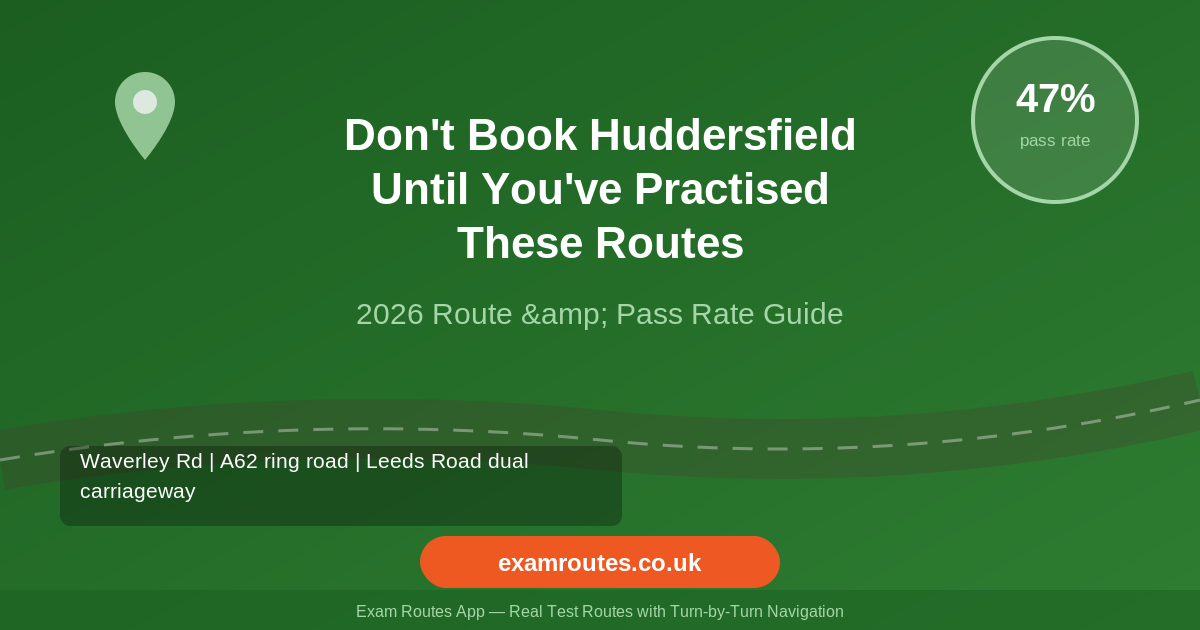
This is the defining Huddersfield feature. Routes climb and descend through areas such as Almondbury, Lindley, Marsh and Birkby, where gradients are steep enough that clutch control and handbrake technique stop being theoretical. Expect to be asked to move off on a hill, and expect to be stopped on one in traffic.
The A62 ring road
Huddersfield’s inner ring road gives you the multi-lane, quick-decision element of the test: lane selection on approach, signage read at speed, and exits that arrive faster than you expect. Circulating the ring road is where lane discipline faults are most commonly recorded.
Leeds Road (A62 corridor)
Heading north-east, Leeds Road offers fast dual carriageway driving with retail and industrial entrances feeding onto it. Two skills matter: joining and leaving at an appropriate speed, and making genuine progress. Driving a 50 or 60mph dual carriageway at 40mph is not cautious, it is a fault.
Residential and rural fringes
Narrow terraced streets with cars parked both sides bring meeting traffic and give-and-take decisions. Push further out and the roads towards the Colne and Holme valleys turn rural, with bends, gradients and limited visibility.
Tricky Spots and Common Challenges
- Hill starts under pressure. Rolling back more than a car’s length, or riding the clutch to hold position, both get marked. Handbrake, find the bite, release — and do it the same way every time.
- Parallel parking on a slope. Local candidates consistently report this as the hardest manoeuvre here. Practise it on a gradient, not just on the flat.
- Roundabout lane changes. Huddersfield learners report this as their most common difficulty. Decide your lane early, hold it through the exit, and mirror-check before any change.
- Steep descents. Coasting downhill with the clutch down or in neutral is a classic fault. Stay in gear and let engine braking help you.
- Narrow terraced streets. Meeting oncoming traffic where only one car fits requires a decision. Make it early and clearly.
- Speed on the dual carriageway. Undue hesitation on Leeds Road is as costly as speeding through a 30.
Practise Real Test Routes on Your Phone
The Exam Routes App gives you access to real driving test routes with turn-by-turn navigation. Practise at your own pace and build confidence before test day.
Pass Rates and Statistics
Huddersfield’s practical pass rate is reported at approximately 47.2%, against a national figure that has recently sat around 48–50%. That is slightly below average but well within the normal band for a busy northern town centre.
The interesting part is why. Huddersfield does not have unusually aggressive traffic or bizarre junction layouts. What it has is topography. A candidate who has practised hill starts a handful of times on a gentle slope will be exposed by a genuinely steep one, and manoeuvres performed on a gradient demand finer clutch control than the same manoeuvres on the flat. The gap between the local rate and the national average is largely a preparation gap, and that is good news — it is fixable.
Your test will last around 38 to 40 minutes and includes roughly 20 minutes of independent driving, either following a sat nav or road signs to a destination.
Top Tips for Passing at Huddersfield
- Find the steepest hill you can and practise there. If you can hill start on the worst gradient in the area, everything on test day feels manageable.
- Do every manoeuvre on a slope. Parallel park uphill, parallel park downhill, and pull up on the right on a gradient.
- Drill the ring road. Circulate the A62 ring road repeatedly from different entry points until lane choices are instinctive.
- Practise joining and leaving Leeds Road. Match your speed to the traffic when merging, and plan your exit well ahead.
- Stay in gear downhill. Make engine braking a habit, not an afterthought.
- Rehearse independent driving with a sat nav. Get used to glancing at a screen without losing road focus — missing a turn is not a fault, but a panicked reaction to missing one might be.
- Test at your practice time of day. Huddersfield town centre at rush hour is a different test to mid-morning.
How the Exam Routes App Can Help
Huddersfield’s routes are hard to guess at from a map, because the difficulty lives in specific gradients and specific junction sequences. The Exam Routes App puts real test routes for UK test centres on your phone with turn-by-turn navigation, so you can drive the hills, the ring road and the Leeds Road corridor exactly as they appear on test. Practising the real thing, repeatedly, is what turns a below-average pass rate into your pass.
Key Takeaways
- Huddersfield’s pass rate is around 47%, marginally below the national average
- Steep gradients are the defining local challenge — hill starts and manoeuvres on slopes
- The A62 ring road tests lane discipline; Leeds Road tests progress on dual carriageways
- Local candidates most commonly struggle with roundabout lane changes and parallel parking on hills
- Tests run about 38–40 minutes including roughly 20 minutes of independent driving
Frequently Asked Questions
What is the pass rate at Huddersfield driving test centre?
Approximately 47.2%, slightly below a national average of around 48–50%.
Where is Huddersfield driving test centre?
Waverley House, Waverley Road, Huddersfield, in the HD1 postcode near the town centre. Nearby parking is limited, so plan your drop-off.
Are Huddersfield test routes hilly?
Yes. Steep gradients are the single most distinctive feature of the area. Expect hill starts, stopping on inclines and manoeuvres performed on slopes.
Does the Huddersfield test include dual carriageways?
Commonly, yes — the Leeds Road corridor provides fast dual carriageway sections. Motorways are not part of the practical test.
How long is the practical test at Huddersfield?
Around 38 to 40 minutes, including about 20 minutes of independent driving using either a sat nav or road signs.
Ready to Pass at Huddersfield? Download Exam Routes
Practise the hills, the ring road and the Leeds Road corridor before test day. The Exam Routes App gives you real test routes with turn-by-turn navigation.