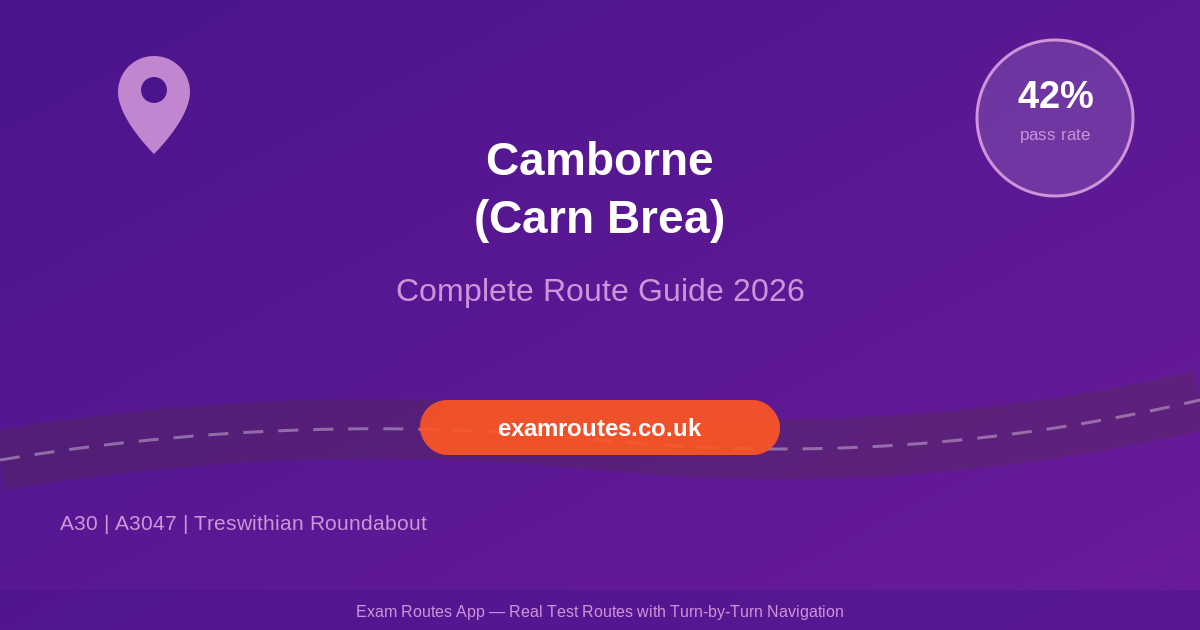
Cornwall’s test centres have a reputation for gentle country lanes and forgiving traffic. Camborne is the exception. Now operating from the Carn Brea Hubb site at Pool, near Redruth, this centre sends candidates onto 70 mph A30 slip roads, through a knot of mini-roundabouts in Pool, and out onto narrow lanes with hedged blind bends — sometimes all within a single 40-minute test.
The pass rate reflects that variety: around 42%, several points below the national average. This guide walks through the centre, the roads, the specific spots that catch learners out, and a realistic preparation plan for passing at Camborne in 2026.
About Camborne (Carn Brea) Test Centre
The centre operates from Carn Brea Hubb, Station Road, Pool, Redruth, Cornwall, TR15 3QS. It replaced the long-standing Wilson Way site, and its position beside the A3047 means you are within reach of the A30 dual carriageway almost immediately.
Take your provisional licence photocard. If you are using your own vehicle, check the basics the day before: tax, insurance covering the test, MOT, tyre tread and pressures, all lights working, and a clean windscreen. Cornwall’s coastal weather means salt and road film build up quickly, and a dirty screen into low sun on the A30 is genuinely dangerous as well as a potential cancellation.
Waiting times here have recently sat around 15 weeks. If you are flexible, Bodmin and Launceston are the nearest alternatives, though both bring their own rural challenges.
The Routes: Roads You Can Expect
Camborne routes are built from three distinct environments, and the transitions between them are where most faults happen.
The A30 dual carriageway
Slip roads from the A3047 put you onto a 70 mph dual carriageway. You need a confident, properly observed merge, a settled position in the left-hand lane, and safe judgement if you need to overtake. Joining too slowly is as much of a problem as joining without checking.
The A3047 through Pool and Camborne
The old main road linking Camborne, Pool and Redruth. Busy, commercial in places, with retail entrances, bus stops and pedestrians. Speed limits change repeatedly along its length.
Pool mini-roundabouts
Pool has a cluster of mini-roundabouts and closely spaced junctions. Mini-roundabouts require you to treat the painted circle as a real roundabout, give way to the right, and signal correctly — and doing three in succession without a lapse of concentration takes practice.
Tehidy Road and the lanes north of Camborne
Tight bends, restricted visibility, hedges to the nearside and occasional oncoming vehicles taking more than their share of the road. Speed choice for the bend ahead — not the bend you are in — is what is being assessed.
Treswithian and the Camborne approaches
The Treswithian roundabout is a regular feature, with multiple exits and enough traffic to require decisive gap acceptance. Church Street and the town-centre approaches add congestion and parked-car obstructions.
Quick tip: The gradient around Carn Brea means hill starts are a live possibility at any point on your test. Practise moving off uphill on a real slope with traffic behind you, not on a flat car park.
Tricky Spots & Common Challenges
- Joining the A30. Building speed on the slip road while checking over your shoulder, then merging into a 70 mph flow. Nervous candidates arrive at the give-way far too slowly.
- Leaving the A30. Getting into the deceleration lane before braking, not braking in the running lane. A common serious fault.
- Pool mini-roundabouts in sequence. Correct signalling on each, no cutting across the painted circle, and awareness of the next one already approaching.
- Tehidy Road bends. Entering too fast, then braking mid-bend. Slow in, gentle out.
- Hill starts around Carn Brea. Rolling back, or over-revving and lurching. Clutch control under pressure.
- Narrow lanes with passing places. Deciding early whether to hold back or proceed, and reversing calmly if needed.
- Low sun and sea mist. West Cornwall mornings can serve up both. Use your visor, keep the screen clean, and slow down when visibility drops.
Pass Rates & Statistics
Camborne has been running at roughly 42%, against a national average nearer 48–49%. Within Cornwall it sits below Launceston (around 46%) and Bodmin (around 44%), and well below the small island and rural centres that top the national table.
The reason is straightforward. A Camborne test asks a candidate to switch between 70 mph dual carriageway, 30 mph town centre and single-track lane inside forty minutes. Each transition is an opportunity for a speed or observation fault. Centres with a narrower range of road types simply present fewer of those moments.
Practically, that means your preparation needs breadth. A learner who is excellent in town but has never merged onto the A30 is not ready for Camborne, and neither is one who is confident on dual carriageways but tentative in the lanes.
Practise Real Test Routes on Your Phone
The Exam Routes App gives you access to real driving test routes with turn-by-turn navigation. Practise at your own pace and build confidence before test day.
Top Tips for Passing at Camborne
- Log real A30 time. Join and leave the dual carriageway repeatedly until merging feels ordinary.
- Drill the Pool mini-roundabouts as a set. Doing them in sequence is a different skill from doing one in isolation.
- Practise bend speed on Tehidy Road. Ask your instructor to comment on your entry speed rather than correcting it, so you learn to judge for yourself.
- Master uphill moving off. Find a real gradient near Carn Brea and repeat until there is no roll-back.
- Rehearse the lanes. Meeting a tractor on a single-track road is a Cornish certainty. Know where the passing places are and reverse without drama.
- Watch your speed on the A3047. Limits change more often than you think along that corridor.
- Book a time of day you have practised. Summer traffic through Pool in August is a different road from February.
How the Exam Routes App Can Help
Camborne rewards familiarity more than most centres, because so much of the difficulty is in the transitions. The Exam Routes App gives you real test routes with turn-by-turn navigation, so you can rehearse the exact sequence — estate to A3047, A3047 to A30, A30 back into Pool — until the changes of pace feel expected rather than jarring.
Practise with a supervising driver in the weeks before your test and you arrive knowing where the mini-roundabouts stack up and where the bends tighten.
Frequently Asked Questions
Where is the Camborne driving test centre now?
Carn Brea Hubb, Station Road, Pool, Redruth, Cornwall, TR15 3QS. It sits beside the A3047 with quick access to the A30, and replaced the former Wilson Way site.
What is the Camborne pass rate in 2026?
Around 42% in recent DVSA data, a few points below the national average of roughly 48–49%. The wide mix of road types on each test is the main reason.
Will my test go on the A30?
Very often, yes. The centre’s position beside the A3047 makes dual-carriageway sections a regular feature, so confident merging and lane discipline at 70 mph are essential.
Are there single-track roads on Camborne test routes?
Some routes include narrow lanes north of Camborne with passing places and limited visibility. Know how to hold back, use a passing place, and reverse calmly if you meet an oncoming vehicle.
Is Bodmin or Launceston an easier alternative?
Their pass rates are slightly higher, but both include their own rural challenges and mean travelling further. Practising the Camborne road types is usually a better use of your time than switching centre.
Get the Edge on Test Day in Cornwall
Download the Exam Routes App and practise the real Camborne routes — A30 slip roads, Pool mini-roundabouts and all — before your test.