Leeds (Colton Mill) 2026: The Complete Route Guide to Passing Your Driving Test
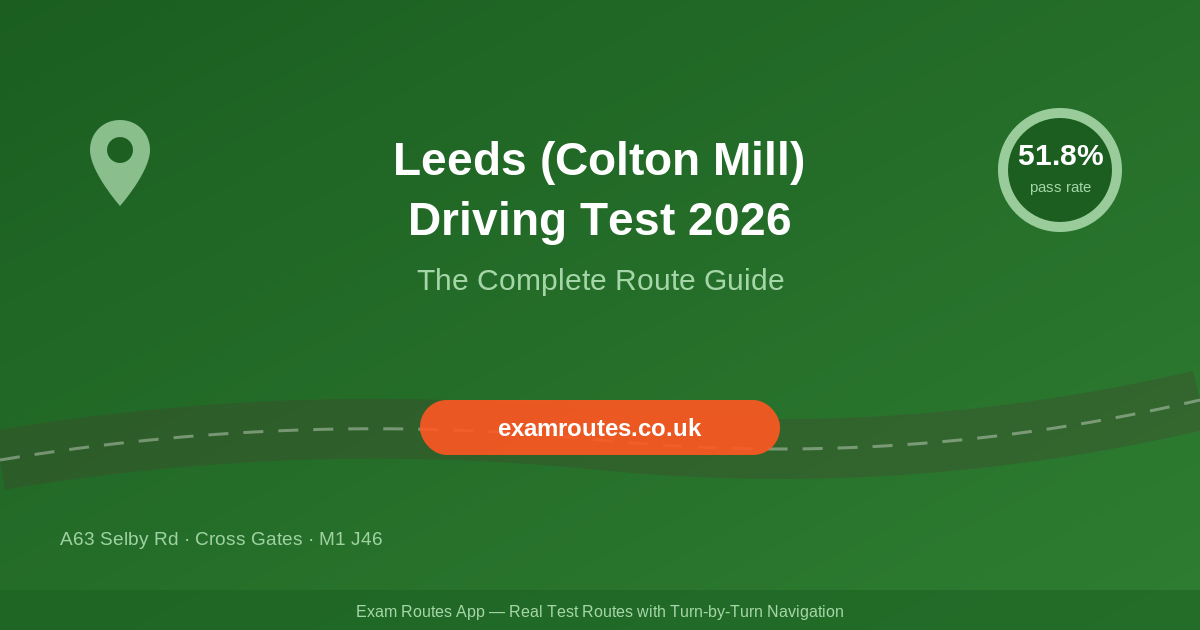
Colton Mill is the busier of Leeds’ two east-side test centres and one of the larger centres in Yorkshire, running 6,432 car tests in the DVSA year to March 2026. Its pass rate of 51.8% is 1.7 points above the 50.1% national average, and the average wait of 6.6 weeks is roughly half the national figure of 12.1 weeks. On the numbers, it is one of the more accessible big-city centres in the north of England.
What makes Colton Mill interesting is the geography. Sit at the test centre and within ten minutes you can be on a 70mph dual carriageway, a village lane with no white line down the middle, or a retail park service road full of shoppers reversing out of bays. Examiners use all three. This guide covers the roads, the junctions that cost people their test, and how to prepare for each of them.
About Leeds (Colton Mill) Test Centre
The centre serves east Leeds from the Colton area, close to the A63 Selby Road corridor and within easy reach of Cross Gates, Whitkirk, Halton and the Thorpe Park development. Check your booking confirmation for the exact address and postcode before you travel; east Leeds has changed a great deal with the link road and retail development, and satellite navigation is not always current.
Parking is usually manageable but fills up on the hour as tests change over. Give yourself 15 minutes. Bring your provisional photocard licence. Make sure the car has a valid MOT if it is over three years old, no warning lights showing on the dashboard, legal tread on all four tyres, L plates front and rear, and a passenger-side mirror for the examiner.
Around 34.4% of the 24-week booking window still had free slots at the last DVSA release, which is unusually generous for a centre this size. If you are flexible on dates, Colton Mill is one of the easier northern centres to actually get into.
The Routes
A63 Selby Road. The main artery east out of Leeds. Fast-moving, multi-lane in places, with signal-controlled junctions and traffic filtering on and off. Expect at least one stretch of it. Speed limit changes along its length catch learners who drive on memory rather than signs.
Bullerthorpe Lane and the M1 J46 approaches. Open, faster roads on the edge of the city with national speed limit sections, sweeping bends and limited overtaking opportunity. This is where examiners assess whether you can make appropriate progress rather than crawl.
Cross Gates, Austhorpe and Whitkirk. Dense suburban Leeds: parked cars, mini-roundabouts, bus routes, schools and 20mph zones. The manoeuvre is often set somewhere in here, and so is the pull-up-on-the-right exercise.
Barwick-in-Elmet, Scholes and the rural fringe. Narrow country lanes with hedgerows, blind bends, farm entrances and mud on the road. Some routes take you out here specifically to see whether you slow down for what you cannot see.
Manston Lane and the Thorpe Park link. Newer road layouts with fresh markings, multi-lane roundabouts and retail-park entrances. Good drivers read the signs; nervous drivers follow the car in front.
Tricky Spots & Common Challenges
The A63 speed limit changes. Selby Road shifts between limits along its length. Missing a repeater sign after a junction is a common way to pick up a speeding fault without realising it.
The Colton roundabout complex. Multi-lane, with retail traffic joining and leaving unpredictably. Choose your lane on approach from the sign, not from where the car ahead goes.
Emerging from side roads onto Selby Road. Fast approaching traffic and restricted visibility mean gap judgement is everything. Waiting for a gap that never comes is hesitation; taking one that is not there is a serious fault.
Country lanes towards Barwick-in-Elmet. Single-track sections with passing places, blind summits and oncoming vehicles that do not slow down. Positioning and speed on approach to bends is what is being marked.
Cross Gates parked-car sections. Give-and-take driving in tight residential streets, often with buses on the same road.
20mph zones around schools. East Leeds has extensive 20mph coverage. Watch for the entry signs on residential turns.
Practise Real Test Routes on Your Phone
The Exam Routes App gives you access to real driving test routes with turn-by-turn navigation. Practise at your own pace and build confidence before test day.
Pass Rates & Statistics
Colton Mill’s 51.8% for 2025-26 came from 6,432 tests and 3,332 passes. The monthly figures show a centre that hovers around and slightly above the national line: 52.6% in March 2026, 56.6% in February, 54.4% in January, but 47.4% back in July 2025. That spread is normal and mostly reflects who is taking tests in a given month rather than anything about the routes.
Against its neighbours:
- Bradford (Heaton) — 56.1%
- Leeds (Colton Mill) — 51.8%
- Leeds (Fearnville) — 51.8%
- Horsforth — 49.7%
- Bradford (Thornbury) — 47.8%
- Heckmondwike — 45.8%
- Wakefield — 45.4%
Top Tips for Passing at Colton Mill
- Drive the A63 in both directions. The junctions and limit changes look completely different eastbound and westbound.
- Practise national speed limit roads. Bullerthorpe Lane and the lanes towards Barwick are where hesitant drivers lose marks for lack of progress.
- Rehearse emerging onto fast roads. Spend a lesson doing nothing but right turns out of side roads onto Selby Road.
- Read signs, not the car in front. On the Colton and Thorpe Park roundabouts, the vehicle ahead of you is frequently in the wrong lane.
- Do the manoeuvres in Cross Gates. Real parked cars, real camber, real pressure — far more useful than an empty side street.
- Slow for blind bends on the rural sections. If you cannot see the road ahead, the examiner expects your speed to reflect that.
- Use the free slots. With around a third of the booking window unbooked, you can often move your test earlier if you keep checking.
How the Exam Routes App Can Help
Colton Mill routes cover a genuinely wide area, and no learner covers all of it by accident. The Exam Routes App gives you real test routes with turn-by-turn navigation, so you can spend a practice session driving the A63, the Colton roundabout and the Barwick lanes in sequence, exactly as the test does. Repetition on the right roads beats hours on the wrong ones.
Frequently Asked Questions
What is the pass rate at Leeds (Colton Mill)?
51.8% for the DVSA year April 2025 to March 2026, from 6,432 car tests. That is 1.7 points above the 50.1% national average.
How long is the wait for a driving test at Colton Mill?
The average wait between booking and testing was 6.6 weeks in June 2026, roughly half the 12.1-week national average.
Is Colton Mill or Fearnville better?
Both passed 51.8% in 2025-26. Colton Mill is busier with a shorter wait and more rural and dual-carriageway driving; Fearnville routes are more consistently urban.
Do Colton Mill routes use the motorway?
Practical test routes do not go onto the M1 itself, but several routes use the fast roads and roundabouts around junction 46.
What manoeuvre am I most likely to get?
Any of the four DVSA manoeuvres can come up. At Colton Mill, parallel parking and pulling up on the right are commonly set in the Cross Gates and Whitkirk residential streets.
Get the Edge on Test Day in Leeds
Stop guessing which roads the examiner will use. The Exam Routes App maps the routes learners actually get tested on, with turn-by-turn navigation you can follow on a normal practice drive.