Newport (Gwent) Driving Test 2026: Pass Rates Revealed – Plus the Routes You Need to Know
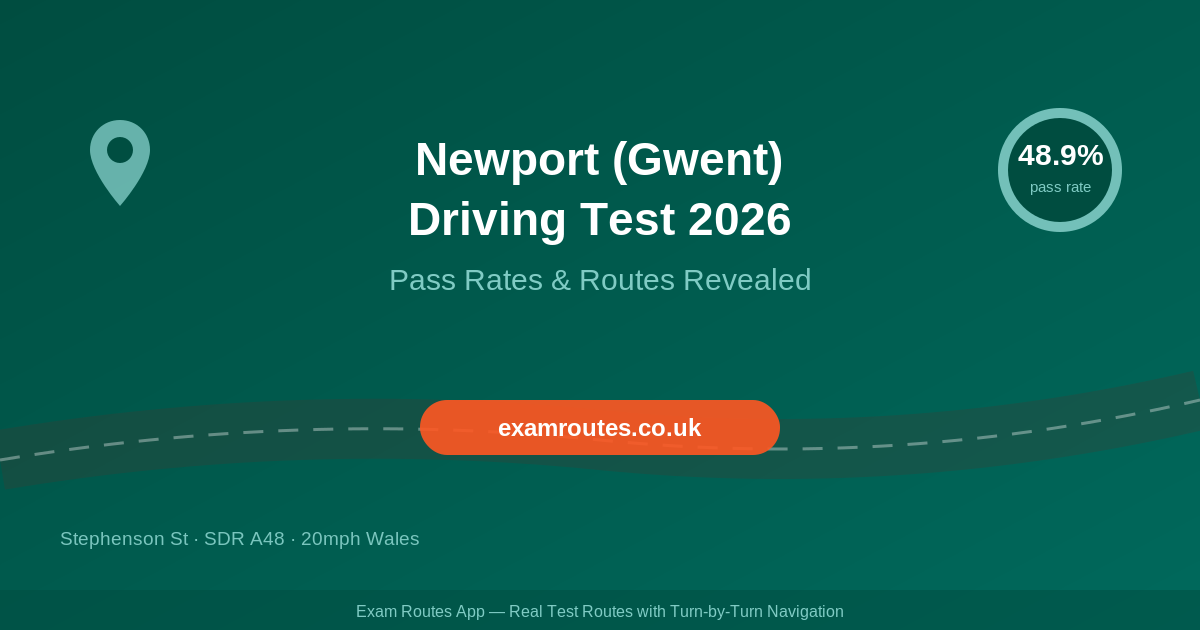
Newport is one of the busiest test centres in Wales. It conducted 8,227 car tests in the DVSA year April 2025 to March 2026 and passed 48.9% of them — 1.2 points below the 50.1% national average. That is a step down from the 51% it managed in 2024-25, and the monthly pattern shows why: the centre has sat in the high 40s almost every month since the summer of 2025.
Newport is not an unusually harsh centre. It is a genuinely demanding driving environment: a city with a heavy industrial fringe, a dense one-way system, a fast southern distributor road, a river with a limited number of crossings, and Wales’ default 20mph limit on most restricted roads. Get comfortable with those five things and the test becomes a normal drive.
About Newport (Gwent) Test Centre
The centre is on Stephenson Street in Liswerry, in the south-east of the city near the docks and industrial estates, postcode NP19 4XH. Confirm this against your GOV.UK booking confirmation before you travel.
The surrounding area is industrial, which means HGVs, works traffic and lorry entrances from the moment you pull out. Allow 15 minutes to park and settle. Bring your provisional photocard licence. The car must have a valid MOT if it is over three years old, no dashboard warning lights, legal tyres, L plates front and rear, and a passenger-side interior mirror for the examiner.
Waiting times are reasonable by national standards: 7.3 weeks in June 2026 against 12.1 weeks nationally, with around 19.8% of the 24-week booking window still unbooked.
The Routes
Liswerry and the industrial estates. Straight out of the centre: wide roads, lorry access points, roundabouts serving warehouses, and vehicles pulling out of yards. Observation and anticipation start immediately.
Corporation Road and Spytty Road. Busy urban roads linking Liswerry with the retail parks and the city. Bus stops, crossings, side roads and frequent 20mph sections.
The Southern Distributor Road (A48 SDR). Newport’s fast east-west route, with large roundabouts, dual carriageway sections and slip roads. This is where lane discipline, merging and appropriate progress are assessed.
The river crossings. George Street Bridge and the city centre crossings funnel traffic and create lane commitment points. Choosing the wrong lane on the approach is very hard to undo.
Chepstow Road, Maindee and Caerleon. Older residential Newport: narrow streets, terraced parking, hills and awkward junctions. Manoeuvres are frequently set here.
Malpas and Bettws. Northern suburbs with steeper gradients, mini-roundabouts and estate roads — a good place to be asked for a hill start or an angle start.
Tricky Spots & Common Challenges
The default 20mph limit. Since Wales moved to a 20mph default on most restricted roads, speed awareness has become the fastest way to fail in Newport. Some roads have been returned to 30mph, so you cannot assume either — you must read signs.
SDR roundabouts. Multi-lane, fast approach, and heavy traffic. Read the sign, choose the lane on approach, hold it through.
Merging onto the dual carriageway. Matching speed on a slip road is a skill many learners have barely practised. Too slow is as dangerous as too fast.
The city one-way system. Multiple lanes, quick-fire signs and short distances between decisions. Learners who look only at the road surface miss the overhead signage.
HGVs around the docks. Large vehicles taking wide lines at roundabouts near the industrial estates. Give them room and do not sit alongside.
Hills in Malpas and Bettws. Hill starts on a gradient with traffic behind is where clutch control gets exposed.
Practise Real Test Routes on Your Phone
The Exam Routes App gives you access to real driving test routes with turn-by-turn navigation. Practise at your own pace and build confidence before test day.
Pass Rates & Statistics
Newport’s 48.9% for 2025-26 came from 8,227 tests and 4,021 passes. The ten-year picture shows a centre that moves within a fairly narrow band: 44.5% in 2018-19, 46.7% in 2019-20, a pandemic-inflated 53.8% in 2020-21, 46.6% and 46.2% in the two years after, then 51% in 2024-25 before this year’s 48.9%.
Set against nearby centres, Newport looks tough — but that is a function of urban roads, not examiners:
- Abergavenny — 64.2%
- Weston-super-Mare — 61%
- Barry — 57%
- Newport (Gwent) — 48.9%
- Gloucester — 47.8%
- Cardiff (Llanishen) — 46.5%
Note the pattern. Rural and small-town centres in south Wales sit well above the national average; the two big cities sit below it. That is the same story as everywhere else in Britain.
Top Tips for Passing at Newport
- Treat every restricted road as 20mph until a sign says otherwise. In Wales that is now the default, and speed faults are the easiest to avoid.
- Practise the SDR in traffic. Merging and lane choice on the A48 is the single biggest technical demand of the test here.
- Learn the one-way system on foot or as a passenger first. Understanding the layout before you drive it removes most of the panic.
- Do hill starts in Malpas or Bettws. Real gradients with real traffic behind you, not a gentle slope on a quiet street.
- Give lorries space near the docks. Never sit in an HGV’s blind spot at a roundabout.
- Practise manoeuvres in Maindee. Terraced streets with tight parking are exactly where the examiner will ask.
- Check your mirrors before every signal. Newport routes are mirror-intensive; examiners notice when the routine slips.
How the Exam Routes App Can Help
Newport’s routes cover a lot of ground, from the docks to Caerleon, and no learner stumbles across all of it by chance. The Exam Routes App maps real driving test routes with turn-by-turn navigation, so you can spend practice hours on the SDR roundabouts, the George Street Bridge approach and the Maindee streets, rather than hoping they come up.
Frequently Asked Questions
What is the pass rate at Newport (Gwent) test centre?
48.9% for the DVSA year April 2025 to March 2026, from 8,227 car tests — 1.2 points below the 50.1% national average.
How long is the wait for a driving test in Newport?
The average booking-to-test wait was 7.3 weeks in June 2026, well below the 12.1-week national average.
Does the 20mph default in Wales apply on the driving test?
Yes. Wales’ 20mph default on restricted roads applies exactly as it does to any other driver, and exceeding it can be marked as a serious fault.
Where is Newport driving test centre?
Stephenson Street, Liswerry, Newport, NP19 4XH — always confirm on your booking confirmation.
Is Cardiff or Newport easier?
Newport passed 48.9% last year against Cardiff (Llanishen) at 46.5%, so Newport is marginally higher — but both are demanding urban centres and the difference is small.
Don’t Book Newport Until You’ve Practised These Routes
Stop guessing which roads the examiner will use. The Exam Routes App maps the routes learners actually get tested on, with turn-by-turn navigation you can follow on a normal practice drive.