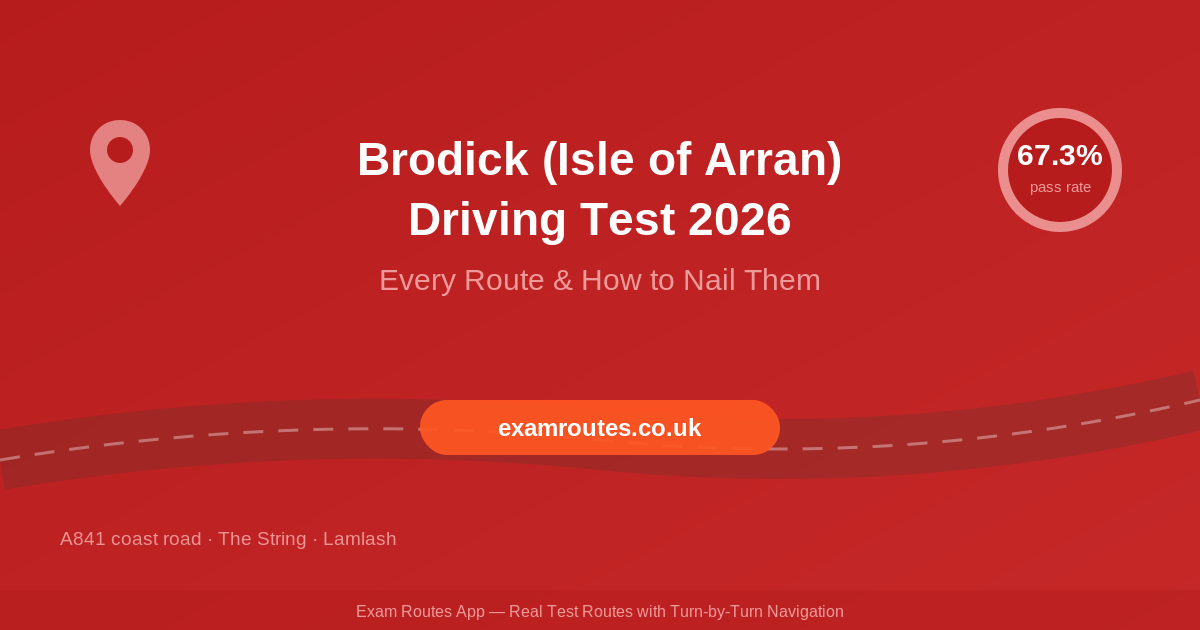
First Time at Brodick (Isle of Arran)? Here’s Every Route and How to Nail Them in 2026
Arran is one of the smallest driving test operations in Great Britain. In the DVSA year April 2025 to March 2026 the island hosted just 55 car tests, of which 37 passed — a 67.3% pass rate, a full 17.2 points above the 50.1% national average. On paper it is one of the easiest places in Britain to pass. In practice, the challenge is different from a city test, not absent.
The catch is availability. The average wait between booking and testing in June 2026 was 19.1 weeks, seven weeks longer than the national average, because examiners travel to the island and test days are limited. If you are learning on Arran, you book early or you wait.
About the Brodick Test Centre
Tests on Arran are conducted from Brodick, the island’s main village and ferry port. DVSA lists this as an area rather than a permanent staffed building, so the meeting point on your booking confirmation is the address that matters — check it carefully and, if you are travelling over on the ferry, build in a generous margin for a delayed sailing.
Everything else is standard. Bring your provisional photocard licence. Your car needs a valid MOT if it is over three years old, no dashboard warning lights, legal tyres, L plates front and rear, and a passenger-side interior mirror. Salt and weather take a toll on island cars, so check your lights and wipers the day before rather than the morning of.
Only around 6.1% of the 24-week booking window still had free slots at the last release. Arran test dates are genuinely scarce.
The Routes
The A841 coast road. This is the island’s ring road and the backbone of every test. It runs Brodick to Lamlash to Whiting Bay southbound, and Brodick to Corrie and Sannox northbound. Two-way for most of its length but frequently narrow, with sharp bends, blind summits, rock faces on one side and a drop to the shore on the other.
Brodick village. The ferry terminal, the shops, the pier road and the seafront. Pedestrian activity is high in summer, parking is on-street, and ferry traffic arrives in a surge rather than a trickle.
Lamlash. The island’s largest settlement after Brodick, with a long seafront, a school, a hospital and the sort of parked-car sections that make give-and-take driving unavoidable.
The String (B880). The road that cuts across the island from Brodick to Blackwaterfoot. Steep gradients, hairpin sections, cattle grids, single-track stretches with passing places and exposed moorland. If you get the String, hill starts and passing place etiquette are being assessed.
Estate and side roads around Brodick. Where manoeuvres are usually set — often on a camber or gradient.
Tricky Spots & Common Challenges
Passing places on single-track sections. The rule is simple and the execution is not: pull into the passing place on your left, or stop opposite one on your right. Never reverse into one at the last moment, and always thank the driver who waited.
Blind bends on the coast road. If you cannot see the exit, your speed must reflect it. Examiners mark speed for the conditions, not the number on the sign.
Livestock and deer. Sheep on the road are routine on Arran, red deer appear at dawn and dusk. Slowing early and giving space is expected.
Cattle grids. Slow to cross them properly. Hitting one at speed is uncomfortable and reads as poor observation.
Ferry surge traffic. When a CalMac sailing docks, Brodick goes from empty to busy in about ninety seconds. If your test coincides, expect queues, hesitant tourists and cars stopping unexpectedly.
Weather. Arran gets a lot of rain and coastal wind. Standing water on the A841 and gusts on exposed sections both demand a change in speed and grip on the wheel.
Practise Real Test Routes on Your Phone
The Exam Routes App gives you access to real driving test routes with turn-by-turn navigation. Practise at your own pace and build confidence before test day.
Pass Rates & Statistics
Brodick’s 67.3% in 2025-26 is high, but the monthly detail shows how volatile a tiny centre is: 81.8% in February 2026, 55.6% in November 2025, 81.8% in October 2025 — and just 25% in April 2025. With single-figure test numbers in some months, one result swings the percentage by ten points or more.
The longer history tells the same story. Recent DVSA financial years for Arran include 54.7% in 2019-20, 62% in 2017-18, 47.7% in 2015-16 and 73.1% in 2013-14. Treat the headline rate as a description of the island’s roads, not a guarantee.
Against nearby centres reachable from the Clyde coast:
- Girvan — 72%
- Campbeltown — 71.6%
- Dunoon — 71.5%
- Brodick (Isle of Arran) — 67.3%
- Ayr — 57.5%
- Irvine — 55.7%
- Rothesay — 52%
Top Tips for Passing at Brodick
- Book the moment you are close to ready. With around 6% of slots free and a 19-week average wait, timing your booking is half the battle.
- Practise passing places until it is instinct. Decide early, signal your intention by slowing, and pull in fully.
- Drive the String at least three times. Gradients, cattle grids and hairpins are not something to meet for the first time on test day.
- Learn Brodick around a ferry arrival. Practise the village when it is actually busy, not at 8am on a Tuesday.
- Slow for what you cannot see. Blind summits and bends on the A841 are where speed faults are collected.
- Expect animals. Sheep, deer and the occasional cyclist on a narrow road. Anticipate rather than react.
- Check your car the day before. If you are relying on the ferry, a warning light on test morning leaves you no options.
How the Exam Routes App Can Help
Even on a small island, knowing which stretches of the A841 and which side roads examiners actually use turns vague practice into targeted practice. The Exam Routes App maps real driving test routes with turn-by-turn navigation, so you can drive the exact sequence — village, coast road, String, manoeuvre — before the day itself.
Frequently Asked Questions
What is the pass rate on the Isle of Arran?
67.3% for the DVSA year April 2025 to March 2026, from 55 car tests. That is 17.2 points above the 50.1% national average, but the small number of tests makes the figure volatile.
How long is the wait for a driving test on Arran?
The average wait was 19.1 weeks in June 2026, about seven weeks longer than the national average, because test days on the island are limited.
Is the Arran driving test easier?
The roads are quieter, but they demand skills city learners rarely practise: passing places, single-track etiquette, cattle grids, gradients and livestock.
Can I take my test on Arran if I live on the mainland?
Yes — there is no catchment area in Great Britain. Factor in the ferry crossing and the long wait for a slot.
What should I practise most before a Brodick test?
Passing places and blind bends on the A841, plus hill starts on the String. Those three cover most of what the routes test.
Ready to Pass? Download Exam Routes Now
Stop guessing which roads the examiner will use. The Exam Routes App maps the routes learners actually get tested on, with turn-by-turn navigation you can follow on a normal practice drive.