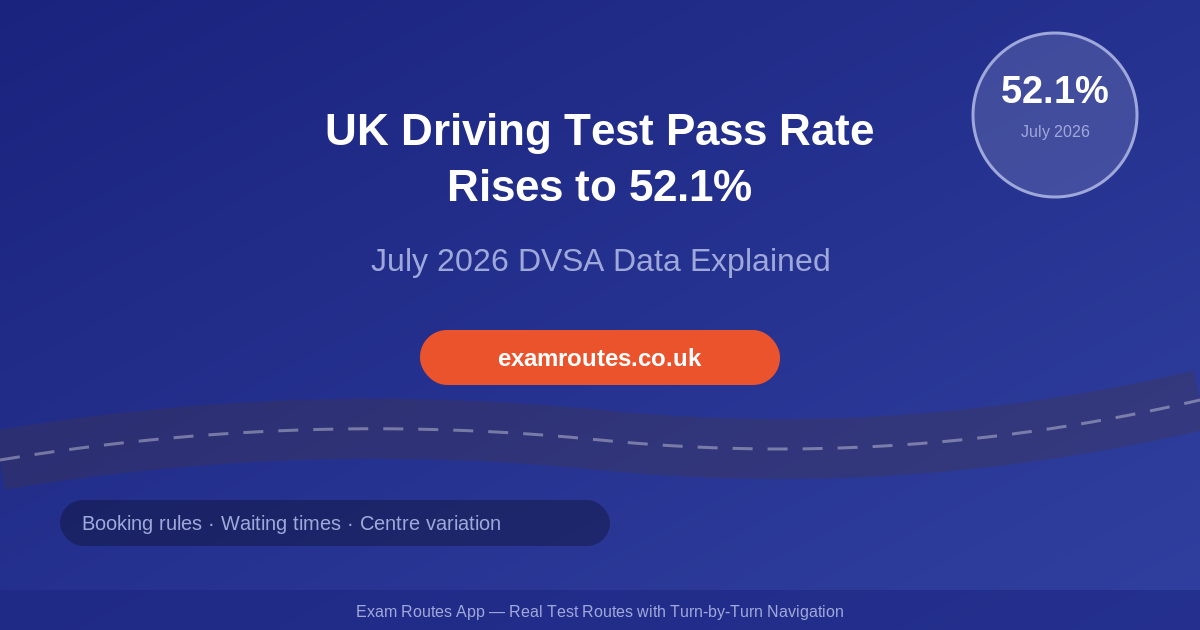
The DVSA has reported that the car practical driving test pass rate reached 52.1% in July 2026 — one of the highest monthly figures recorded in recent years, and a notable jump on the long-run average of around 48–50%. The agency framed it as evidence that learners and instructors are preparing better, and pointed candidates towards its “Ready to Pass?” readiness checklist.
A single month is not a trend. But this figure sits alongside a run of stronger results and a period of significant change in how tests are booked, so it is worth unpacking what is actually going on — and what it means if you have a test coming up.
The Headline Numbers
| July 2026 car pass rate | 52.1% |
|---|---|
| Recent long-run average | Around 48–50% |
| Historic pattern | The rate hovered near 45–48% for much of the 2010s |
| First-time pass rate | Consistently lower than the overall rate |
| Typical seasonal pattern | Summer months often outperform winter months |
Two caveats before reading too much into it. First, monthly figures are noisier than annual ones — a good July does not guarantee a good autumn. Second, summer months tend to flatter the numbers: longer daylight, better road conditions and more settled weather all help.
Why the Pass Rate Might Be Rising
1. The booking rule changes have reshaped who sits the test
2026 has brought a sequence of significant changes to how car practical tests are booked. From 31 March the number of times a learner can change a booking dropped from six to two. From 12 May only the learner themselves can book or manage their own car test. From 9 June, a booked test can only be moved to one of the three nearest test centres.
Taken together, these rules make it harder to grab a slot speculatively and then shuffle it around. The practical effect is that more of the people sitting the test are people who deliberately chose that date because they expected to be ready.
2. Long waits mean more preparation time
Waiting times remain a real problem — averages of around 20 weeks or more in many areas, with London and parts of the South East considerably worse. The unintended consequence is that candidates have far longer to prepare between booking and testing than they did before the backlog.
3. The cost of failing has gone up
With a long rebooking wait and the price of additional lessons, failing is expensive in both money and months. That pushes learners and instructors towards only presenting for test when genuinely ready — exactly what the DVSA’s “Ready to Pass?” campaign has been arguing for years.
4. Better preparation tools
Learners today have access to hazard perception practice, route familiarity resources and structured readiness checklists that simply did not exist a decade ago. Familiarity with local test roads in particular removes a large source of avoidable faults.
Practise Real Test Routes on Your Phone
The Exam Routes App gives you access to real driving test routes with turn-by-turn navigation. Practise at your own pace and build confidence before test day.
What This Does and Doesn’t Mean for You
- It does not mean the test has got easier. The marking standard is unchanged. The same serious and dangerous faults end tests as before.
- It does not mean your local centre is at 52%. Pass rates vary enormously by test centre — from below 35% at some urban centres to above 65% at remote rural ones.
- It does mean readiness is the key variable. The rise correlates with changes that filter out under-prepared candidates, not with any softening of standards.
- It does mean booking speculatively is now a poor strategy. With only two permitted changes and a restricted set of centres you can move to, booking before you are close to ready wastes a slot you cannot easily reclaim.
Test Centre Variation Still Dominates
National averages are useful for headlines and almost useless for planning. What matters to you is your test centre, and the spread is enormous.
| Highest-performing centres | Remote Scottish and island centres regularly exceed 65–70% |
|---|---|
| Lowest-performing centres | Several dense urban centres, particularly in London, sit in the mid-30s |
| Main driver of the gap | Traffic density, road complexity and candidate experience levels |
| Manual vs automatic | Manual pass rates run consistently higher nationally |
| Practical implication | Local road familiarity matters more than the national figure |
How to Put Yourself on the Right Side of the Statistic
- Only book when you are close to ready. With two permitted booking changes, a speculative slot is a wasted one.
- Use the DVSA’s readiness checklist. The ‘Ready to Pass?’ criteria are a genuine benchmark, not marketing.
- Practise the roads around your specific test centre. The national average tells you nothing about your route.
- Drive in the conditions you will be tested in. Same time of day, same weather range, same traffic level.
- Fix the common faults first. Junction observation, mirrors, steering control and undue hesitation account for a large share of failures nationally.
- Do full-length practice drives. Forty minutes of unbroken concentration is a skill in itself.
- Check your car early. A vehicle fault on the forecourt costs you the fee and the slot.
How the Exam Routes App Can Help
If the rising pass rate is really being driven by better preparation, then the most direct thing you can do is prepare on the roads that will actually be used. The Exam Routes App gives you real UK driving test routes with turn-by-turn navigation for centres across the country, so the junctions, roundabouts and road types on your test are ones you have already driven.
Frequently Asked Questions
What is the UK driving test pass rate in 2026?
The DVSA reported a car practical pass rate of 52.1% for July 2026, above the recent long-run average of roughly 48–50%. Monthly figures fluctuate, and summer months typically perform better than winter ones.
Has the driving test got easier?
No. The marking standard and the fault criteria are unchanged. The rise is generally attributed to booking rule changes, longer preparation periods and better readiness among candidates rather than any softening of the test.
Why do pass rates vary so much between test centres?
Traffic density and road complexity are the biggest factors. Remote rural centres regularly exceed 65%, while some busy urban centres sit in the mid-30s. Candidate experience levels also differ by area.
What are the 2026 booking rule changes?
From 31 March 2026 learners can change a car test booking a maximum of two times; from 12 May 2026 only the learner can book or manage their own test; and from 9 June 2026 a booked test can only be moved to one of the three nearest test centres.
Does a higher national pass rate improve my chances?
Only indirectly. Your outcome depends on your own readiness and your local test centre, not on the national average. Focus on the faults you make and the roads you will be driving.
Get the Edge on Test Day
Practise real driving test routes with turn-by-turn navigation and put yourself firmly on the right side of the pass rate.