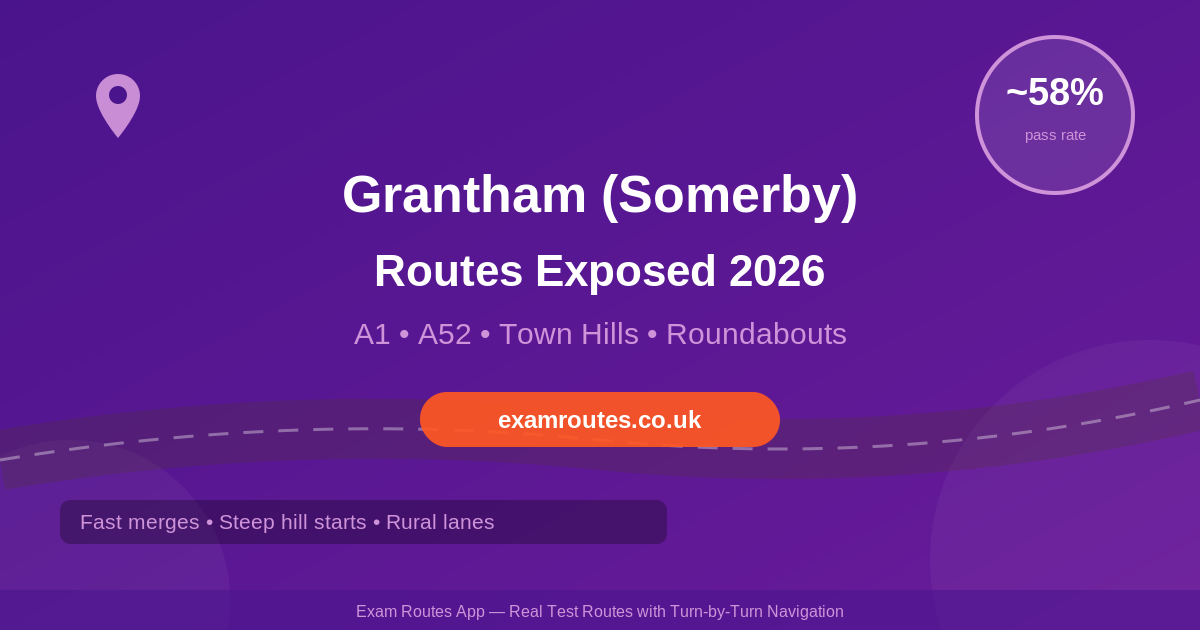
Grantham’s practical test centre at Somerby, on the old Spitalgate airfield site south-east of the town, produces one of the more distinctive route mixes in the East Midlands. In a single 40-minute drive you can be asked to merge onto a 70 mph trunk road, hold a hill start on a steep town street, negotiate a large roundabout complex and then read a rural road where the village arrives faster than you expected.
This guide maps out what that actually means in practice: the roads, the junctions, the faults they generate, and how to prepare for each of them.
About Grantham (Somerby) Test Centre
The centre is on the Spitalgate site to the south-east of Grantham, away from the town centre. That location shapes the routes: examiners have quick access to the A1 and A52 in one direction and to Grantham’s older, hillier streets in the other.
Practical points before test day: arrive early, know exactly where you are parking, and check your car meets DVSA requirements. Bring your provisional photocard licence. If you are using your instructor’s car, confirm the booking details with them the day before rather than the morning of.
Waiting times: Grantham (Somerby) serves a wide rural catchment and waits have run into the mid-teens of weeks in recent reporting. With only two booking changes now permitted, plan your lessons around the date rather than assuming you can push it back.
The Routes: Mapped Section by Section
Section 1 — Out of the centre and onto the fast roads
Many routes head towards the A1 or A52 early. These are high-speed merges where the assessed skills are acceleration to match the flow, mirror and blind spot checks in the right order, and a decisive commitment to the gap. Learners fail here by joining too slowly and forcing traffic in the nearside lane to brake. Practise until building to 60–70 mph on a slip road feels ordinary.
Section 2 — Roundabout complexes
The larger roundabouts around Grantham, including the Downtown and Swingbridge areas, involve multiple lanes and signed exits that come up quickly. Read the sign, choose the lane, hold it. The classic fault is a late realisation followed by a lane change inside the roundabout, which is usually marked as a serious fault because of the risk to vehicles alongside you.
Section 3 — The town centre and the hills
Grantham’s older streets rise and fall more than people expect. Hill starts on a real gradient, in traffic, with a car behind you, are a completely different exercise from a gentle slope on a practice road. Clutch control, handbrake timing and not rolling back are all in play. If your car stalls on a hill during the test it is not automatically a fail — how you recover matters — but repeated stalling will accumulate faults.
Section 4 — Rural roads and villages
Head out of town and the roads narrow. National speed limit applies, but that is a limit, not a target. The specific Grantham challenge is deceleration timing: villages appear suddenly after an open stretch, and carrying 60 mph towards a 30 mph sign because you did not see it coming is one of the most common serious faults in this area.
Section 5 — Manoeuvres
Quieter residential streets and the estate roads near the centre are the usual venues. Expect one of: reverse bay park, forward bay park, parallel park, or pull up on the right and reverse two car lengths. The emergency stop appears in roughly one test in three.
Practise Real Test Routes on Your Phone
The Exam Routes App gives you access to real driving test routes with turn-by-turn navigation. Practise at your own pace and build confidence before test day.
Tricky Spots and Common Challenges at Grantham
- Slip road merges onto the A1. Too slow is as dangerous as too fast. Match the flow.
- Lane selection on the multi-lane roundabouts. Decide early, on the approach, not at the give-way line.
- Steep hill starts in traffic. Rolling back more than a car’s length is a serious fault.
- Village speed limit transitions. Look for the change in street lighting and housing density as an early warning, not just the sign.
- Agricultural vehicles on rural roads. Overtaking a tractor is rarely the right call on a test. Hang back, stay patient, and only go when it is genuinely safe and legal.
- Independent driving on unfamiliar rural lanes. The sat nav can announce a turn late. If you miss it, carry on safely — a wrong turn is not a fault.
Pass Rates and Statistics
Grantham (Somerby) reports a pass rate around 57–58% in recent periods, comfortably above the national average of roughly 50%. That is typical for a rural-catchment centre where traffic density is lower than in a city, but the routes are demanding in a different way — speed judgement and rural road reading replace heavy urban congestion as the main challenge.
| Route element | What the examiner is assessing | Common fault |
|---|---|---|
| A1/A52 merge | Progress, mirrors, blind spot, commitment | Joining too slowly |
| Multi-lane roundabout | Lane discipline and signalling | Changing lane mid-roundabout |
| Town hill start | Clutch control, handbrake, no roll-back | Rolling back / repeated stalling |
| Rural to village | Anticipation and speed management | Late deceleration into a 30 zone |
| Manoeuvre | Control, accuracy, effective observation | Reversing without looking round |
Seven Tips for Passing at Grantham
- Do at least three sessions on the A1 or A52 slip roads until merging feels routine rather than alarming.
- Practise hill starts on the steepest street you can find safely, with a car behind you if possible.
- Drive the roundabout complexes at different times of day so you learn the lane markings rather than following the car in front.
- Rehearse the rural-to-village transition deliberately. Pick a village, drive in at the limit, and practise reading the approach.
- Use a sat nav for your independent driving practice, mounted where you would have it on test day.
- Learn all the show me, tell me questions. They are free marks and they settle your nerves before you move off.
- Avoid the school run for your test slot if you have a choice. Mid-morning is calmer on Grantham’s town roads.
How the Exam Routes App Helps
Grantham’s difficulty is spread across five very different road types, which makes unstructured practice inefficient — you can easily spend ten hours driving and barely touch the merges or the hills. The Exam Routes App gives you real UK test routes with turn-by-turn navigation so you can drive each section deliberately, repeat the parts that unsettle you, and arrive on test day with the roundabouts and the hill starts already familiar.
Frequently Asked Questions
Where is Grantham driving test centre?
It is at the Somerby / Spitalgate site to the south-east of Grantham, in Lincolnshire, away from the town centre.
Will I have to drive on the A1 during my test?
It is likely that your route will include a fast dual carriageway section on the A1 or A52. Merging confidently at speed is an important skill to practise before booking.
Is Grantham a good test centre to book?
Its pass rate is above the national average, and the routes are fair. The trade-off is that waits at rural centres can be long, so book early.
Do Grantham routes include hill starts?
Yes — the older parts of the town have real gradients, and hill starts in traffic are a regular feature of local routes.
What happens if I stall on my test?
A single stall in a safe place, recovered calmly, is usually recorded as a driving fault at worst. Stalling in a hazardous position, or repeatedly, can become a serious fault.
Don’t Leave Your Grantham Test to Chance
Download the Exam Routes App and practise the roads your examiner actually uses — turn-by-turn, at your own pace, as many times as you like.