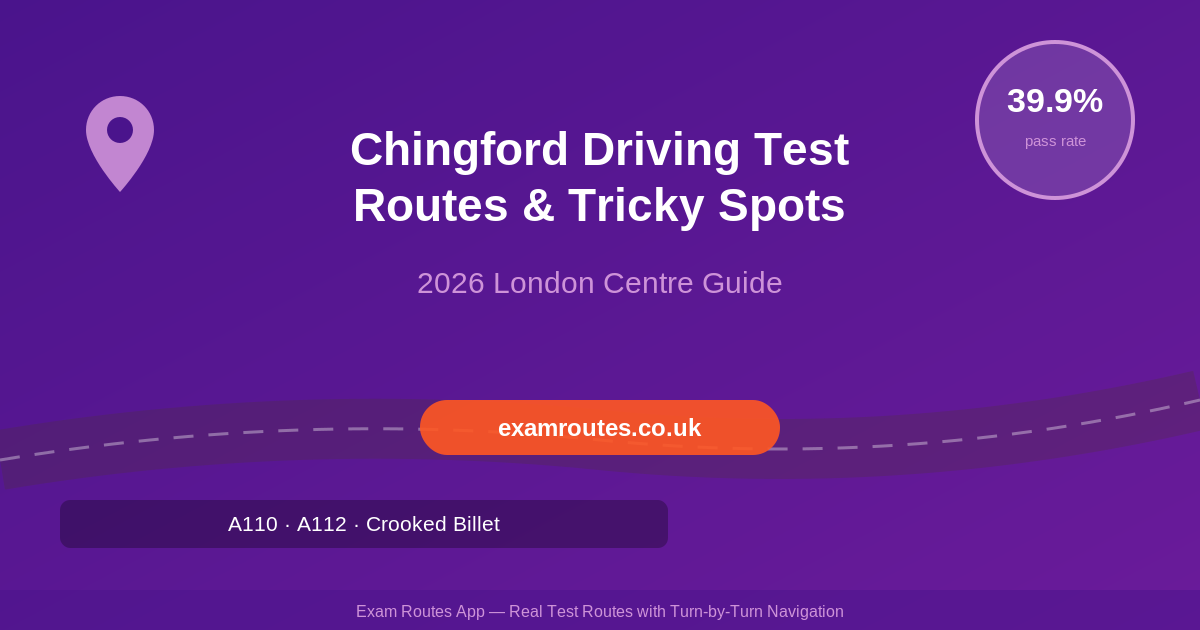
Chingford has a reputation, and the numbers back it up. With a pass rate hovering around 39.9%, it sits among the hardest test centres in Great Britain, and comfortably in the bottom group for London. That is not because the examiners are unfair — it is because the test area combines everything that makes London driving difficult: dense parked-car residential streets, fast dual carriageway sections, a genuinely intimidating roundabout at Crooked Billet, bus lanes, and the edge of Epping Forest where the road opens up and the speed limit changes without much warning. If you are booked at Chingford, preparation is not optional. This guide sets out exactly what you are dealing with.
About Chingford Driving Test Centre
Chingford Driving Test Centre is at Doric House, 128 Station Road, Chingford, London E4 6AD — a short distance from Chingford station and the shops on Station Road. It is a busy urban location, so parking outside is realistically not going to happen at peak times. Most instructors use the side streets nearby and walk in.
Take your provisional licence. If the car is yours rather than your instructor’s, check that it meets DVSA requirements: valid tax and MOT, insurance covering the test, L plates front and rear, a working speedometer and handbrake, and an extra interior mirror.
Because Station Road itself is congested, a test can begin with a fairly demanding manoeuvre out of a tight space into moving traffic. Getting used to that specific situation is a genuinely useful piece of preparation.
The Routes: Roads You Should Expect
Chingford routes typically draw from these areas:
- A110 Station Road and Kings Head Hill — the spine of the test area, busy, with bus stops, side turnings and pedestrian crossings.
- A112 Chingford Mount Road and Sewardstone Road — heavy traffic, shops, parked vehicles and frequent buses.
- A1009 The Ridgeway and Rangers Road — the Epping Forest edge, where the character of the road changes completely.
- Highams Park, Larkswood and Friday Hill estates — residential streets used for manoeuvres and junction work.
- The A406 North Circular approaches and Crooked Billet — the fastest and most demanding part of many routes.
Independent driving is usually sat-nav led and can take you out toward Woodford or Walthamstow before looping back. Expect one manoeuvre, and be ready for the emergency stop.
Tricky Spots & Common Challenges
Crooked Billet roundabout. This is the one candidates worry about, and with reason. Multiple lanes, fast approaches from the A406, and traffic that changes lane late. The answer is preparation, not bravery: know which lane you need well before you arrive, signal correctly, keep your lane through the roundabout, and check the nearside mirror before you exit.
Chingford Mount Road. Parked cars on both sides narrow the running lane, buses pull out, and pedestrians cross between vehicles. Hold back, give way where the obstruction is on your side, and make eye contact with drivers rather than assuming.
Bus lanes. Several roads in the area have peak-hour bus lanes. Read the sign, check the times, and stay out of them when they are operating. Driving in an active bus lane is both a test fault and a fine in real life.
Rangers Road and the forest edge. Wide, tree-lined, and much quieter than the rest of the route — which is precisely why candidates drift over the speed limit here. Watch for deer, cyclists, horse riders and pedestrians crossing to the forest.
Kings Head Hill. A gradient plus junctions plus parked cars. Hill starts and clutch control are tested here in a way that shows up quickly if you have not practised.
Narrow residential streets. Around Larkswood and Friday Hill, meeting oncoming traffic in a gap-wide street is routine. Examiners want to see you plan, choose a gap and hold back — not edge forward and force a stand-off.
Practise Real Test Routes on Your Phone
The Exam Routes App gives you access to real driving test routes with turn-by-turn navigation. Practise at your own pace and build confidence before test day.
Pass Rates & Statistics
Chingford’s pass rate is approximately 39.9%, which places it well below the Great Britain average and among the lowest in the country. Roughly two in five candidates pass. Nearby east London centres such as Barking sit in similar territory, while Hendon and West Wickham, both in London, run closer to 51%.
The message is not that Chingford is impossible — thousands of people pass there every year. It is that the local road environment leaves very little margin for a candidate who is still thinking about the basics. If mirrors, observation and gap judgement are automatic for you, Chingford is manageable. If they are not yet automatic, more practice before you book will cost less than a retest.
Top Tips for Passing at Chingford
- Drive Crooked Billet until it is boring. Different times of day, different exits, until lane choice is instinctive.
- Practise meeting traffic on narrow residential streets — deciding early who goes first is the whole skill.
- Learn the local bus lane times so you are not reading signs under pressure on test day.
- Master hill starts on Kings Head Hill and the surrounding gradients.
- Keep your speed honest on Rangers Road. The quiet stretch is where speeding faults happen.
- Practise moving off from a tight parked position into moving traffic, which is how many Chingford tests begin.
- Book a mock test at a realistic time of day. Chingford at 9am and Chingford at 2pm are different tests.
Choosing Your Test Time at Chingford
Time of day matters more at Chingford than at most centres. The first slot of the morning avoids the worst of the Station Road congestion but runs straight into the school run and commuter traffic on the A112 and A406. Mid-morning, roughly 10.30am to midday, is usually the calmest window: the rush has cleared and the afternoon school traffic has not started. Late afternoon slots put you into both the school pick-up and the start of the evening peak.
None of this means an afternoon test is a bad idea — examiners mark to the same standard whatever the traffic, and heavy traffic sometimes works in your favour because everything moves slowly. What matters is that you have practised in similar conditions. If your lessons have all been at 11am on a Tuesday and your test is at 4pm on a Friday, you are meeting the area at its busiest for the first time under maximum pressure.
Weather is worth a thought too. The forest roads and the tree-lined sections around The Ridgeway collect leaves and standing water in autumn, and low sun through the trees on The Ridgeway genuinely reduces visibility. Practising in those conditions is not wasted time.
How Exam Routes App Can Help
At a centre this demanding, familiarity is worth more than any last-minute tip. The Exam Routes App gives you real Chingford test routes with turn-by-turn navigation so you can rehearse Crooked Billet, the A112 and the forest roads before your test. Practise them with a supervising driver, in real traffic, until the route feels like home ground rather than an obstacle course.
Frequently Asked Questions
Why is the Chingford pass rate so low?
The test area combines dense parked-car streets, bus lanes, hills, a fast North Circular roundabout and quiet forest roads, so candidates face a very wide range of situations in one test.
What is the pass rate at Chingford driving test centre?
Around 39.9% in the latest DVSA data, one of the lowest in Great Britain.
Where is Chingford driving test centre?
Doric House, 128 Station Road, Chingford, London E4 6AD.
Does the Chingford test go on the North Circular?
Routes commonly use the approaches to the A406 and the Crooked Billet roundabout, though the amount of dual carriageway varies by route.
Should I book somewhere else instead?
You can, but only if it is genuinely convenient. Booking an unfamiliar centre 40 minutes away to chase a higher pass rate often backfires. Practising Chingford properly is usually the better plan.
Don’t Leave Your Chingford Test to Chance
Download the Exam Routes App and practise real Chingford routes — including Crooked Billet — with turn-by-turn navigation.