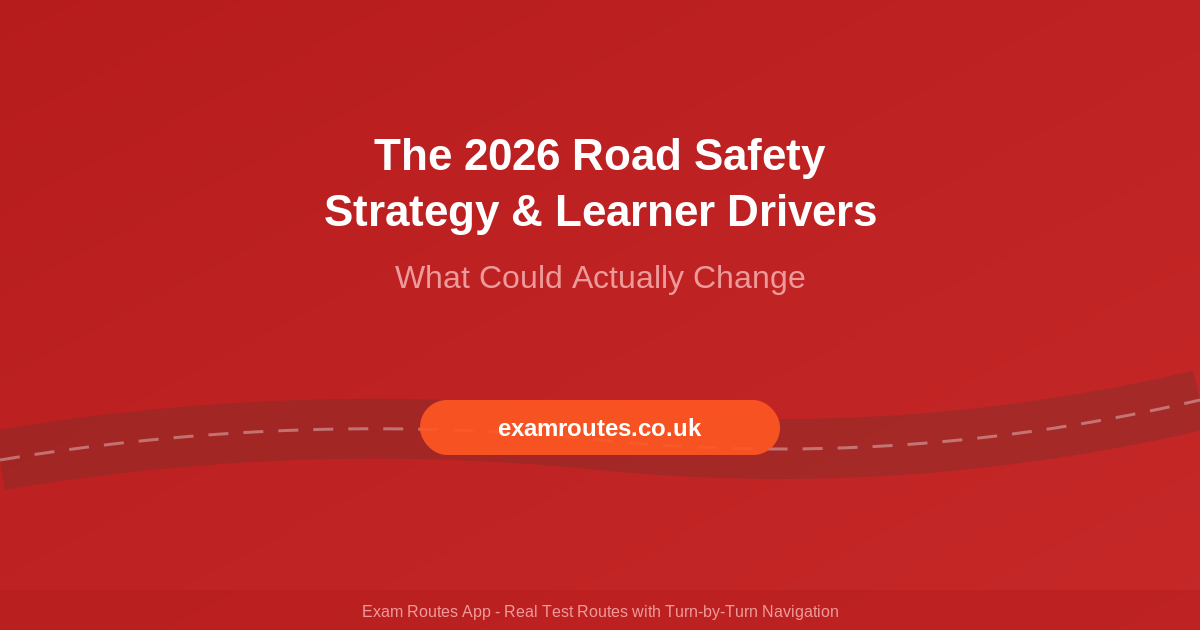
In January 2026 the government published a new road safety strategy for Great Britain – the first substantial refresh of national road safety policy in over a decade. It sets a headline target of cutting deaths and serious injuries by 65 per cent by 2035, and several of the measures inside it are aimed squarely at new and learner drivers.
If you are learning to drive right now, this matters. Some proposals could change how long you must hold a provisional licence before you can book a test. Others could change the rules that apply to you in your first years on the road. Here is what is in the strategy, what is confirmed, what is still only a consultation, and what it means for your plans.
Why Young and New Drivers Are the Focus
The numbers behind the strategy are stark. Drivers aged 17 to 24 hold around 6 per cent of UK driving licences but are involved in roughly 24 per cent of collisions where someone is killed or seriously injured.
That disparity is not primarily about skill in the technical sense – most new drivers can control a car perfectly well. It is about experience: hazard anticipation, decision-making under pressure, driving in the dark and in bad weather, and carrying passengers. Those are the things that take time and mileage to develop, and the test cannot fully measure them.
What the Strategy Proposes for Learners
A minimum learning period
The most significant proposal for anyone currently learning. The government has consulted on requiring learners to hold a provisional licence for a minimum period – three or six months have both been floated – before they can take the practical test.
The logic is that a fixed window forces learners to experience a full range of conditions: night driving, rain, ice, heavy traffic, motorway-style roads. The obvious concern is the effect on people who need a licence urgently for work or caring responsibilities, and on intensive course providers.
A lower alcohol limit for novice drivers
The strategy includes consultation on a lower blood alcohol limit applying specifically to newly qualified drivers. Several European countries already operate a near-zero limit for drivers in their first years.
Broader measures
Alongside the learner-specific proposals sit wider changes around enforcement, vehicle safety technology, and road design. Some of these will affect what you are taught – driver assistance systems have already begun appearing in theory test content.
Practise Real Test Routes on Your Phone
The Exam Routes App gives you access to real driving test routes with turn-by-turn navigation. Practise at your own pace and build confidence before test day.
What Is Confirmed and What Is Not
This is the part that matters most, and it is easy to get wrong when headlines circulate.
- Confirmed: the strategy itself, published January 2026, and its 2035 casualty reduction target.
- Consulted on, not law: the minimum learning period. The consultation window closed in May 2026, and any change would need to go through the proper process before taking effect.
- Consulted on, not law: the lower novice alcohol limit.
- Not in the strategy: a full graduated driving licence scheme with passenger and night-time curfews, which has been debated repeatedly but has not been adopted as policy.
In other words: nothing in the strategy changes the rules for your test today. If you are booked, your test proceeds under the current system.
Should You Rush to Book Before Anything Changes?
No. Any minimum learning period would need consultation, legislation and a lead-in period, and would almost certainly apply to new provisional holders rather than people already learning. Booking a test you are not ready for is a far more reliable way to lose money than any policy change.
What It Means in Practice
Whether or not a minimum learning period becomes law, the reasoning behind it is sound and you can act on it yourself right now.
- Deliberately vary your conditions. Book lessons in the rain, at dusk, in rush hour and on faster roads – not just the pleasant mid-morning slots.
- Do not treat the test as the finish line. The first six months after passing carry the highest risk. Consider structured post-test training.
- Get motorway experience. Learners have been allowed on motorways with an approved instructor in a dual-controlled car since 2018, and uptake remains low.
- Build genuine private practice. Hours behind the wheel with a supervising driver, within the insurance and licence rules, is what turns competence into experience.
- Follow official sources. Changes to test and licensing rules are announced through GOV.UK, not through social media summaries.
How Exam Routes App Can Help
Experience is mileage with purpose. The Exam Routes App gives you real UK driving test routes with turn-by-turn navigation, so the practice you do between lessons is structured rather than aimless – the same roads, the same junctions, driven in different conditions until they hold no surprises.
Whatever the rules end up saying about how long you must learn for, the drivers who pass first time and stay safe afterwards are the ones who put in varied, deliberate practice. This makes that easier to do.
Frequently Asked Questions
When was the new UK road safety strategy published?
It was published in January 2026 and sets a target of reducing deaths and serious injuries by 65 per cent by 2035.
Is a minimum learning period now the law?
No. It was put out to consultation, with the consultation deadline in May 2026. Any change would require further steps before coming into force.
How long would a minimum learning period be?
Three months and six months have both been proposed. Nothing has been confirmed.
Does the strategy introduce graduated driving licences?
A full graduated licensing scheme with curfews and passenger limits is not part of the strategy, although the idea continues to be debated.
Why do the proposals target young drivers?
Drivers aged 17 to 24 hold about 6 per cent of licences but are involved in around 24 per cent of collisions causing death or serious injury, a gap driven largely by lack of experience.
Get the Edge on Test Day
Whatever the rules change to, preparation wins. Practise real UK driving test routes with turn-by-turn navigation before your test.