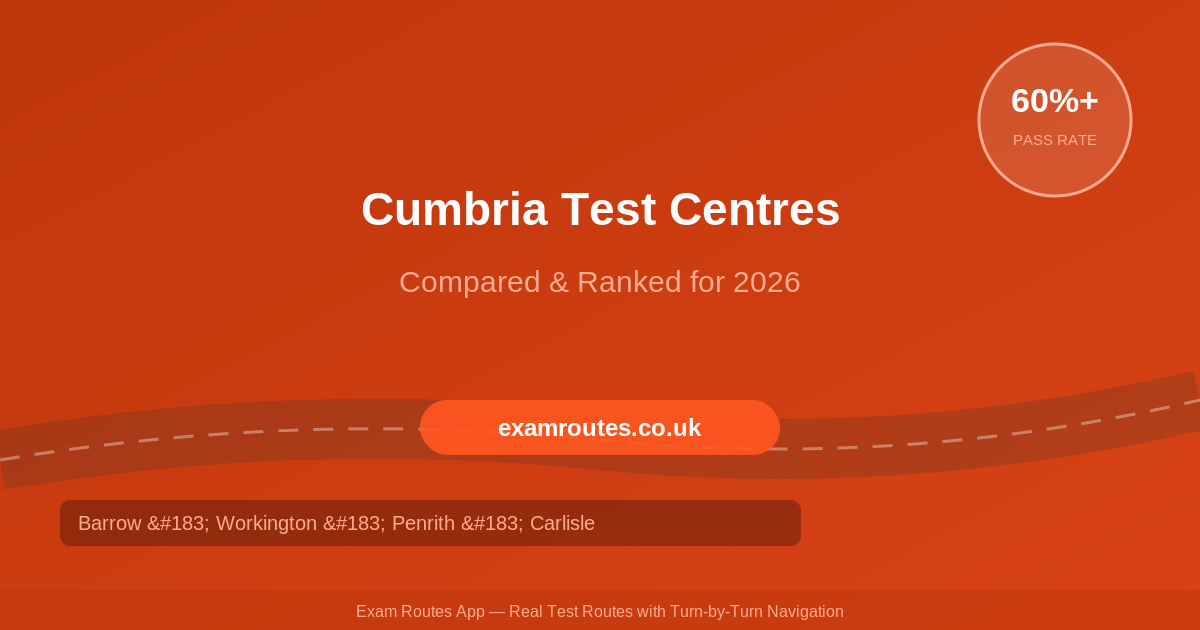
Cumbria is quietly one of the best places in Britain to take a driving test. While the national practical pass rate hovers around 48–50%, several Cumbrian centres have recorded rates above 60% in recent DVSA data, and Barrow-in-Furness has ranked among the strongest centres in England with roughly two thirds of candidates passing.
That does not mean you should drive three hours to book one. It does mean the differences between centres in the county are large enough to be worth understanding — particularly if you live somewhere with two realistic options. Here is how Cumbria’s centres compare in 2026, and what the numbers actually tell you.
Cumbria’s Test Centres at a Glance
| Test centre | Recent pass rate | Route character |
|---|---|---|
| Barrow-in-Furness | ~66% | Town streets, peninsula roads, light traffic |
| Workington | ~62% | Coastal town, A595 links, some rural |
| Penrith | ~60%+ | Market town, A6, rural junctions, M6 fringe |
| Whitehaven | High 50s–60s | Coastal, steep gradients, narrow streets |
| Carlisle | ~52–58% | City gyratory, A595 bypass, busiest in county |
Figures are drawn from recent published DVSA centre-level data and vary by reporting period. Always check the latest official statistics before drawing conclusions.
Why Cumbrian Centres Outperform the National Average
The explanation is not that Cumbrian examiners are lenient. Examiners work to the same national standard everywhere, and the DVSA monitors marking consistency across centres. What differs is the road environment.
- Lower traffic density. Fewer vehicles per mile means fewer forced decisions, fewer conflicts and more room to recover from a small error before it becomes a serious one.
- Simpler junction design. Cumbria has relatively few multi-lane urban gyratories, spiral roundabouts or complex bus-lane networks compared with Greater Manchester, the West Midlands or London.
- Candidate mix. Rural learners often have more access to private practice in a family car, which adds hours that lessons alone cannot buy.
- Fewer pedestrians and cyclists per junction, which reduces the number of situations where a candidate has to make a judgement call under pressure.
The mirror image of this is London, where several centres have dipped below 40% in recent quarters. The gap between the strongest Cumbrian centre and the weakest London one is well over 25 percentage points — the largest geographic spread in the UK test system.
Practise Real Test Routes on Your Phone
The Exam Routes App gives you access to real driving test routes with turn-by-turn navigation. Practise at your own pace and build confidence before test day.
Centre by Centre
Barrow-in-Furness
Consistently one of England’s highest-performing centres. Routes cover the town’s grid streets, the industrial areas around the shipyard and the roads out towards Dalton and the peninsula. Traffic is light outside shift changes at the shipyard, which is worth avoiding when you book.
Workington
Strong rates and a mixed route profile: coastal town driving, the A595 and A596 corridors, and rural sections towards Cockermouth. The A-road driving is the part candidates most often under-prepare for.
Penrith
A compact market town with an outsized road network because of the M6 and A66 junctions nearby. Expect rural T-junctions with limited visibility and open-road speed limits. Penrith’s high pass rate hides the fact that its rural sections require genuine confidence at 60mph.
Whitehaven
The most physically demanding of the Cumbrian centres. Steep coastal gradients, narrow Georgian streets and tight parking mean hill starts and meeting traffic are near-guaranteed. Good rates, but not an easy drive.
Carlisle
The county’s busiest centre and the closest thing Cumbria has to an urban test. Kingstown roundabout, the A595 western bypass, Hardwicke Circus and the Botchergate city-centre section make it the most demanding of the five, which is why its pass rate sits below the others despite still beating the national average.
Should You Travel for a Better Pass Rate?
Generally, no — and since 2026 the DVSA has made it harder to do so anyway. Booking rules introduced during the year limit learners to moving a test only to one of the three nearest test centres, and cut the number of permitted booking changes from six to two. Those changes were designed to stop bulk-booking and centre-hopping, and they mean chasing a distant high-percentage centre is far less practical than it used to be.
The evidence also argues against it. A candidate who knows the roads, the junction sequences and the local hazards outperforms a candidate who has driven a route once, regardless of the headline rate. Familiarity is worth more percentage points than geography.
How to choose your Cumbrian test centre
- Pick the centre whose roads you can realistically practise every week.
- If you have two nearby options, choose the one whose route character matches your weaker skills — practise those roads rather than avoiding them.
- Avoid booking Barrow around shipyard shift changes and Carlisle during the morning commuter peak.
- Remember the three-nearest-centre rule if you plan to move your booking.
What the Numbers Do Not Tell You
Pass rates are an average of everyone who turned up, including candidates who were nowhere near ready. A centre at 66% is not offering you a 66% chance — your personal chance depends almost entirely on your preparation. The DVSA’s own fault data shows the same top reasons for failure everywhere in the country: not looking properly at junctions, poor steering control, incorrect positioning at roundabouts and failing to respond to traffic signs. Those faults do not care which county you are in.
How the Exam Routes App Can Help
Whichever Cumbrian centre you book, the fix is the same: drive its routes before test day. The Exam Routes App gives you real driving test routes with turn-by-turn navigation on your phone, so you can practise Carlisle’s Kingstown roundabout, Whitehaven’s gradients or Penrith’s rural junctions with a supervising driver, and turn a good regional pass rate into your own result.
Frequently Asked Questions
Which Cumbrian driving test centre has the highest pass rate?
Barrow-in-Furness has recorded the strongest figures in the county in recent data, with roughly two thirds of candidates passing. Workington and Penrith have also reported rates above 60%.
Why are Cumbria’s pass rates so much higher than London’s?
Road environment rather than marking. Lower traffic density, simpler junction layouts and more opportunity for private practice all reduce the number of situations where a candidate can make a costly error.
Can I book a Cumbrian test centre if I live elsewhere?
You can book any centre with availability, but since 2026 you may only move an existing booking to one of the three nearest centres, and you can change a booking only twice. Travelling far for a higher pass rate is rarely worth it.
Is Carlisle harder than the other Cumbrian centres?
Yes, relatively. It is the county’s busiest centre, with a city gyratory, a fast bypass and dense city-centre traffic, which is why its pass rate sits below Barrow, Workington and Penrith while still beating the national average.
Does a high pass rate mean the test is easier?
Not in terms of standard. Examiners apply the same national marking criteria everywhere. Higher rates reflect the road environment and candidate preparation, not a softer test.
Book Smart, Practise Smarter — Get Exam Routes
Download the Exam Routes App and practise the roads your examiner actually uses, with turn-by-turn navigation on your phone. Walk into your test knowing the routes.