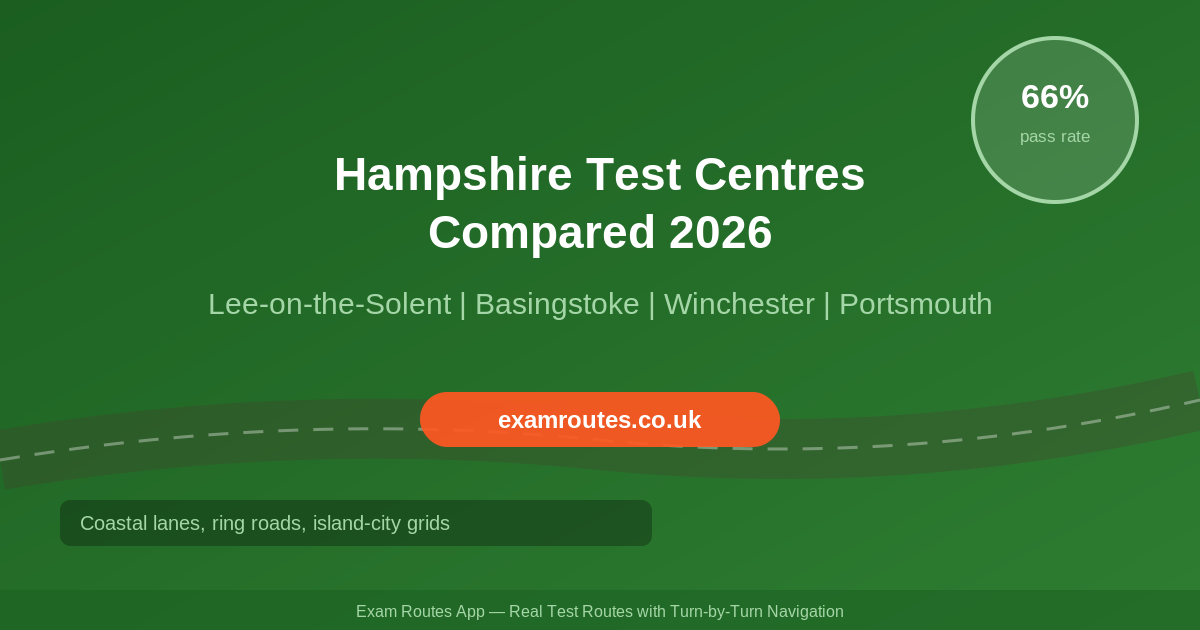
Hampshire contains one of the widest pass-rate gaps of any English county. Lee-on-the-Solent regularly records one of the highest pass rates in Great Britain, while Southampton (Maybush), less than twenty miles away, sits well below the national average. Two learners of identical ability could book those two centres and face very different odds — not because the examiners differ, but because the roads do.
This 2026 guide compares Lee-on-the-Solent, Basingstoke, Winchester, Portsmouth, Southampton (Forest Hills) and Southampton (Maybush): the numbers, the routes, and how to choose.
Hampshire Driving Test Pass Rates Compared (2026)
Figures reflect the most recent DVSA car practical test data reported for 2025–26. Published rates move by a point or two between sources depending on the period used.
| Test centre | Approximate pass rate | Vs national average (~49%) | Defining feature |
|---|---|---|---|
| Lee-on-the-Solent | around 66% | Far above | Quiet coastal roads, low traffic density |
| Basingstoke | around 59% | Well above | Ring road, roundabout network |
| Winchester | around 57% | Above | Historic streets, hills, rural lanes |
| Portsmouth | around 50% | Around average | Island city, dense grid, heavy traffic |
| Southampton (Forest Hills) | around 50% | Around average | Suburban roads, Common area |
| Southampton (Maybush) | around 43% | Below | Docks traffic, complex urban junctions |
Quick tip: Lee-on-the-Solent and Southampton (Maybush) are roughly 23 percentage points apart. That is the single biggest intra-county gap in southern England, and it is almost entirely explained by traffic density.
Lee-on-the-Solent: One of the Highest Pass Rates in Britain
At around 66%, Lee-on-the-Solent is consistently near the top of the national table. The reason is straightforward: the routes cover quiet coastal and residential roads on the Gosport peninsula, with far fewer complex multi-lane junctions than a city centre test. Traffic density is low for a southern England centre.
That does not make it a free pass. The peninsula has plenty of mini-roundabouts, narrow residential roads with parked cars, and 20mph zones where speed control matters. Because traffic is lighter, examiners have more opportunity to see whether you make proper progress — hesitation is a common fault here precisely because there is often nothing stopping you.
Basingstoke: Roundabout Country
Basingstoke was largely built as a post-war expansion town, which means a ring road and an unusually high density of roundabouts. If you are tested here, you will meet several, including multi-lane ones where the correct lane is not obvious until you read the signs properly.
At roughly 59%, Basingstoke rewards learners who have drilled roundabout approach: read the sign, choose the lane early, signal at the right moment, hold the lane. Get that routine right and most of a Basingstoke test is straightforward.
Winchester: Hills, History and Narrow Streets
Winchester combines a compact historic centre with steep approaches and surrounding rural lanes. Expect one-way sections, narrow streets with heavy pedestrian activity, and hill starts. There is often a rural component with national speed limit bends and limited visibility.
At around 57% it sits comfortably above average, but the fault profile is distinctive: pedestrian awareness in the city centre, and clutch control on the hills.
Practise Real Test Routes on Your Phone
The Exam Routes App gives you access to real driving test routes with turn-by-turn navigation. Practise at your own pace and build confidence before test day.
Portsmouth: An Island City
Portsmouth is one of the most densely populated cities in Europe, built on an island with limited road capacity. Tests involve a tight grid of terraced streets, heavy on-street parking, frequent pedestrians and cyclists, and the pressure of continuous traffic. At around 50%, Portsmouth performs respectably for that environment.
Meeting oncoming traffic between parked cars is a routine part of a Portsmouth test, and so is dealing with cyclists. The Highway Code hierarchy rules matter here more than in most places.
The Two Southampton Centres: A Real Difference
Southampton has two centres and they are not equivalent. Forest Hills sits around 50%, while Maybush is closer to 43%. Maybush routes take in busier arterial roads with docks and freight traffic, plus more complex junction sequences. Forest Hills routes tend to spend more time in suburban areas.
If you can practise both and have flexibility on dates, the Forest Hills figures are meaningfully better. But the more important factor is which roads you have actually driven — a well-practised Maybush candidate beats an unprepared Forest Hills one every time.
Which Hampshire Centre Should You Book?
- Want the best statistical odds? Lee-on-the-Solent, but expect long waits.
- Solid on roundabouts? Basingstoke.
- Good on hills and pedestrian-heavy streets? Winchester.
- Confident in dense traffic? Portsmouth or Southampton.
Because Lee-on-the-Solent’s reputation is well known, its waiting list is often long. Weigh a few extra months against a few extra percentage points — for most learners, taking a well-practised test sooner is the better call.
How the Exam Routes App Can Help
The gap between Hampshire’s best and worst pass rates is mostly a gap in road familiarity. The Exam Routes App lets you follow real test routes with turn-by-turn navigation so you can drive the Basingstoke roundabout network, the Portsmouth grid or the Southampton arterials with a supervising driver before test day.
Frequently Asked Questions
Which Hampshire test centre has the highest pass rate in 2026?
Lee-on-the-Solent, at roughly 66%, one of the highest in Great Britain. Basingstoke follows at around 59% and Winchester at about 57%.
Is it worth travelling to Lee-on-the-Solent for a better chance?
Only if you can practise there. Its high rate comes from quieter roads, and that advantage disappears if you arrive without having driven the area.
What is the difference between Southampton Maybush and Forest Hills?
Maybush routes involve busier arterial and docks-related traffic and record a lower pass rate, around 43% against roughly 50% at Forest Hills.
Does Portsmouth’s density make it harder?
It produces more hazards per mile, which means more opportunities for faults. The marking standard is the same everywhere, but preparation matters more in dense traffic.
Can I book at any Hampshire centre?
Yes. Any learner can book at any DVSA test centre in the UK regardless of where they live.
Ready to Pass? Download Exam Routes Now
From Lee-on-the-Solent to Southampton, practise the real routes before test day. Turn-by-turn navigation on your phone.