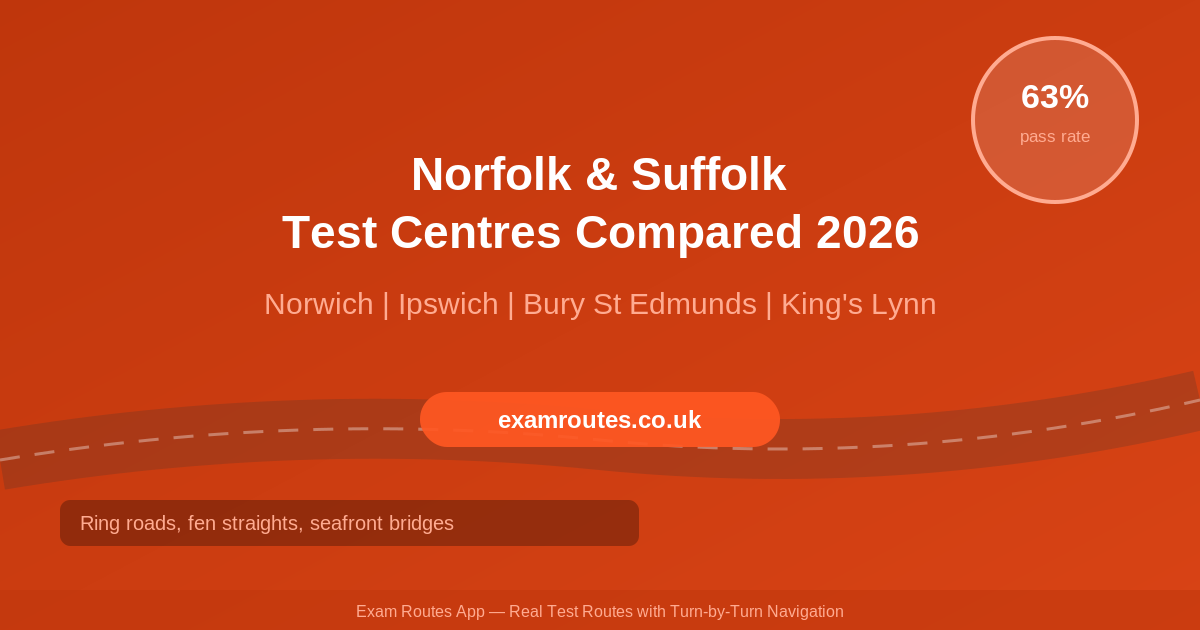
East Anglia produces some of the most encouraging driving test statistics in England — and some of the most surprising contrasts. Norwich has two test centres whose pass rates differ by nearly twenty percentage points. Ipswich records one of the strongest figures in the East. Meanwhile, the county average for Suffolk sits below the national figure, which tells you how much depends on picking the right centre.
This 2026 guide compares Norwich (Peachman Way), Norwich (Jupiter Road), Ipswich, Bury St Edmunds, King’s Lynn and Great Yarmouth.
Norfolk and Suffolk Pass Rates Compared (2026)
Figures are based on the most recent DVSA car practical test data reported for 2025–26. Sources differ slightly depending on the date range used.
| Test centre | Approximate pass rate | Vs national average (~49%) | Road mix |
|---|---|---|---|
| Ipswich | around 63% | Far above | Town roads, A14 junctions, rural fringe |
| Norwich (Peachman Way) | around 62% | Far above | Outer ring road, business parks, rural |
| Bury St Edmunds | around 57% | Above | Market town streets, A14, country lanes |
| King’s Lynn | around 53% | Above | Docks area, one-ways, fen roads |
| Great Yarmouth | around 50% | Around average | Seafront, bridges, seasonal traffic |
| Norwich (Jupiter Road) | around 42% | Well below | Inner-city streets, dense junctions |
Quick tip: Two centres in the same city, twenty points apart. If you are learning in Norwich, which centre you book is one of the biggest single decisions you will make.
The Norwich Split: Peachman Way vs Jupiter Road
Norwich’s two centres serve very different road networks. Peachman Way, on the outskirts, sends candidates onto the outer ring road, business park estates and rural roads towards the Broads. Traffic is steadier, junctions are more predictable, and the pass rate sits around 62%.
Jupiter Road routes head into denser inner-city areas, with more complex junction sequences, more parked cars, more cyclists and more pedestrian activity. The pass rate is roughly 42%.
This is not a difference in examiner standards. It is a difference in how many hazards you meet per mile. If both are available and you can practise either, the Peachman Way figures speak for themselves — but the routes there include faster ring-road driving, so you must be confident at 50–60mph and in lane discipline.
Ipswich: The Strongest Numbers in the East
Ipswich records around 63%, the highest in Suffolk and one of the highest in the region. Routes combine town roads with the A14 corridor and rural fringes. It is a well-balanced test: nothing exotic, but you need to make proper progress on faster roads and handle roundabouts confidently.
The gap between Ipswich’s figure and the Suffolk county average is a reminder that county-level statistics hide a lot. Book the centre, not the county.
Practise Real Test Routes on Your Phone
The Exam Routes App gives you access to real driving test routes with turn-by-turn navigation. Practise at your own pace and build confidence before test day.
Bury St Edmunds: Market Town and A14
Bury St Edmunds, at roughly 57%, offers a market-town centre with narrow historic streets, plus access to the A14 for faster driving. Expect one-way sections, pedestrian-heavy areas near the town centre, and country lanes on the outskirts.
The recurring theme is adapting speed. Learners who drive the whole test at one pace tend to pick up faults at both ends — too fast in town, too slow on the A-road.
King’s Lynn: Fen Roads and a Working Port
King’s Lynn sits around 53%. The town has a compact historic core with one-way systems, a working port area with commercial traffic, and long straight fen roads on the outskirts where the national speed limit applies but visibility across flat land can be deceptive.
Those long straight roads catch people out. They feel safe, so learners either drift over the limit or hesitate at junctions where an approaching vehicle is much closer than it appears.
Great Yarmouth: Seafront and Seasonal Traffic
Great Yarmouth is around the national average at roughly 50%. Its defining features are the seafront, the river bridges and heavy seasonal tourist traffic. A February test and an August test are meaningfully different experiences, though the standard applied is identical.
Bridge approaches and the one-way sections near the river are where most Yarmouth candidates need the practice.
Which East Anglian Centre Should You Book?
- In or near Norwich? Peachman Way has substantially better odds than Jupiter Road, provided you are confident on ring-road speeds.
- In Suffolk? Ipswich leads on the numbers; Bury St Edmunds is a strong alternative with shorter town routes.
- In west Norfolk? King’s Lynn, with practice on the fen roads.
- On the coast? Great Yarmouth, ideally outside the summer season.
How the Exam Routes App Can Help
The Norwich split shows exactly why route familiarity matters: the same city, the same examiners, wildly different outcomes. The Exam Routes App lets you follow real test routes with turn-by-turn navigation, so you can drive the Peachman Way ring-road sections, the Ipswich A14 junctions or the King’s Lynn one-ways with a supervising driver before your test.
Frequently Asked Questions
Which Norfolk or Suffolk test centre has the highest pass rate in 2026?
Ipswich at roughly 63%, with Norwich (Peachman Way) very close behind at about 62%.
Why do the two Norwich centres differ so much?
Route geography. Peachman Way uses outer ring road and business park routes; Jupiter Road covers denser inner-city streets with far more hazards per mile.
Can I choose which Norwich centre I take my test at?
Yes. When booking through the official DVSA service you select a specific test centre, so you can pick either one subject to availability.
Is Great Yarmouth harder in summer?
Traffic volume rises substantially with tourist season, which means more hazards. The marking standard does not change, but preparation matters more.
Should I book by county pass rate?
No. County averages hide big differences between centres. Norwich alone spans roughly twenty percentage points.
Get the Edge on Test Day
Practise the real routes around Norwich, Ipswich, Bury St Edmunds, King’s Lynn and Great Yarmouth before you sit your test.