Everyone talks about hazard perception, because it is the unfamiliar half. But the multiple-choice section is where most people who fail actually lose their theory test – and it is the half you can most reliably revise for.
Here is how the multiple-choice section works in 2026, what it covers, and a revision approach that beats endlessly retaking the same practice papers.
How the Multiple-Choice Section Works
Multiple-choice section at a glance
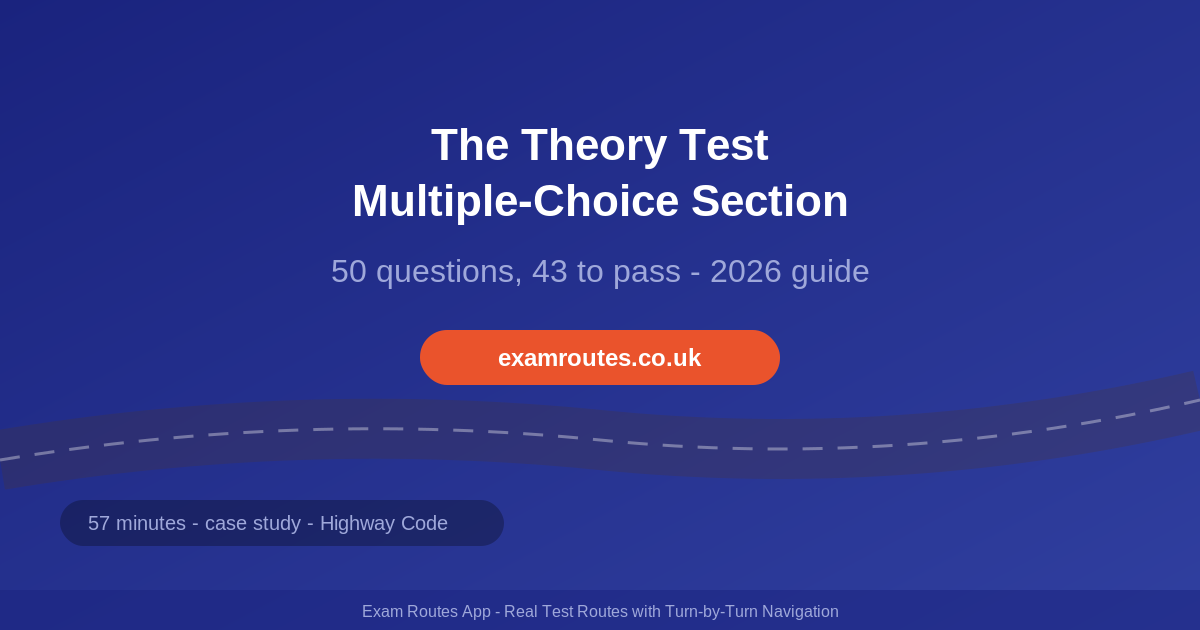
| Questions | 50 |
| Pass mark | 43 out of 50 |
| Time allowed | 57 minutes |
| Format | On screen, one question at a time, with a review screen at the end |
| Practice time | Up to 15 minutes of optional practice questions before the test starts |
| Break | Optional break of up to 3 minutes before the hazard perception section |
Both sections must be passed in the same sitting. Pass the multiple choice and fail hazard perception and you retake the whole thing.
What the Questions Cover
Questions are drawn from a published bank covering these topic areas:
- Alertness and attitude
- Safety and your vehicle, including safety margins
- Hazard awareness
- Vulnerable road users – pedestrians, cyclists, horse riders, motorcyclists
- Other types of vehicle, and vehicle handling
- Motorway rules and rules of the road
- Road and traffic signs
- Documents, incidents, accidents and emergencies
- Vehicle loading
The three areas that consistently trip people up are road signs (there are far more than you think), stopping distances (which people memorise and then misapply), and documents – insurance categories, MOT rules and what you must tell the DVLA.
The Case Study
Part of the multiple-choice section is a case study: a short scenario shown on screen, followed by five questions about it. It is not harder than the rest of the test, but it is different – you are applying the same knowledge to a described situation rather than answering an abstract question. Read the scenario twice before you start answering.
Flagging and Reviewing
You can flag any question you are unsure of and come back to it. Use this. Do not sit staring at question 12 for four minutes – flag it, keep moving, and return with the pressure off. With 57 minutes for 50 questions you have just over a minute each, which is comfortable if you do not get stuck.
Practise Real Test Routes on Your Phone
Passed your theory? The Exam Routes App gives you real driving test routes with turn-by-turn navigation so you can start preparing for the practical straight away.
A Revision Plan That Works
Weeks 1-2: read, don’t test
Work through the Highway Code properly. Not skim – read. Most theory questions are Highway Code rules rephrased, so understanding the reasoning behind a rule means you can answer questions you have never seen before.
Week 3: topic by topic
Take one topic at a time and do questions only on that topic. Mixed practice tests too early just tell you that you are getting things wrong; topic practice tells you what you are getting wrong.
Week 4: full mock tests
Now do full 50-question timed mocks. Aim to consistently score 47 or above before booking – a comfortable margin, because test-day nerves cost a few marks.
Throughout: keep a wrong-answer list
Every question you get wrong goes on a list with the reason. Review the list, not the whole question bank. This is the single highest-value revision habit and almost nobody does it.
Common Mistakes
- Memorising answers rather than rules. The question bank is large and questions are reworded. Learn the rule.
- Ignoring road signs. They are a big chunk of the test and pure recall, so they are free marks if you put the hours in.
- Booking too early. A theory test costs money and a slot; sit it when your mocks are consistently in the high 40s.
- Rushing the case study. Five questions rest on reading one scenario carefully.
- Forgetting the certificate expires. Your theory pass is valid for two years. If you do not pass your practical within that window you must take the theory again.
On the Day
Bring your provisional driving licence – without it you will not be allowed to sit the test and you will lose your fee. Arrive at least 15 minutes early, leave your phone in the locker, and use the practice questions at the start to settle your nerves rather than skipping them.
Frequently Asked Questions
How many questions do you need to get right in the theory test?
43 out of 50 in the multiple-choice section. You must also pass hazard perception in the same sitting.
How long is the multiple-choice section?
57 minutes, with up to 15 minutes of optional practice questions beforehand and an optional break of up to 3 minutes afterwards.
What is the case study in the theory test?
A short scenario shown on screen followed by five questions about it, testing whether you can apply the rules to a realistic situation.
Can I go back and change my answers?
Yes. You can flag questions and review or change answers at any point before you finish the section.
How long is a theory test pass valid?
Two years. If you have not passed your practical test in that time, you have to sit the theory test again.
The Bottom Line
The multiple-choice section is the most controllable part of getting your licence. Read the Highway Code properly, revise by topic, keep a wrong-answer list, and only book when your mocks are consistently at 47 or above.
Ready for the Practical? Download Exam Routes Now
Practise real driving test routes with turn-by-turn navigation and get ready for the road, not just the screen.