Wolverhampton Test Routes Exposed: Every Turn, Junction & Roundabout Mapped (2026)
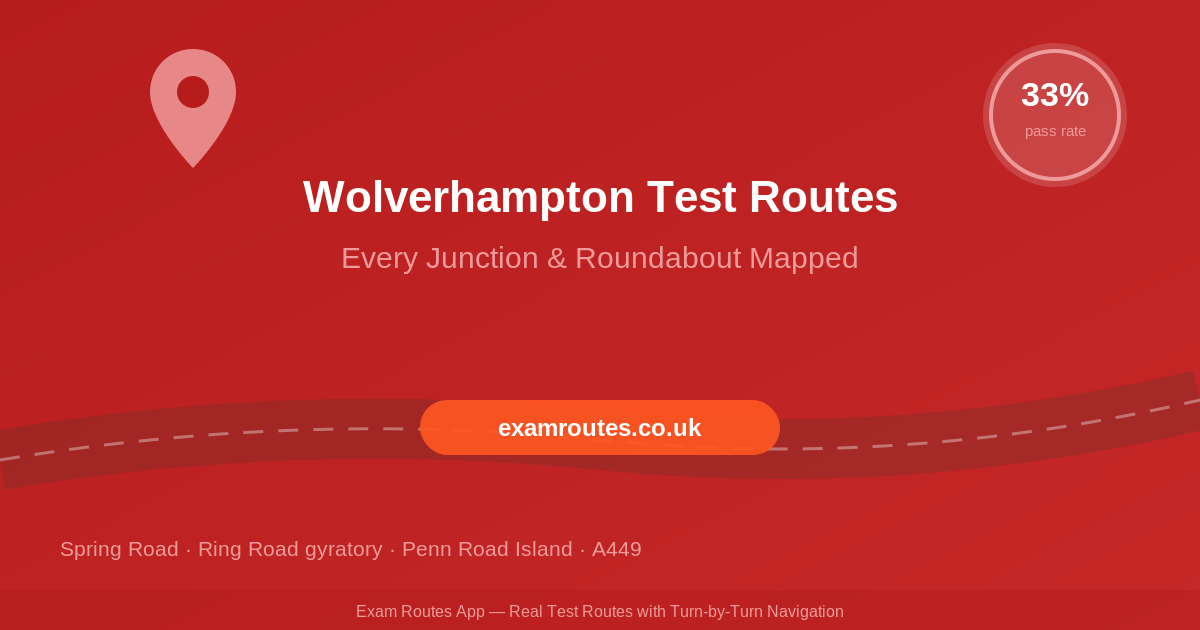
Wolverhampton has the lowest car driving test pass rate in Great Britain. The most recent DVSA figures put it around 33–34%, against a national average of 48.7%. Put plainly: two out of every three candidates who sit a test at Spring Road leave without a licence.
That number frightens learners, and it should be taken seriously — but not fatalistically. Examiners in Wolverhampton mark to exactly the same DVSA standard as examiners in Dorchester or Kendal. What differs is the road network. Wolverhampton’s routes pack an unusual amount of difficulty into 38 minutes: multi-lane island roundabouts, a ring road gyratory, fast dual carriageway sections, dense industrial traffic and residential streets so tightly parked that meeting oncoming traffic becomes a constant negotiation.
This guide maps out what you are actually facing — the roads, the junctions, the specific faults that end tests here — and how to prepare so the statistic works for you rather than against you.
About Wolverhampton Driving Test Centre
The centre is at Spring Road, Spring Road Industrial Estate, Ettingshall, Wolverhampton, WV4 6JX, just off the A4126 to the south-east of the city centre. It shares the estate with distribution and trade units, which means HGV movements, forklifts crossing access roads and delivery vans parked in awkward places.
Practical points:
- Getting there. Spring Road is easy to overshoot. Do a dry run with your instructor so you are not flustered on arrival.
- Parking. Limited on-site. Most candidates park on the estate roads nearby, which are themselves busy with commercial traffic.
- Bring your provisional licence and a test-legal car: taxed, insured, roadworthy, L plates front and rear, and an additional interior mirror for the examiner.
- Timing. The estate is at its worst between 7:30 and 9:30 am when shift changes and deliveries overlap. If you have a choice of slot, mid-morning or early afternoon is calmer.
Because you leave from an industrial estate, your first ninety seconds involve wide access roads with poor sightlines around parked lorries, then an immediate transition to fast A-road traffic. That contrast catches people out.
The Routes: Roads That Keep Coming Up
The DVSA does not publish test routes. What is well documented by local instructors, however, is the set of roads that appear on Wolverhampton tests with high frequency.
The A4126 and Ettingshall corridor
Straight out of the estate. Bilston Road and the surrounding industrial approaches carry heavy commercial traffic and have frequent side turnings, bus stops and pedestrian crossings. Observation and anticipation are being marked from the moment you turn out.
Penn Road and Penn Road Island
The A449 Penn Road is a major arterial route with multi-lane sections and a large island where lane discipline decides the test. Getting into the wrong lane on approach is survivable; changing lanes mid-roundabout is not.
The Ring Road (St Patrick’s, St David’s, St John’s)
Wolverhampton’s ring road is a series of named gyratory sections with short distances between junctions, multiple lanes and traffic lights that filter. You may need to change lanes twice in a few hundred metres while reading overhead signage. This is the single most demanding element of a Wolverhampton test.
The A449 Stafford Road
Dual carriageway at 40–50 mph with slip roads, filter lanes and busy junctions. Examiners use it to assess whether you can make appropriate progress, hold a lane, and change lanes with proper mirror and blind spot checks at speed.
Residential Ettingshall, Blakenhall and Parkfields
Terraced streets with parking on both sides, unmarked crossroads, and narrow gaps where you must judge who goes first. This is where most Wolverhampton faults are actually recorded.
Tricky Spots and Common Challenges
- Ring road lane changes. Short gaps between junctions mean you must decide early, check mirrors and blind spot, and move once. Late lane changes are the classic serious fault here.
- Penn Road Island. Multi-lane approach with heavy traffic. Read the road markings on approach and commit to your lane before you reach the give-way line.
- Emerging from industrial side roads. Parked HGVs block your view. Creep and peep is correct; edging out blind is a dangerous fault.
- Meeting traffic in Blakenhall and Parkfields. Parked both sides, one usable lane. Identify whose side the obstruction is on, then either hold back or proceed decisively. Freezing costs you an undue hesitation mark.
- Stafford Road slip roads. Joining at insufficient speed is the recurring problem. Build up on the slip and merge, do not stop and hope.
- Bus lanes. Several city routes have peak-hour bus lanes with time plates. Reading the plate rather than guessing is part of the assessment.
- Cyclists and pedestrians. The Highway Code hierarchy of road users applies. Leave 1.5 metres when passing a cyclist and give way to pedestrians waiting to cross at a junction you are turning into.
Know the Roads Before the Examiner Does
The Exam Routes App lets you drive real test routes with turn-by-turn navigation, so the tricky junctions are familiar long before test day.
Pass Rates & Statistics
Wolverhampton sits at the bottom of the national table with a pass rate around 33–34%. Nearby Featherstone (34%) and Wednesbury (36%) are barely better, which tells you something important: this is a Black Country road network issue, not a Wolverhampton examiner issue.
The breakdown by transmission is also revealing. Recent local figures show a manual pass rate around 38% against roughly 27% for automatics at this centre. Automatic candidates are often converting from a manual course or learning later in life, and the automatic gearbox does nothing to help with lane discipline on a gyratory — which is where the marks are lost.
What the low rate does not mean is that you should automatically book elsewhere. Since May 2026, DVSA booking rules limit you to two changes and restrict transfers to your three nearest centres or your original one, so shopping around is far less flexible than it used to be. More importantly, if you learn in Wolverhampton, you should test in Wolverhampton — you will be a better driver for it, and you will not be caught out by unfamiliar roads at a “easier” centre.
Top Tips for Passing at Wolverhampton
- Master the ring road before anything else. Drive it repeatedly at different times of day until lane selection is instinctive rather than calculated.
- Practise Penn Road Island in traffic. A quiet Sunday lap teaches you the layout but not the decision-making. Go when it is busy.
- Rehearse dual carriageway joins on Stafford Road. Slip road, mirrors, blind spot, merge. Ten repetitions and it stops being frightening.
- Book lessons in Blakenhall and Parkfields. Narrow terraced streets are where the marks disappear, and they are the cheapest thing to practise.
- Learn the bus lane times. Read the plate, not the paint. It takes five seconds and saves a fault.
- Do not fixate on the pass rate. You are being marked on your driving, not on the centre’s average. Prepare for the roads and the number stops mattering.
- Take a mock test on a full route. Thirty-eight minutes of continuous assessment is a stamina exercise as much as a skill one.
How the Exam Routes App Can Help
Wolverhampton punishes unfamiliarity more than almost any other centre in the country. When you are reading overhead signage on the ring road for the first time while also managing a lane change, something has to give — and it is usually your observation.
The Exam Routes App lets you drive real test routes with turn-by-turn navigation so the layout is already in your head. When the ring road stops being a puzzle, your attention goes back to mirrors, speed and hazard perception — which is what the examiner is actually marking. You can repeat the sections that unsettle you as often as you like, with your instructor or during private practice with a supervising driver.
Frequently Asked Questions
Why is the Wolverhampton pass rate so low?
The route network, not the examiners. Wolverhampton tests combine a multi-lane ring road gyratory, the A449 dual carriageway, large island roundabouts and densely parked terraced streets. That is a very high number of decision points in 38 minutes, so there are more chances to make a mistake.
Where is Wolverhampton driving test centre?
Spring Road, Spring Road Industrial Estate, Ettingshall, Wolverhampton, WV4 6JX, just off the A4126 south-east of the city centre. On-site parking is limited, so most candidates park on nearby estate roads.
Should I book a different test centre instead?
Since May 2026 you can only change a booking twice and only to one of your three nearest centres or back to your original one, so it is much harder to shop around. If you learn on Wolverhampton roads, testing there is usually the sensible choice.
Does the Wolverhampton test include the ring road?
Very often. The named gyratory sections are the most demanding part of the route and are where lane discipline faults are most commonly recorded.
Is the automatic pass rate lower at Wolverhampton?
Local figures suggest roughly 27% for automatic tests against about 38% for manual. The gearbox is not the issue — lane discipline and observation on complex junctions are.
How many faults can I get at Wolverhampton?
The same as anywhere: up to 15 driving faults and no serious or dangerous faults. The DVSA standard is national and does not vary by centre.
Don’t Leave Your Test to Chance
Download the Exam Routes App and practise the roads that actually appear on UK driving tests. Available on the App Store and Google Play.