Don’t Book Macclesfield Until You’ve Practised These Routes (2026 Guide)
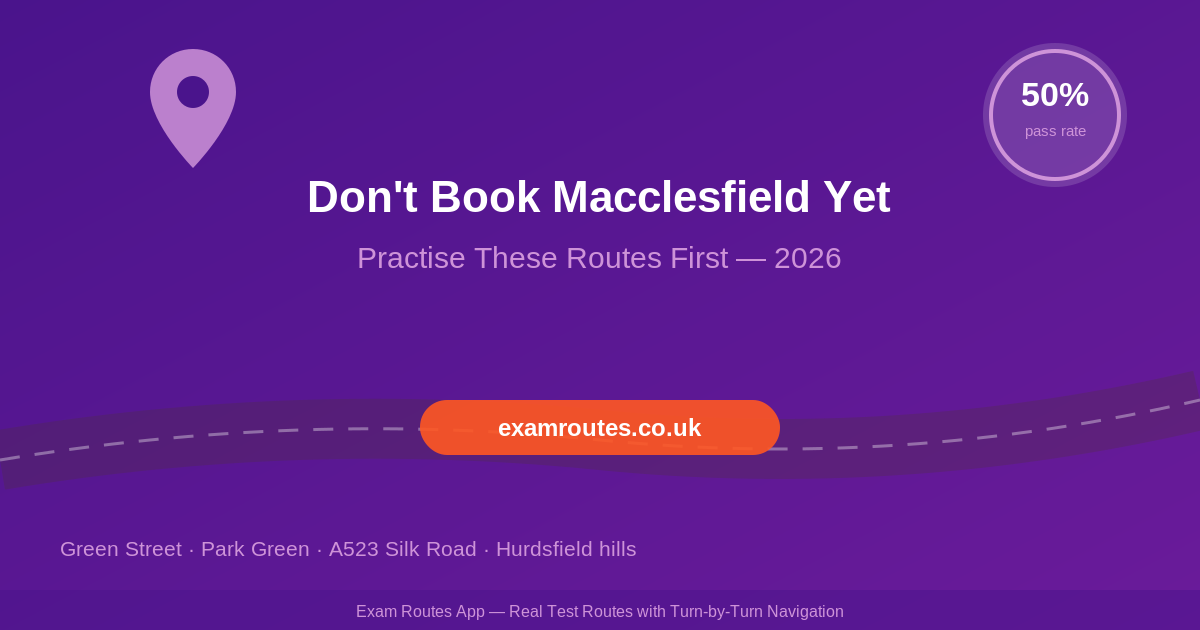
On paper, Macclesfield looks like a comfortable place to sit your driving test. Recent DVSA figures put the pass rate around 50%, roughly in line with or a little above the Great Britain average of 48.7%. It is a Cheshire market town rather than a city, and the surrounding countryside is genuinely beautiful.
The reality on test day is more demanding. Macclesfield routes squeeze town centre one-way sections, a cluster of busy roundabouts, steep gradients on the eastern side of town, and fast A-road driving into a single 38-minute test. Then there is the parking problem: the test centre has no car park, so your test begins and ends on residential streets that are already full.
If you are about to book at Macclesfield, here is what to practise first.
About Macclesfield Driving Test Centre
The centre is at Unit 4 Bailey Court, Green Street, Macclesfield, Cheshire, SK10 1JQ, close to the town centre on the eastern side.
Key practicalities:
- No on-site parking. This is the single most important thing to know. You will park on nearby residential roads, which are often full. Arrive twenty minutes early, not ten.
- Bring your provisional licence and a test-legal car — taxed, insured for the test, roadworthy, L plates front and rear, and an extra interior mirror.
- Facilities are minimal. Plan accordingly.
- Because there is no car park, forward and reverse bay parking are less likely to be set at the centre than at other sites, which shifts the odds towards parallel parking or pulling up on the right during the route.
Green Street sits close to the town’s one-way network, so your first two minutes involve real decisions rather than a gentle roll-out.
The Routes: Roads That Keep Coming Up
The DVSA no longer publishes official routes. What local instructors consistently report is that Macclesfield tests draw on four areas.
1. Town centre and the one-way system
Green Street, Hibel Road, Churchill Way and the streets around the bus station. One-way sections, traffic lights, pedestrian crossings and bus movements in a compact area. Lane discipline and reading signage early both matter.
2. The main roundabouts
Park Green roundabout, the Gawsworth Road roundabout and the bus station roundabout are all regulars. Several sit on gradients, which adds clutch and handbrake management to the observation task.
3. The A-roads: A523, A537 and A34
The A523 Silk Road is the fast element — a dual carriageway bypass with slip roads where examiners assess joining, lane discipline and making appropriate progress. The A537 London Road and the A34 Manchester Road offer busy urban A-road driving with side turnings and parked vehicles.
4. Residential and hillside estates
Hurdsfield, Upton Priory and the streets rising towards the eastern edge of town. Narrow, parked-up, and in places genuinely steep. Hill starts here are not a formality.
Tricky Spots and Common Challenges
- The one-way system. Multiple lanes, short distances between decision points. Read the signage on approach, not at the junction.
- Park Green roundabout. Busy, with traffic joining from several directions and pedestrian crossings close to the exits.
- Joining the A523 Silk Road. The recurring fault is merging too slowly. Build speed on the slip road, check your right blind spot, and merge decisively.
- Hurdsfield gradients. Uphill junctions where you must hold the car on the biting point or handbrake while observing. Rolling back is a serious fault.
- Parking around the test centre. Green Street and the roads around it are tight and often full. If you are still hunting for a space five minutes before your slot, you start the test flustered.
- Meeting traffic on residential streets. Parked both sides in Hurdsfield and the older terraces. Decide early who has priority and act.
- Speed limit changes. The transition from the 70 mph Silk Road back into 30 and 20 mph zones is sharp. Learners routinely carry too much speed in.
- Rural lanes towards Rainow and the Peak fringe. Some routes head east into narrow, hedged lanes with blind bends and steep gradients.
Practise Real Test Routes on Your Phone
The Exam Routes App gives you access to real driving test routes with turn-by-turn navigation. Practise at your own pace and build confidence before test day.
Pass Rates & Statistics
Reported pass rates for Macclesfield cluster around 50%, with independent sources giving figures between roughly 49.9% and 53.5% depending on the period sampled. The Great Britain average is 48.7%, so Macclesfield is a touch above par rather than an outlier in either direction.
That middling figure is arguably more honest than an extreme one. It reflects a test that has a bit of everything: town centre complexity, a proper dual carriageway, gradients, and rural lanes. There is no single element that trips everybody up, which means there is also nowhere to hide if a particular skill is weak.
Nationally, the first-time pass rate is around 49%, essentially identical to the overall rate. In other words, sitting the test again does not statistically improve your odds much on its own — targeted practice does.
Top Tips for Passing at Macclesfield
- Solve the parking problem in advance. Drive to Green Street at the same time of day as your test slot, at least twice, and find out where you will realistically park.
- Practise hill starts properly. Not on a gentle slope — on the Hurdsfield gradients. Uphill, at a junction, with traffic behind you.
- Do the one-way system until it is dull. Hibel Road, Churchill Way, Green Street. Know which lane you need before you are in it.
- Get real A523 practice. Joining and leaving a 70 mph dual carriageway is not the same skill as driving through town, and it appears on most routes.
- Rehearse parallel parking and pulling up on the right. With no car park at the centre, these are more likely than bay parking.
- Watch the speed transitions. Coming off the Silk Road into a 30 zone needs deliberate braking, not coasting.
- Drive the eastern lanes. If your route heads towards Rainow, blind bends and single-track sections need a completely different approach from town driving.
How the Exam Routes App Can Help
Macclesfield’s difficulty is spread across four very different environments, which makes it hard to prepare for in a handful of lessons. Most learners are strong in one or two of them and weak in the rest.
The Exam Routes App lets you drive real test routes with turn-by-turn navigation so you can find out which part of the route exposes you, then go back and repeat exactly that section — the Silk Road slip, the Hurdsfield hill, the one-way system — rather than paying for a full lesson to reach it each time. Practise with your instructor or with a supervising driver during private practice.
Frequently Asked Questions
What is the pass rate at Macclesfield driving test centre?
Reported figures cluster around 50%, with sources giving between roughly 49.9% and 53.5% depending on the period. The Great Britain average is 48.7%, so Macclesfield sits slightly above par.
Where is Macclesfield driving test centre?
Unit 4 Bailey Court, Green Street, Macclesfield, Cheshire, SK10 1JQ, close to the town centre on the eastern side.
Is there parking at Macclesfield driving test centre?
No. There is no on-site car park, so you will need to park on nearby residential roads. These fill up quickly, so arrive around twenty minutes before your slot.
Which manoeuvre is most likely at Macclesfield?
Because there is no car park at the centre, bay parking is less likely to be set there than at other sites. Parallel parking and pulling up on the right during the route are both common. Practise all four regardless.
Does the Macclesfield test include the Silk Road?
The A523 Silk Road frequently features as the higher-speed element of the route, testing joining, lane discipline and appropriate progress on a dual carriageway.
Are there steep hills on the Macclesfield test?
Yes. The eastern side of town towards Hurdsfield and the Peak District fringe includes genuine gradients, so uphill junctions and hill starts should be well practised.
Ready to Pass? Download Exam Routes Now
Practise the roads your examiner actually uses with the Exam Routes App. Available on the App Store and Google Play.