Darlington is one of the busier test centres in the North East, and it has a reputation among local instructors for being fair but unforgiving on observation. The town packs a lot of pedestrian crossings, mini-roundabouts and multi-lane junctions into a compact area, so a candidate who has only practised on quiet estate roads tends to feel the pace immediately.
If you are booked at Darlington in 2026, the good news is that the routes are learnable. There is no exotic hazard here, no mountain pass and no motorway. What there is instead is volume: crossing after crossing, junction after junction, with enough traffic that hesitation gets punished and enough space that going too slowly stands out.
This guide covers where the centre is, the roads that keep appearing on Darlington routes, the spots that catch learners out, what the pass rate actually tells you, and how to prepare so test day feels like another lesson.
About Darlington Driving Test Centre
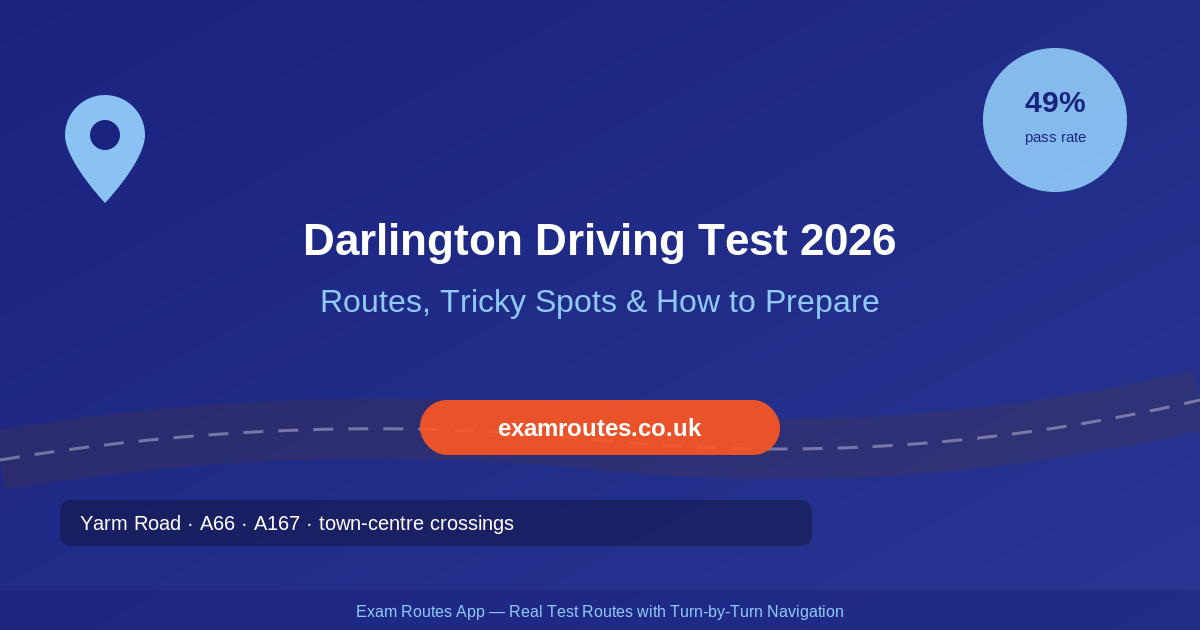
Darlington driving test centre operates from High Point Business Park on Yarm Road, on the eastern side of town (DL1 4PW). Always check the address printed on your booking confirmation, because the DVSA occasionally moves operations between sites and Darlington also handles vocational testing.
Parking at business-park sites is usually limited and shared with other units, so arrive with fifteen or twenty minutes to spare rather than five. Use that time to walk the immediate area if you can — knowing which way you will be asked to turn out of the car park removes one small unknown from the start of the test.
What to bring on the day
- Your UK photocard provisional licence
- Your theory test pass certificate number (the examiner can look it up, but have it to hand)
- A car that meets DVSA rules — taxed, insured for the test, roadworthy, with L plates and an extra interior mirror
- Your glasses or contact lenses if you need them to read a number plate at 20 metres
The Routes: Roads You Are Likely to Meet
Test routes from Yarm Road tend to fan out in three directions: back towards the town centre and its one-way sections, east along the A66 corridor, and south through residential streets towards Hummersknott and Blackwell. Expect a genuine mix within forty minutes.
- A66 — The main east–west dual carriageway. Joining and leaving it tests slip-road speed matching and lane discipline more than anything else.
- A167 / Grange Road — Multi-lane approaches into town with filter lanes and traffic-light junctions where lane choice needs to be made early.
- Yarm Road itself — Busy, commercial, and lined with side turnings and vehicle entrances — a constant test of anticipation.
- Residential Darlington — Haughton, Eastbourne and Hummersknott streets bring parked cars, narrow gaps and priority decisions.
- Mini-roundabouts — Darlington has plenty. They come up quickly and reward early observation rather than late braking.
You may also be taken onto short national-speed-limit stretches on the edge of town, where the examiner wants to see you make safe, confident progress rather than crawling at 40 in a 60 without reason.
Tricky Spots and Common Challenges
Pedestrian crossings, and lots of them
Darlington has an unusually high density of crossings within a short radius of the centre. Zebras, pelicans and puffins appear in sequence, sometimes two within a hundred metres. The fault that costs candidates here is not failing to stop — it is stopping in a way that surprises the driver behind, or creeping forward while someone is still on the crossing. Scan the pavements early: a pedestrian approaching a zebra is information you should already have.
Multi-lane roundabouts and lane choice
Where the A66 corridor meets local roads, roundabouts have two or three approach lanes with painted destinations. Committing to a lane late is where marks disappear. Read the sign board on approach, choose, and then hold your line through the roundabout without drifting.
The town-centre one-way sections
Darlington’s inner streets include one-way sections and bus-priority markings. The risk is a late lane change when you spot your exit. If you find yourself in the wrong lane, stay in it and follow it safely — a calm detour is not a fault, a last-second swerve is.
Making progress on the A66
Nervous candidates join dual carriageways too slowly and then sit at 50 in a 70 with a queue building. Examiners mark undue hesitation. Use the full slip road, match the traffic, and keep left unless you are overtaking.
Practise Real Test Routes on Your Phone
The Exam Routes App gives you access to real driving test routes with turn-by-turn navigation. Drive the roads around Darlington at your own pace and build confidence before test day.
Pass Rates and Statistics
Recent DVSA figures put Darlington’s car practical pass rate at roughly 49–50 per cent, which sits almost exactly on the national average of around 48–50 per cent for 2024/25. In other words, Darlington is a statistically ordinary centre: it neither flatters nor punishes candidates as a group.
What that average conceals is the split between candidates who have practised the local road types and those who have not. The faults recorded most often at centres like Darlington are observation at junctions, use of mirrors when changing direction, and inappropriate speed — all of which are habits, not luck.
Read pass rates carefully
A centre’s headline pass rate says as much about who books there as it does about the roads. Rural centres often look generous because candidates arrive later in their learning; busy urban centres look harsh because they absorb a huge volume of first attempts. Use the number as context, never as a prediction of your own result.
Top Tips for Passing at Darlington
- Practise crossings deliberately. Drive a loop that includes four or five different crossing types and get used to reading pedestrians early.
- Rehearse joining and leaving the A66 until slip roads stop feeling like a leap of faith.
- Learn the mini-roundabouts near the centre. Approach speed is everything — arrive able to go, rather than arriving and then deciding.
- Book a lesson at the same time of day as your test. Yarm Road at 08:30 is a different road from Yarm Road at 13:30.
- Practise the sat nav section. Twenty minutes of independent driving is now roughly half the test.
- Get comfortable with parked-car streets in Haughton or Eastbourne, where you must judge gaps and give way politely without stopping dead.
- If you take a wrong turn, keep driving safely. Route errors are not faults; the reaction to them can be.
How the Exam Routes App Can Help
The Exam Routes App maps real test routes used around Darlington and gives you turn-by-turn navigation so you can drive them with a supervising driver or in a lesson. Instead of guessing which roads the examiner favours, you can spend your practice hours on the crossings, roundabouts and A66 junctions that actually appear.
Practising with the app is not about memorising a route so you can drive it on autopilot. Examiners use a bank of routes and pick them on the day, and half of your test is now independent driving where you follow a sat nav or road signs on your own. The point of route practice is familiarity — so that when a junction appears, your attention is free for the traffic rather than being spent working out where the road goes.
Frequently Asked Questions
Where is Darlington driving test centre?
It operates from High Point Business Park on Yarm Road, Darlington, DL1 4PW, on the eastern side of town. Check your booking confirmation for the exact unit and any parking instructions.
What is the pass rate at Darlington?
Recent DVSA data puts it at around 49–50 per cent, effectively level with the national average. Your own preparation matters far more than the centre’s headline figure.
Will I go on the A66 during my test?
Very possibly. Dual carriageway sections are a normal part of Darlington routes, so practise joining, lane discipline and leaving at speed.
Are Darlington routes hard?
They are busy rather than technically difficult. The challenge is the density of crossings and junctions, which punishes late observation.
Can I see the official Darlington test routes?
No — the DVSA stopped publishing routes in 2010. Examiners use a bank of established routes, which is why practising the local road network is the realistic approach.
Ready to Pass at Darlington? Download Exam Routes
Download the Exam Routes App and practise the real roads used around your test centre, with turn-by-turn navigation, before you sit in the examiner’s passenger seat.