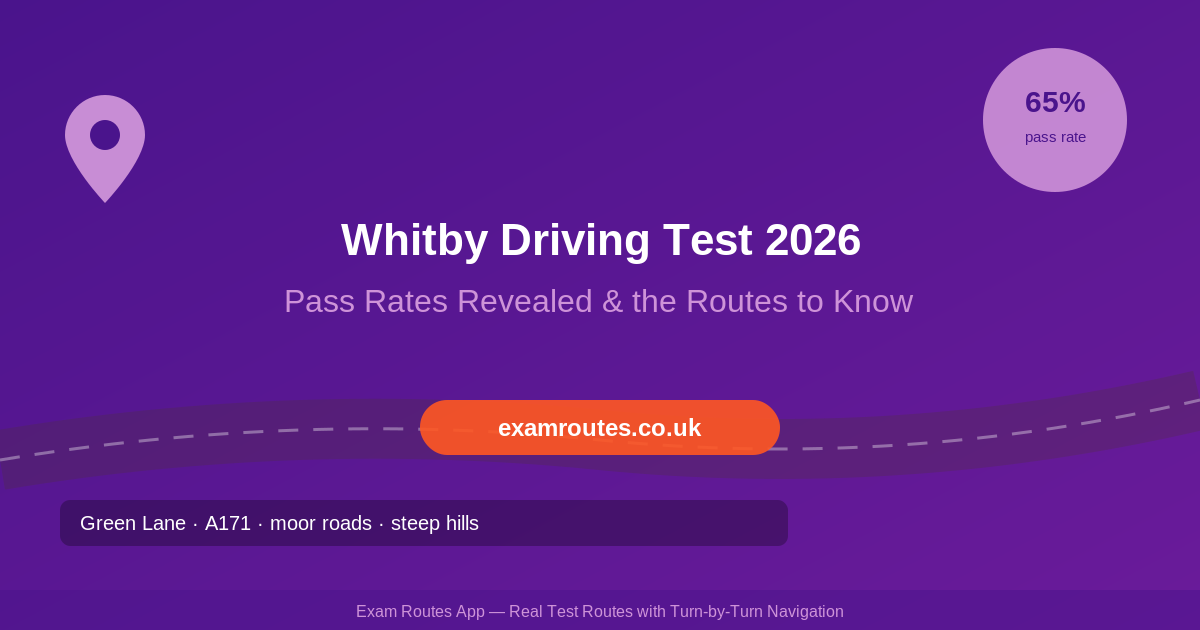
Whitby is one of the highest-scoring driving test centres in the country. Recent DVSA figures put its car practical pass rate at around 65 per cent — roughly fifteen points above the national average of about 50 per cent. On paper that makes it look like an easy ride. In practice, Whitby simply asks a different set of questions from an urban centre, and candidates who assume it will be gentle get caught out.
The town sits between the North York Moors and the sea, which means gradients, tight harbour-side streets, and open moorland roads at the national speed limit. There is far less stop-start traffic than in a city, but far more hill work, more single-track judgement, and more rural bends where reading the road ahead really matters.
This guide explains where the centre is, which roads appear on Whitby routes, why the pass rate is so high, and what you should practise if you want to be part of it.
About Whitby Driving Test Centre
Whitby driving test centre operates from Unit F11, St Hilda’s Business Centre, Green Lane, Whitby, YO22 4ET. It is a small site, so do not expect a large waiting room or generous parking — check your confirmation email for current arrangements.
Because Whitby runs fewer tests than a city centre, availability can be tight and cancellations move quickly. If you are travelling in for a test, drive the local roads beforehand: arriving straight off the A171 and going out on your test twenty minutes later is not a plan.
What to bring on the day
- Your UK photocard provisional licence
- Your theory test pass certificate number (the examiner can look it up, but have it to hand)
- A car that meets DVSA rules — taxed, insured for the test, roadworthy, with L plates and an extra interior mirror
- Your glasses or contact lenses if you need them to read a number plate at 20 metres
The Routes: Roads You Are Likely to Meet
Whitby routes make full use of the town’s geography. Expect a mix of steep residential streets, the seafront and harbour area, and open roads heading out towards the moors or along the coast.
- A171 (Whitby to Guisborough / Scarborough) — Fast, open, undulating road with long bends and national speed limit sections.
- A174 towards Sandsend — Coastal road with gradients, sea views and speed changes as you enter and leave villages.
- Whitby’s hill streets — Steep gradients around the town where hill starts and gear choice are genuinely tested.
- Harbour and town centre — Narrow, busy in season, with pedestrians stepping out and tight give-and-take between parked cars.
- Moor edge roads — Rural lanes with limited visibility, blind bends, and occasional livestock or horse riders.
What Whitby lacks in multi-lane roundabouts it makes up for in gradient and rural judgement. If your practice has all been on flat, wide roads, the hills alone will change how the car feels.
Tricky Spots and Common Challenges
Hill starts, and hill everything
Whitby is built on slopes. You may be asked to pull up and move off on a gradient steep enough that clutch control genuinely matters. Practise moving off uphill smoothly, without rolling back, and without revving the engine into next week. Rolling back into the space behind you is an immediate serious fault.
Narrow streets with parked cars
The older parts of town leave barely a car’s width between parked vehicles. Examiners look for you to hold back, make eye contact, and take your turn — not to squeeze through and hope. Stopping dead in the middle of the road when you had a clear space to wait in is equally a fault.
Rural bends on the A171
Out on the moor road the danger is speed carried into a bend you cannot see round. Slow in, look through the bend, and accelerate gently out. Examiners mark this as planning and anticipation, and it is where confident-but-untested drivers lose marks.
Seasonal pedestrians and tourists
In summer the harbour area fills with people who are not looking at the road. Whitby examiners expect a visibly cautious approach here: cover the brake, reduce speed, and treat every gap between parked cars as a potential pedestrian.
Horses, cyclists and farm traffic
On the moor edge you may meet a horse rider or a tractor. Pass wide and slow — at least a car’s width for a horse, and no engine revving. Getting this wrong is one of the quickest ways to turn a good drive into a fail.
Practise Real Test Routes on Your Phone
The Exam Routes App gives you access to real driving test routes with turn-by-turn navigation. Drive the roads around Whitby at your own pace and build confidence before test day.
Pass Rates and Statistics
Whitby’s car practical pass rate of roughly 65 per cent for 2024/25 puts it among the strongest performers in Great Britain, well clear of the national average of around 50 per cent. Rural and coastal centres consistently top these tables.
The reason is partly the roads and partly the candidates. Fewer tests are conducted, traffic volumes are lower, and learners in rural areas often accumulate more supervised driving hours before booking. That does not make the test easier — it means the local population arrives better prepared on average. The standard the examiner applies is identical to the standard in central London.
Read pass rates carefully
A centre’s headline pass rate says as much about who books there as it does about the roads. Rural centres often look generous because candidates arrive later in their learning; busy urban centres look harsh because they absorb a huge volume of first attempts. Use the number as context, never as a prediction of your own result.
Top Tips for Passing at Whitby
- Master hill starts on a genuinely steep gradient, not a gentle slope. Whitby will find the steep one.
- Practise meeting oncoming traffic in narrow streets until holding back feels natural.
- Drive the A171 at national speed limit with a supervising driver and work on reading bends early.
- Rehearse rural observation: gateways, mud on the road, blind summits and slow-moving vehicles.
- If you test in summer, practise the harbour area at a busy time so pedestrians are not a shock.
- Book early. Whitby runs a smaller test volume and slots go quickly.
- Do not let the high pass rate make you complacent — the marking sheet is national, not local.
How the Exam Routes App Can Help
The Exam Routes App maps the coastal and moorland roads used around Whitby with turn-by-turn navigation, so you can build hours on the exact gradients, bends and narrow sections that appear on test rather than guessing from a map.
Practising with the app is not about memorising a route so you can drive it on autopilot. Examiners use a bank of routes and pick them on the day, and half of your test is now independent driving where you follow a sat nav or road signs on your own. The point of route practice is familiarity — so that when a junction appears, your attention is free for the traffic rather than being spent working out where the road goes.
Frequently Asked Questions
What is the pass rate at Whitby?
Around 65 per cent for 2024/25 — roughly fifteen points above the national average, and among the highest in Great Britain.
Where is Whitby driving test centre?
Unit F11, St Hilda’s Business Centre, Green Lane, Whitby, YO22 4ET. It is a small site with limited facilities.
Is the Whitby driving test easier?
The marking standard is the same everywhere. Whitby has less heavy traffic but more hills, narrow streets and rural bends, so it tests different skills.
Will I drive on the moors during my test?
Possibly. Routes often include open national-speed-limit roads towards the moors, where planning and bend approach are assessed.
Is it worth travelling to Whitby for a higher pass rate?
Only if you can practise there properly. Driving unfamiliar hills and rural bends for the first time on test day usually costs more than the pass rate gains.
Don’t Leave Your Whitby Test to Chance
Download the Exam Routes App and practise the real roads used around your test centre, with turn-by-turn navigation, before you sit in the examiner’s passenger seat.