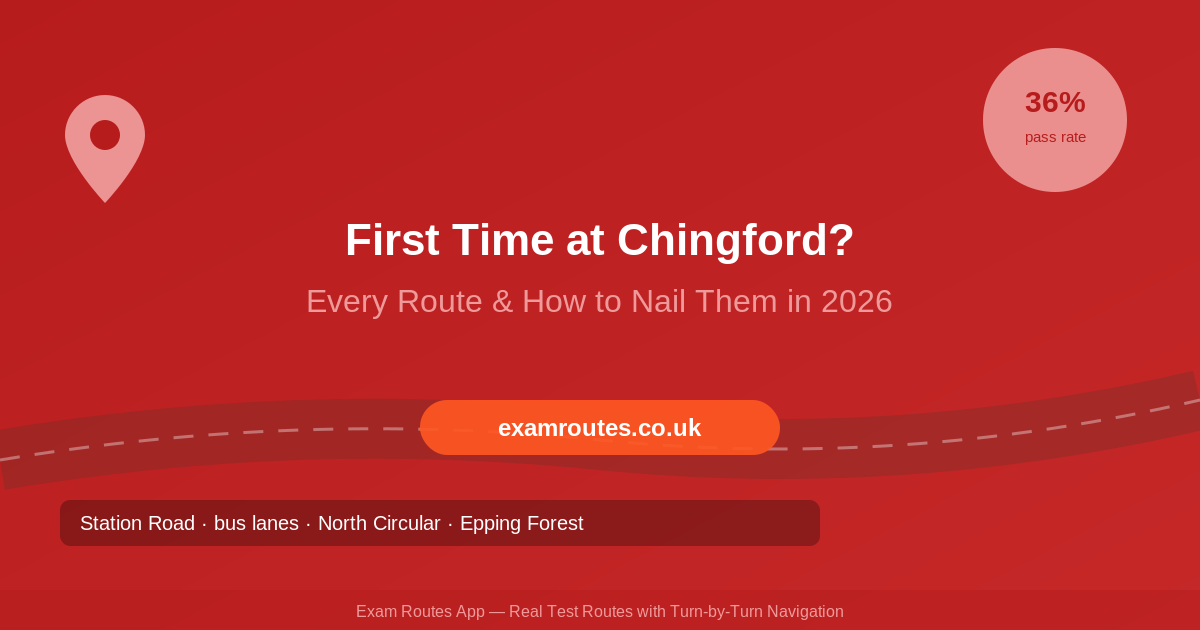
Chingford is one of the hardest test centres in London, and the numbers do not soften it. Recent figures put the car practical pass rate at around 36 per cent against a national average of roughly 50 per cent, with first-time passes lower still. If you are booked here, the honest advice is to over-prepare.
None of that is because Chingford examiners are harsh. It is because the roads are relentless. Station Road and the surrounding high streets combine bus lanes, loading bays, pedestrian crossings, box junctions and heavy parked-car pressure in the same hundred metres, and the routes push out towards the North Circular where speed and lane discipline replace all of that with a different kind of pressure.
This guide covers the centre, the roads you will meet, the mistakes that dominate the fault sheets here, and a preparation plan that reflects how demanding this centre really is.
About Chingford Driving Test Centre
Chingford driving test centre is at Doric House, 128 Station Road, Chingford, London, E4 6AD. Parking is very limited, which is itself part of the challenge — you may need to park some distance away and walk, so build that into your timings.
This is a high-volume centre conducting many thousands of tests a year, which means slots fill fast and cancellations move quickly. It also means the examiners see every version of every fault, and the standard is applied consistently.
What to bring on the day
- Your UK photocard provisional licence
- Your theory test pass certificate number (the examiner can look it up, but have it to hand)
- A car that meets DVSA rules — taxed, insured for the test, roadworthy, with L plates and an extra interior mirror
- Your glasses or contact lenses if you need them to read a number plate at 20 metres
The Routes: Roads You Are Likely to Meet
Routes from Station Road work the local high streets and residential grid before pushing out towards Walthamstow, Highams Park, the North Circular corridor or the edge of Epping Forest.
- Station Road and Chingford Mount Road — Dense high-street driving: buses, crossings, loading, and constant side turnings.
- Bus lanes — Marked bus lanes with operating-hour plates that must be read and obeyed.
- A406 North Circular corridor — Fast multi-lane driving with heavy merging and lane changes.
- Residential Chingford and Highams Park — Narrow streets, permit parking on both sides, and priority give-and-take.
- Epping Forest edge roads — Faster, more open sections with bends, horse riders and cyclists.
You may also meet box junctions, yellow-line restrictions and one-way sections. Manoeuvres are frequently set on residential streets where the parking pressure makes them genuinely difficult.
Tricky Spots and Common Challenges
Bus lanes and their operating hours
The most avoidable fault at Chingford. A bus lane with a time plate is legal to use outside those hours and a fault inside them, and candidates who cannot read the plate at a glance either enter illegally or swerve out at the last moment. Learn to read the sign early and plan your position hundreds of metres in advance.
High-street pedestrian pressure
Station Road produces pedestrians stepping out from between buses and parked vehicles constantly. Examiners want to see a speed that gives you time to react and eyes that are scanning the pavement, not just the car in front.
Box junctions
Entering a box junction when your exit is not clear is a common London fault. The rule is simple and the discipline is hard when traffic is crawling: do not enter unless you can clear it, except when turning right and held only by oncoming traffic.
Joining and leaving the North Circular
The A406 asks for confident merging, decisive lane selection and firm progress. Candidates who have practised only on local streets are usually too slow to join and too tentative to change lanes.
Parked-car pressure on residential streets
In Chingford’s residential grid, cars line both sides and oncoming traffic is constant. This is meeting-traffic judgement in its purest form: choose a gap, hold back, make eye contact, and move decisively when it is your turn.
Manoeuvres in tight spaces
A parallel park on a busy Chingford street is nothing like one on an empty road. Expect a real gap, real traffic waiting, and real pressure. Practise until you can do it with a car behind you.
Practise Real Test Routes on Your Phone
The Exam Routes App gives you access to real driving test routes with turn-by-turn navigation. Drive the roads around Chingford at your own pace and build confidence before test day.
Pass Rates and Statistics
Chingford’s recent car practical pass rate has been reported at around 36 per cent, with first-time pass rates near 35 per cent. That places it well below the national average of roughly 50 per cent and among the lower-performing London centres.
London centres dominate the bottom of the pass-rate table for structural reasons: traffic density, complex road markings, high candidate volumes and a large proportion of first attempts. It does not mean you cannot pass at Chingford — it means the margin for unpractised habits is smaller here than almost anywhere else.
Read pass rates carefully
A centre’s headline pass rate says as much about who books there as it does about the roads. Rural centres often look generous because candidates arrive later in their learning; busy urban centres look harsh because they absorb a huge volume of first attempts. Use the number as context, never as a prediction of your own result.
Top Tips for Passing at Chingford
- Put serious hours into bus-lane awareness. Read the plates, plan your lane early, and never make a late correction.
- Practise Station Road at a genuinely busy time. A quiet Sunday drive teaches you nothing about this centre.
- Learn box junction rules until they are automatic, then practise them in real queuing traffic.
- Do at least two lessons on the A406 for merging, lane discipline and confident progress.
- Rehearse parallel parking on a real street with traffic behind you, not in a car park.
- Build meeting-traffic judgement on the residential grid until holding back feels routine.
- Practise the twenty-minute sat-nav independent driving section in exactly this kind of traffic.
- Arrive very early. Parking near the centre is limited and a stressful arrival costs you the first five minutes of the test.
How the Exam Routes App Can Help
The Exam Routes App maps the real roads used on Chingford test routes — the high streets, the bus-lane sections, the residential grid and the A406 links — with turn-by-turn navigation, so you can spend your practice hours where the marks are actually lost.
Practising with the app is not about memorising a route so you can drive it on autopilot. Examiners use a bank of routes and pick them on the day, and half of your test is now independent driving where you follow a sat nav or road signs on your own. The point of route practice is familiarity — so that when a junction appears, your attention is free for the traffic rather than being spent working out where the road goes.
Frequently Asked Questions
Where is Chingford driving test centre?
Doric House, 128 Station Road, Chingford, London, E4 6AD. On-site parking is very limited.
What is the pass rate at Chingford?
Around 36 per cent in recent reporting, with first-time passes near 35 per cent — well below the national average of roughly 50 per cent.
Why is Chingford so hard?
Dense high-street traffic, bus lanes, box junctions, heavy parked-car pressure and fast A406 sections, all inside one forty-minute test.
Should I book somewhere else instead?
Only if you can practise there. Travelling to an easier centre you have never driven in usually costs more than it gains — and DVSA rules now limit you to your three nearest centres when moving a booked test.
Will I drive on the North Circular?
Possibly. Faster multi-lane sections feature on some Chingford routes, so practise merging and lane changes.
Chingford Is Tough. Go in Prepared.
Download the Exam Routes App and practise the real roads used around your test centre, with turn-by-turn navigation, before you sit in the examiner’s passenger seat.