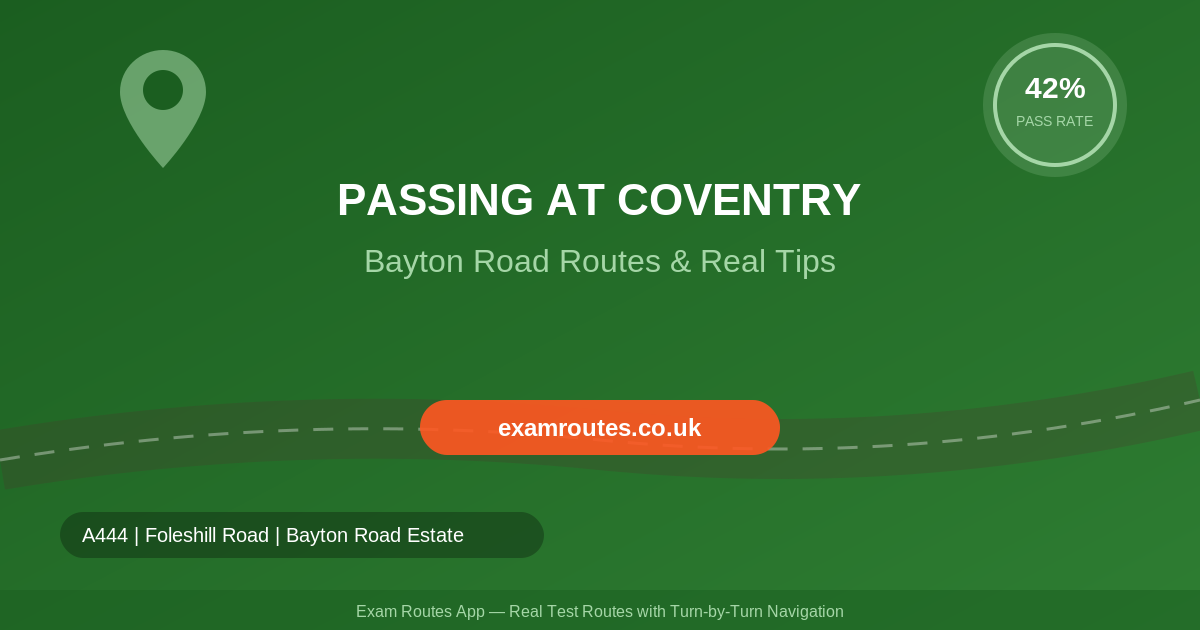
Your instructor will tell you where the test centre is, which manoeuvres to practise, and how many faults you are allowed. What they will rarely tell you — because it is uncomfortable — is that Coventry (Bayton Road) is one of the harder centres in the West Midlands, with a pass rate that has sat around 42% in recent reporting periods against a Great Britain average of roughly 48-49%.
That is not a reason to avoid it. It is a reason to prepare differently. Coventry’s routes are built around fast dual carriageways, large multi-lane roundabouts and industrial estate traffic, and the faults that fail people there are not random. They are predictable, they repeat, and once you know what they are you can train them out.
Here is the honest version of passing at Coventry: the roads, the specific spots, and the habits that separate the people who pass from the people who rebook.
About Coventry (Bayton Road) Test Centre
The centre is at 42 Bayton Road, Bayton Road Industrial Estate, Coventry CV7 9EJ — technically in Exhall, on the northern edge of the city near the M6 and the A444.
What you need to know before test day:
- Location — industrial estate, so expect HGVs, delivery vans and lorries manoeuvring near the centre.
- Parking — on-site space is limited and shared with the estate. Plan for your instructor to drop you.
- What to bring — provisional licence, a car that meets DVSA rules (valid MOT if over three years old, insurance covering the test, L-plates, extra mirror, working seatbelts and no dashboard warning lights).
- Test types — car practical tests, manual and automatic.
The eyesight check happens in the car park. Because the estate is busy, examiners will often ask you to read a plate at an angle across moving traffic. Take a proper look before you answer.
The Routes: Roads That Come Up Again and Again
Bayton Road sits between the A444, the Longford area and the northern Coventry suburbs. That geography shapes almost every route.
The A444 (Phoenix Way)
Fast dual carriageway with 50 and 70mph sections, slip roads and lane changes. Examiners use it to test whether you can make progress and hold a lane at speed. Under-driving here is as much of a fault as over-driving.
Bedworth Road and Longford Road
Busy urban distributor roads with parked cars, side turnings, bus stops and pedestrian crossings. Most observation faults happen on these.
Foleshill Road
Dense, commercial, and constantly interrupted by parked and stopping vehicles. High pedestrian numbers. If you struggle with meeting oncoming traffic, this is where it will show.
The Bayton Road industrial estate itself
Wide roads, lorry traffic, and a lot of vehicles reversing. Manoeuvres are frequently set within the estate.
Residential streets around Exhall and Bedworth
Narrow, parked-up and used for the parallel park and pulling up on the right.
Tricky Spots and Common Challenges
1. Joining and leaving the A444
Slip road speed matching is the single biggest differentiator at Coventry. Learners join too slowly and force traffic in lane one to brake, which is a serious fault. Get up to the speed of the traffic on the slip road, not on the carriageway.
2. Multi-lane roundabouts on the A444 corridor
Lane selection has to happen early. Once you are committed at speed, changing your mind is dangerous. Learn which lane serves which exit before test day.
3. Lorries in the industrial estate
Articulated vehicles need the full width of the road to turn. Do not creep up alongside one that is manoeuvring, and be prepared to hold back further than feels natural.
4. Foleshill Road parked-car sections
Classic hesitation and progress territory. The examiner wants to see you assess the gap, decide, and move — not sit indefinitely waiting for a perfectly empty road.
5. Speed limit changes
The routes move between 30, 40, 50 and national speed limit sections quickly. Failing to spot a limit change is one of the most common Coventry faults. Watch for repeater signs and street lighting.
6. Pedestrian crossings on Bedworth Road
Several crossings in short succession. Approach ready to stop, not just hoping the light stays green.
Practise Real Test Routes on Your Phone
The Exam Routes App gives you access to real driving test routes with turn-by-turn navigation. Practise at your own pace and build confidence before test day.
Pass Rates and What They Actually Mean
Coventry (Bayton Road) has been reported at roughly 42-42.5% in recent DVSA periods. That puts it several points below the national figure.
Two things explain most of the gap:
- Route difficulty. Dual carriageway work and large roundabouts are genuinely harder than the residential and rural driving that dominates high-scoring centres.
- Test-taker mix. Large urban centres have high volumes of first-attempt candidates, and first-timers pass at a lower rate everywhere.
What the number does not tell you is anything about your chances. A candidate who has driven the A444 slip roads twenty times is in a completely different position to one who has never joined a dual carriageway under test conditions.
Six Tips Your Instructor Might Not Emphasise Enough
- Train dual carriageway joins until they are boring. Not once. Repeatedly, in different traffic conditions.
- Say your lane choice out loud in practice. “Left lane for the second exit.” It forces early decisions, which is exactly what Coventry rewards.
- Practise at your test time. Bayton Road at 8:30am, with shift traffic in the estate, is a completely different test to 1pm.
- Do not treat 40mph limits as advisory. Driving at 32 in a 40 is a progress fault, and it happens constantly on Coventry routes.
- Rehearse manoeuvres around lorries. A reverse bay park with a van pulling in behind you is a real Coventry scenario.
- Get your mirror routine automatic. Every lane change on the A444 needs mirror, signal, blind spot, move — in that order, every time.
How the Exam Routes App Can Help
The problem with Coventry is not that the roads are secret — it is that there are a lot of them and most learners never drive the right ones. The Exam Routes App gives you real driving test routes with turn-by-turn navigation, so you can practise the A444 sections, the Longford and Foleshill roads, and the estate streets used for manoeuvres, in the order an examiner would use them.
Drive a route, note where you hesitated, then drive it again. That loop is what turns a 42% centre into a manageable one.
Frequently Asked Questions
Where is Coventry driving test centre?
42 Bayton Road, Bayton Road Industrial Estate, Coventry CV7 9EJ, in Exhall on the northern edge of the city.
What is the pass rate at Coventry Bayton Road?
Recent DVSA reporting has put it around 42-42.5%, below the Great Britain average of roughly 48-49%.
Do Coventry test routes use dual carriageways?
Yes. The A444 features heavily, including joining and leaving via slip roads. Independent driving sections often run along it.
Why is Coventry’s pass rate low?
A combination of demanding route features — fast dual carriageways, multi-lane roundabouts, industrial traffic — and a high proportion of first-attempt candidates.
Should I book a different Coventry centre?
Bayton Road is Coventry’s main car test centre. Booking further afield only helps if you actually practise there; otherwise you trade a known challenge for an unknown one.
Don’t Leave Your Test to Chance
Download the Exam Routes App and drive the real routes before the examiner does. Turn-by-turn navigation, hundreds of UK test centres, practise whenever suits you.