Exeter’s test centre is on Heron Road in the Sowton Industrial Estate, and that address tells you most of what you need to know. Within a couple of minutes of leaving the car park you can be on a fast A-road, at a large roundabout, in an industrial estate full of lorries, or heading out towards genuinely rural Devon lanes. Few centres in the South West cover so many road types so quickly.
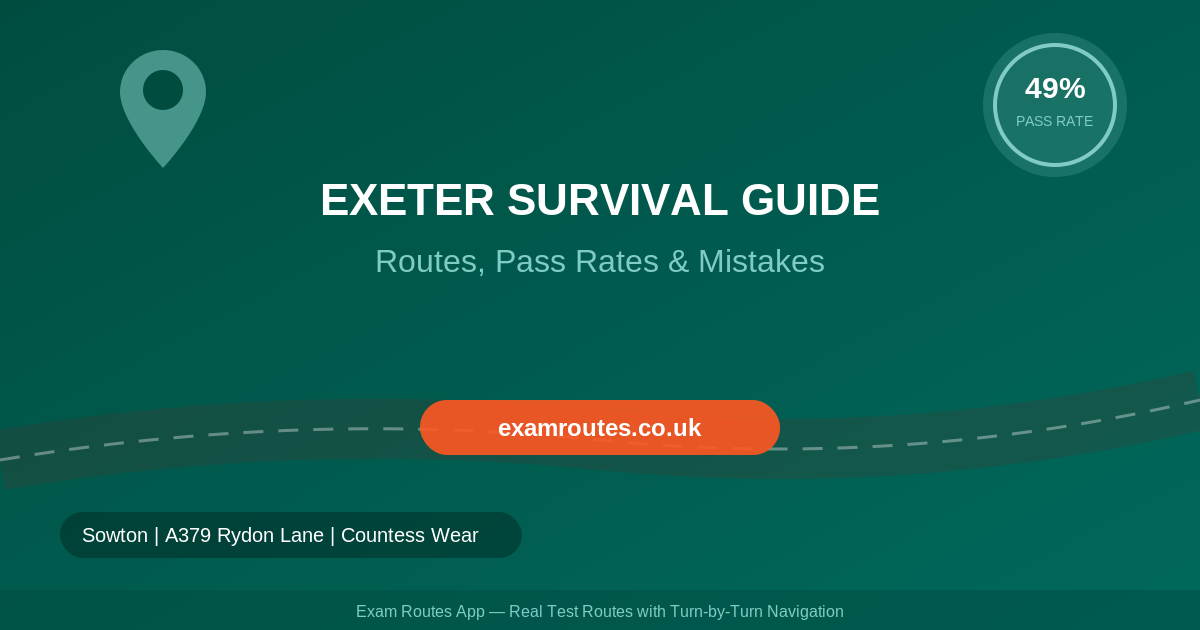
Reported pass rates for Exeter cluster around 45-50% depending on the reporting period, with 49-49.6% being typical. That is roughly the Great Britain average of 48-49%. Exeter is not a punishing centre — but it is a varied one, and variety is what catches out learners who have practised the same three streets for six months.
This survival guide covers the centre, the routes, the pass rate context, and the mistakes that end Exeter tests.
About Exeter Driving Test Centre
Address: Heron Road, Sowton Industrial Estate, Exeter EX2 7LL. It sits east of the city near the M5 junction 30 corridor and the A379.
- Parking — on-site parking is available, and reverse bay parking is commonly set here.
- Getting there — the estate is well signposted but busy with commercial traffic. Allow extra time in the morning.
- What to bring — provisional licence, roadworthy car with valid insurance and MOT, L-plates, an additional interior mirror, and any glasses you need.
- Test types — car practical, manual and automatic.
The Routes: Road Types You Will Meet
Sowton Industrial Estate
Wide roads, roundabouts, lorries and vans, plus retail park entrances. Manoeuvres and the first few minutes of the test usually happen here.
A379 Rydon Lane and Honiton Road
Fast dual and near-dual carriageway sections with a chain of roundabouts. Progress, lane discipline and roundabout technique are assessed heavily here.
Heavitree, Whipton and Pinhoe
Established residential suburbs with parked cars, side turnings, mini-roundabouts and pedestrian crossings. Observation and meeting-traffic faults concentrate here.
Topsham Road and Countess Wear
Mixed-speed roads with a large roundabout and river crossings. Lane choice matters.
Rural lanes towards Clyst St Mary and Woodbury
Narrow, hedged, national speed limit lanes with blind bends and passing places. Speed judgement is the whole test here — going too fast is dangerous, going too slow is a progress fault.
Tricky Spots That Catch Learners Out
1. The Sowton roundabouts
Several in quick succession, with commercial traffic that does not always signal helpfully. Choose your lane on approach and stick to it.
2. Countess Wear roundabout
Multi-lane and busy, connecting Topsham Road, the A379 and the Exeter bypass. Lane errors here are common and expensive.
3. Rural lanes near Clyst St Mary
National speed limit does not mean 60 is appropriate. The examiner wants a speed you could stop within the distance you can see to be clear. Equally, crawling at 25 on a straight clear lane is undue hesitation.
4. Mini-roundabouts in Heavitree and Whipton
Small, often with poor visibility and drivers who treat them as give-way lines. Approach ready to stop and give way to the right properly.
5. Parked cars on Heavitree residential streets
Narrow with vehicles both sides. Decide early who has priority.
6. Cyclists and pedestrians near the university and hospital
Exeter has heavy foot and cycle traffic around the RD&E hospital and the university approaches. Expect it and slow early.
Practise Real Test Routes on Your Phone
The Exam Routes App gives you access to real driving test routes with turn-by-turn navigation. Practise at your own pace and build confidence before test day.
Pass Rates and Statistics
Published figures for Exeter vary by source and period, generally falling between 45% and 52%, with 49-49.6% the most commonly cited recent number. The Great Britain average is roughly 48-49%.
Exeter’s number is interesting because the routes contain both easy-scoring and hard-scoring elements. Rural lanes and industrial estate roads are relatively forgiving. The A379 roundabout chain and the city suburbs are not. Candidates tend to fail in the middle section of the test rather than at the start or end.
Mistakes to Avoid at Exeter
- Treating rural lanes as a rest. They are where speed and hazard-awareness faults appear. Read the road, not the sign.
- Late lane choice on the A379. Decide 200 metres out.
- Rushing the reverse bay park. The Sowton car park is busy. Take the extra second to check for vehicles moving behind you.
- Under-driving in 40mph sections. Progress faults are among Exeter’s most common.
- Ignoring lorries in the estate. Give them room to swing; do not sit in their blind spot.
- Assuming a mini-roundabout is a give-way. It is a roundabout. Signal and give way to the right.
- Only practising in the city. If you have never driven a Devon lane at 50, you are not ready for an Exeter test.
How the Exam Routes App Can Help
Exeter’s difficulty is spread across four or five distinct environments, and covering all of them properly takes planning. The Exam Routes App gives you real driving test routes with turn-by-turn navigation, so you can drive the Sowton estate, the A379 roundabout sequence, the Heavitree suburbs and the rural lanes in the order an examiner would link them.
That structure matters more at a centre like Exeter than almost anywhere else, because the challenge is switching between road types smoothly rather than mastering any single one.
Frequently Asked Questions
Where is Exeter driving test centre?
Heron Road, Sowton Industrial Estate, Exeter EX2 7LL, east of the city centre.
What is the pass rate at Exeter?
Recent published figures generally sit between 45% and 52%, with around 49% being the most commonly reported. That is close to the Great Britain average.
Do Exeter test routes include country roads?
Yes. Lanes towards Clyst St Mary, Woodbury and the surrounding villages feature regularly, including national speed limit sections.
Is reverse bay parking common at Exeter?
It is frequently set in the test centre car park, though all four DVSA manoeuvres remain possible.
What is the hardest part of the Exeter test?
Most instructors point to the A379 roundabout sequence and lane discipline around Countess Wear, plus speed judgement on the rural lanes.
Don’t Leave Your Test to Chance
Download the Exam Routes App and drive the real routes before the examiner does. Turn-by-turn navigation, hundreds of UK test centres, practise whenever suits you.