Bournemouth’s driving test centre sits at 21-23 Gillam Road, Northbourne, BH10 6BW — a residential road on the northern side of town. From there, examiners can send you towards the Wessex Way dual carriageway, into the terraced streets of Winton and Charminster, out to the Castle Lane roundabouts, or down towards the seafront. Each of those environments tests something different, and each has a handful of spots where Bournemouth tests reliably go wrong.
This is a road-by-road breakdown: the turns, the junctions and the roundabouts that make up a Bournemouth test route, and what to do at each one.
About Bournemouth Driving Test Centre
Address: 21-23 Gillam Road, Northbourne, Bournemouth BH10 6BW.
- Location — a residential street, so the first turn of your test is usually into a quiet road rather than straight onto a main carriageway.
- Parking — very limited on-site. Most candidates are dropped off. Do not circle the street looking for a space five minutes before your slot.
- What to bring — provisional licence, a test-legal car with valid insurance, MOT where applicable, L-plates and an extra interior mirror.
- Test types — car practical, manual and automatic.
Because the centre is in a residential area, the eyesight check and the first minute of driving are relatively calm. That lulls some candidates. The difficulty arrives within about four minutes.
The Routes: Every Section Mapped
Section 1 — Northbourne residential streets
Wimborne Road, Redhill Avenue and the surrounding grid. Parked cars, junction density and pedestrians. The examiner is establishing your baseline: mirrors, signalling, junction observation.
Section 2 — Castle Lane West and the roundabout chain
Castle Lane West is a fast, wide distributor road with several large roundabouts linking to Wessex Way and Ringwood Road. This is where lane discipline is assessed. Learners who choose a lane late get marked here more than anywhere else in Bournemouth.
Section 3 — Wessex Way (A338)
Dual carriageway with a 50mph limit through much of the urban section, slip roads, and the Cooper Dean roundabout at its eastern end. Progress, lane holding and slip road speed matching are the competences under test.
Section 4 — Winton and Charminster
Dense high street driving. Buses, delivery vehicles, pedestrian crossings, cyclists, and cars pulling out of parking bays. Observation and anticipation faults concentrate here.
Section 5 — Talbot Village and Wallisdown
University area with heavy student foot traffic, bus lanes, and a mix of speed limits including 20mph zones.
Section 6 — Manoeuvre streets
Quiet residential roads off Wimborne Road and Redhill Drive are used for the parallel park and pulling up on the right. Reverse bay parking may be set at a nearby car park.
Tricky Spots, Turn by Turn
1. Cooper Dean roundabout
Large, multi-lane, and connecting Wessex Way, Castle Lane East and Holdenhurst Road. Traffic moves quickly. Get in lane early, keep your lane through the roundabout, and signal off at the correct exit.
2. Wessex Way slip roads
Join at the speed of the traffic, not below it. Forcing lane one to brake is a serious fault.
3. Winton high street
Buses stopping without much warning, and vehicles reversing out of angled bays. Cover the brake and leave a gap.
4. The Wallisdown 20mph sections
Easy to overshoot when you have just come off a 50mph road. Check your speedometer after every limit change.
5. Mini-roundabouts around Charminster
Give way to the right, signal properly, and do not straight-line them.
6. Pedestrian crossings near the university
Frequent and often used by groups. Approach ready to stop.
7. Narrow parked-up residential roads
Northbourne and Winton streets can reduce to a single passable lane. Decide, position, and go — or hold back clearly and wave nobody through.
Practise Real Test Routes on Your Phone
The Exam Routes App gives you access to real driving test routes with turn-by-turn navigation. Practise at your own pace and build confidence before test day.
Pass Rates and Statistics
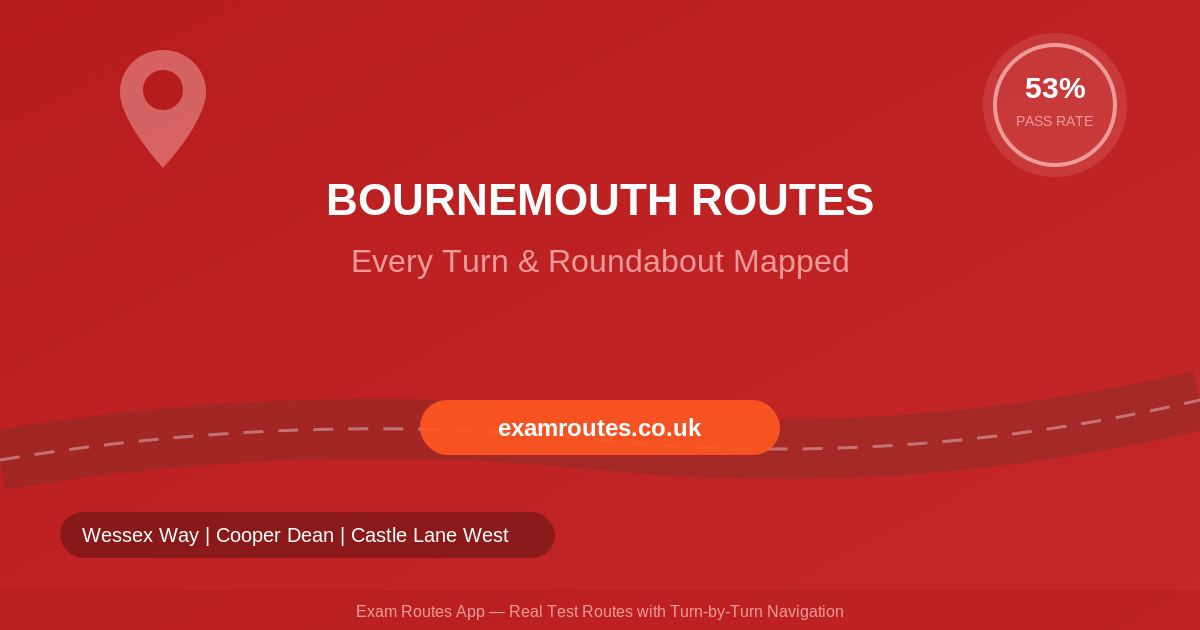
Historical DVSA data for Bournemouth has shown a pass rate around 52-53%, above the Great Britain average of roughly 48-49%, though more recent figures move with each reporting period.
The relatively healthy number makes sense given the route mix: a substantial share of the test is spent on residential roads and well-marked distributor roads rather than complex city-centre one-way systems. The difficulty is concentrated in a few specific places — Cooper Dean, the Wessex Way slips, and Winton high street — rather than spread across the whole route.
Practically, that means targeted practice works unusually well at Bournemouth. Fix those three areas and your odds change noticeably.
Seven Tips for Passing at Bournemouth
- Drill Cooper Dean roundabout from every approach. It is the single most influential feature on the route network.
- Practise Wessex Way joins repeatedly. Speed matching is a skill, not a one-off.
- Check your speed after every limit change. Bournemouth routes move between 20, 30, 40 and 50 quickly.
- Drive Winton at a busy time. A quiet Winton teaches you nothing about the real thing.
- Rehearse manoeuvres on real residential roads. Cambered, parked-up streets, not empty car parks.
- Anticipate buses. Expect them to stop; plan whether you will hold back or pass safely.
- Keep making progress. Castle Lane West is a road where under-driving gets marked.
How the Exam Routes App Can Help
Knowing that Cooper Dean matters is one thing; being able to practise it in the sequence an examiner uses is another. The Exam Routes App gives you real driving test routes with turn-by-turn navigation so you can drive the Northbourne streets, the Castle Lane roundabout chain, the Wessex Way section and Winton high street in a realistic order.
Because Bournemouth’s difficulty is concentrated in specific places, route-based practice pays off faster here than at centres where the challenge is spread evenly.
Frequently Asked Questions
Where is Bournemouth driving test centre?
21-23 Gillam Road, Northbourne, Bournemouth BH10 6BW.
What is the pass rate at Bournemouth?
Published DVSA data has shown Bournemouth around 52-53%, above the Great Britain average of roughly 48-49%, though figures shift each reporting period.
Does the Bournemouth test use dual carriageways?
Yes. Wessex Way (A338) features on many routes, including slip road joins and the Cooper Dean roundabout.
Is there parking at Bournemouth test centre?
Space is very limited. Most candidates are dropped off by their instructor.
What causes most fails at Bournemouth?
Lane discipline at the large roundabouts, observation on Winton high street, and speed limit changes between the fast distributor roads and the 20mph zones.
Don’t Leave Your Test to Chance
Download the Exam Routes App and drive the real routes before the examiner does. Turn-by-turn navigation, hundreds of UK test centres, practise whenever suits you.