Kings Heath is inner-south Birmingham, and a driving test here is an urban test in the fullest sense. Within five minutes of leaving the centre you can be on a six-lane arterial road, a residential street with cars parked nose to tail on both sides, a busy shopping high street with buses pulling in and out, or a large signal-controlled island where four lanes of traffic all want the same gap. There is very little quiet mileage. That is exactly why candidates who prepare properly for Kings Heath tend to become genuinely capable drivers.
This guide sets out what the Birmingham Kings Heath driving test involves in 2026 — the roads examiners work with, where faults are most often recorded, how the pass rate compares nationally, and a preparation plan that reflects how the area actually drives.
About Kings Heath Driving Test Centre
The centre serves south Birmingham — Kings Heath, Moseley, Billesley, Yardley Wood, Highter’s Heath, Druids Heath and the fringes of Selly Oak and Hall Green. Confirm the address on your DVSA booking email; Birmingham has multiple car test centres and candidates have arrived at the wrong one.
- Parking: tight. The surrounding streets carry residents’ restrictions and high demand. Plan to arrive early and expect to walk a short distance.
- Bring: provisional licence, a roadworthy test-legal car with valid insurance and MOT, working lights and legal tyres. Birmingham examiners will not overlook a bald tyre or an obscured plate.
- Timing: if you can choose your slot, avoid the school-run peaks around 08:30 and 15:15. The area around Alcester Road South and the high street becomes genuinely difficult at those times, and while the examiner will make allowances, you would rather not need them.
The Routes: Roads You Should Expect
A435 Alcester Road South
The spine of the area. Bus lanes, bus stops, loading bays, a shopping frontage with pedestrians stepping out, side roads on both sides and traffic signals. This road alone tests observation, lane discipline, timed restriction awareness and progress. Read the bus lane signs — the operating hours vary and copying the car in front is how candidates end up in a lane they should not be in.
A4040 outer ring road
Vicarage Road, Brook Lane, Yardley Wood Road and the connecting sections of Birmingham’s outer circle route form the fast element of many Kings Heath routes. Wider, quicker, with multi-lane approaches and traffic-light junctions where the correct lane is determined a long way back.
Moseley and the Wake Green area
Older, leafier streets with heavy on-street parking, narrow effective widths and frequent give-and-take with oncoming traffic. Moseley village itself is congested and full of pedestrians.
Billesley, Yardley Wood and Druids Heath
Post-war estate roads that provide the quieter ground examiners use for manoeuvres — reverse bay parking where there is a suitable car park, parallel parking on residential streets, and pulling up on the right.
Maypole and Highter’s Heath
The Maypole island area to the south is a significant junction with multiple lanes and heavy traffic. Routes that head this way test your ability to commit to a lane and hold it.
Tricky Spots & Common Challenges
- Kings Heath high street. Buses stopping without much warning, delivery vehicles double-parked, cyclists filtering, pedestrians crossing between stationary cars. The skill is anticipation: watching the pavement, not just the road.
- Bus lanes with timed restrictions. Entering a bus lane during its operating hours is a serious fault and a potential penalty notice. Learn the signs on Alcester Road South specifically.
- The Vicarage Road / Alcester Road junction. Busy, signal-controlled, with turning traffic and pedestrians. Blocking the junction or creeping over the stop line generates faults.
- Maypole island. Multi-lane with quick exits. Decide early, signal clearly, do not change lanes on the island.
- Narrow residential streets in Moseley. Meeting traffic where only one car fits. Examiners look for early decision-making, appropriate speed and courtesy without hesitancy.
- Cyclists and e-scooters. South Birmingham has substantial cycle traffic. Passing distance and blind-spot checks before every left turn are non-negotiable.
- Traffic-light filter arrows. Several junctions in the area use green filter arrows. Moving on a filter that does not apply to your direction is a serious fault.
Pass Rates & Statistics
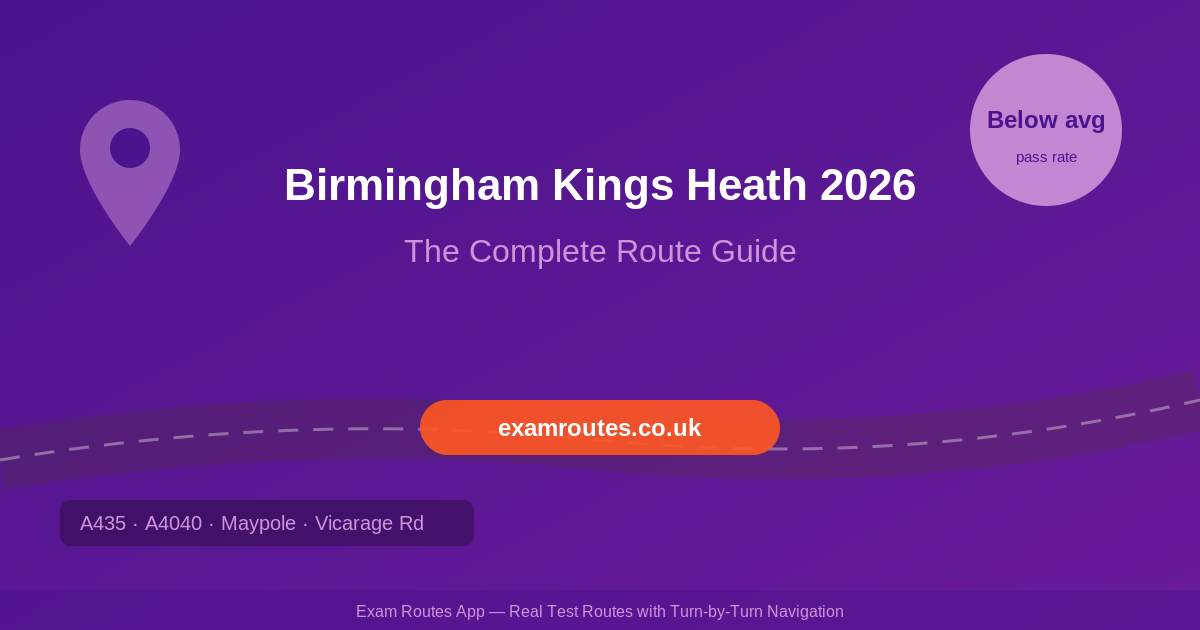
Birmingham’s car test centres generally sit below the national average, and Kings Heath is no exception. This is normal for dense urban centres: more junctions per mile, more vulnerable road users, more parked-car conflict and less margin for a slow decision. London, Birmingham and Manchester centres cluster at the lower end of the DVSA table for the same structural reasons.
Read that as information, not as a verdict. A lower centre pass rate does not mean examiners mark harder — the standard is national and applied identically. It means the environment gives you more opportunities to make a mistake in 38 minutes of driving. The counter-measure is simply more hours in exactly this kind of traffic before you book.
Always check the DVSA’s latest published pass rate data rather than a figure quoted second-hand, because the numbers are revised each reporting period.
Practise Real Test Routes on Your Phone
The Exam Routes App gives you access to real driving test routes with turn-by-turn navigation. Practise at your own pace and build confidence before test day.
Top Tips for Passing at Kings Heath
- Do most of your practice in traffic, not around it. Quiet Sunday-morning lessons will not prepare you for Alcester Road South at 17:00. Ask your instructor for deliberately busy sessions.
- Master the bus lane signs. Photograph them, learn the hours, and practise the road at different times so you know which lane is legal when.
- Build a habit of a mirror check before every position change. Around parked cars, around buses, before every turn. In this area you will change position dozens of times per test.
- Commit early on multi-lane approaches. Read the overhead and ground markings, choose, signal, hold. Late lane changes are the single biggest generator of serious faults on the A4040.
- Practise meeting traffic on narrow streets until it is automatic. Moseley’s residential roads demand it constantly.
- Rehearse the manoeuvres in real estate conditions — a bay park in a genuinely busy car park, not an empty one, and a parallel park on a street with passing traffic.
- Keep your speed honest in the 20mph zones. Parts of south Birmingham are 20mph. Driving 27mph through one because it feels slow is a straightforward fault.
- Plan your arrival. Parking is difficult. Being late for a DVSA test means losing the fee and the slot.
How the Exam Routes App Can Help
The value of route practice is highest exactly where Kings Heath is hardest: complex junctions you cannot afford to meet for the first time under test conditions. The Exam Routes App gives you real driving test routes with turn-by-turn navigation, so you and your instructor — or you and a supervising driver — can work through the roads examiners actually use.
For a centre like Kings Heath, that means arriving at the Maypole island or the Vicarage Road junction already knowing the lane you need. It does not replace skill. It removes surprise, and surprise is what turns a competent learner into a nervous one.
Frequently Asked Questions
Is Kings Heath a hard place to take a driving test?
It is demanding. Dense urban traffic, bus lanes, heavy parking and multi-lane junctions all feature within a short distance of the centre, which is why Birmingham centres generally sit below the national pass rate.
What roads are most likely on a Kings Heath test route?
The A435 Alcester Road South, the A4040 outer ring road including Vicarage Road and Yardley Wood Road, plus residential streets in Moseley, Billesley and Yardley Wood.
Do Kings Heath test routes include dual carriageways?
Sections of the outer ring road and the roads towards Maypole provide multi-lane driving. You are more likely to face complex signal-controlled junctions than long high-speed stretches.
What happens if I accidentally drive in a bus lane?
During operating hours it will usually be recorded as a serious fault, and it can also attract a penalty from the council. Learn the specific hours on Alcester Road South before your test.
Which manoeuvre am I most likely to get?
Any of the four can come up. In this area, reverse bay parking and parallel parking are common because suitable car parks and residential streets are close to the centre.
Get the Edge on Test Day in Birmingham
Practise the real Kings Heath test routes with turn-by-turn navigation and walk into your test already knowing the junctions.