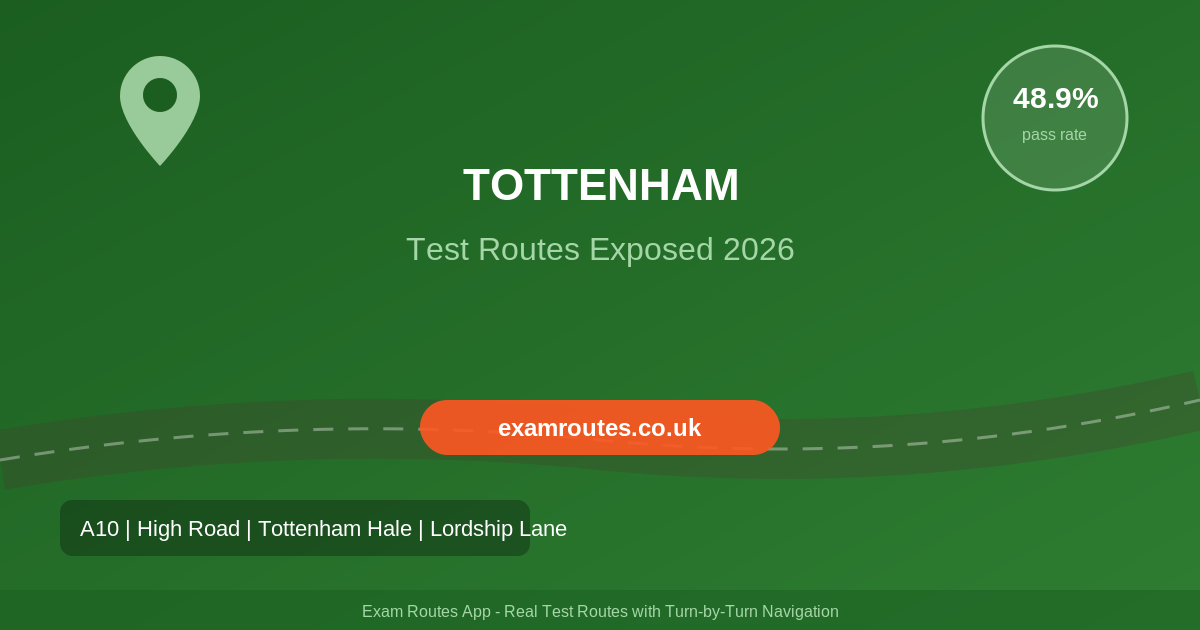
Tottenham has one of the busiest driving test centres in north London, and one of the most misunderstood. Learners hear “north London” and assume the worst. The DVSA data says otherwise: in the year to March 2026 Tottenham passed 48.9% of car tests across 9,844 tests — only 1.2 points below the 50.1% national average, and comfortably ahead of several neighbouring centres. What makes Tottenham hard is not the examiners. It is the specific set of turns, junctions and roundabouts that its routes keep returning to. This guide maps them.
About Tottenham Test Centre
Tottenham sits in the N17 area of Haringey, wedged between the A10 Great Cambridge Road to the west, the High Road running north to south through the middle, and Tottenham Hale and the Lea Valley to the east. It is a dense, mixed-use part of London: terraced residential streets, arterial bus corridors, retail parades, a stadium, an industrial estate and a major transport interchange, all inside a few square kilometres.
Practical notes before test day:
- Parking is limited and mostly on-street with restrictions. Arrive early and check the signs before you leave the car — a ticket is a miserable way to start a test.
- Bring your photocard licence and a car that meets DVSA rules: legal tyres, working lights, no dashboard warning lights, an additional interior mirror and L plates.
- Traffic changes everything here. A 9am test and a 1pm test at Tottenham are effectively two different exams. Practise at your booked time of day at least once.
Every Turn: The Roads Tottenham Routes Are Built From
DVSA no longer publishes official routes, but the road network narrows the possibilities considerably. Almost every Tottenham route draws on four blocks of road.
1. The High Road corridor (A1010). The spine of the area, running from Bruce Grove north towards Edmonton. Bus lanes, bus stops, loading bays, cycle infrastructure, side roads every few hundred metres and heavy pedestrian activity. Expect bus lane timings to matter and expect to be held up — patience without hesitation is the skill being assessed.
2. The A10 Great Cambridge Road. A fast, wide arterial with traffic-light junctions rather than roundabouts. Lane discipline, timely signalling and right turns across oncoming traffic are the themes. Getting into the correct lane a long way back is the whole game.
3. The residential grid. Lordship Lane, White Hart Lane, Philip Lane, Bruce Grove and the streets between them. Narrow, parked on both sides, with speed cushions, chicanes and 20mph limits. This is where manoeuvres are set and where meeting oncoming traffic gets practised for real.
4. Tottenham Hale and Northumberland Park. The gyratory and retail park approaches near Tottenham Hale bring multi-lane junctions, bus and cycle priority, and a lot of pedestrians. Northumberland Park adds industrial estate roads with HGVs turning across your path.
Every Junction and Roundabout That Catches Learners Out
- Tottenham Hale gyratory. Multiple lanes, signals, buses and cyclists in the same space. Learners fail here by choosing a lane late and then correcting across a solid white line.
- The A10 / Lordship Lane junction. A busy signalled crossroads. Right turns need a clear plan on where to wait and when to go — creeping into the box is a classic fault.
- Bruce Grove. Narrow, busy, buses stopping constantly, pedestrians stepping out between parked cars. Observation is everything.
- White Hart Lane near the stadium. Wide in places, restricted in others, with event-day layouts and a lot of pedestrian crossings. Speed limit changes here are easy to miss.
- Yellow box junctions. Tottenham has several on the High Road and around the A10. Entering when your exit is not clear is a serious fault, and it is one of the most common ways learners lose a test in London.
- Bus lanes and bus stop clearways. Many operate at specific hours. Read the sign, not the road surface, and never stop in a bus stop clearway even to let someone pass.
- Cycle lanes and cyclists filtering. Under the Highway Code hierarchy of road users, cyclists come before you at junctions. Check your nearside mirror and blind spot before every left turn without exception.
Practise Real Test Routes on Your Phone
The Exam Routes App gives you access to real driving test routes with turn-by-turn navigation. Practise at your own pace and build confidence before test day.
Pass Rates and Statistics
Tottenham’s recent DVSA figures, year to March 2026 unless stated:
- Pass rate: 48.9% (national average 50.1%)
- Tests conducted: 9,844, of which 4,812 passed
- Most recent published month (March 2026): 47.8%
- Average wait: 10.3 weeks as of July 2026, against 12.8 weeks nationally
The trend matters more than the headline. Tottenham passed just 39.6% in 2019-20 and 37.5% in 2018-19. It has climbed steadily to 48.9%, and monthly figures across the last year have swung between 46.7% and 52%. That is a centre that has become notably more passable, not less.
Against its neighbours, Tottenham is a strong choice. Wood Green sits at 46.8%, Chingford at 39.9% and Wanstead at 44.4% with a 20.3-week wait. Barnet is close on 49.9% but averages 21.1 weeks. On the combination of pass rate and waiting time, Tottenham is one of the better-value bookings in north London.
Top Tips for Passing at Tottenham
- Master lane choice on the A10. Decide early, signal early, and never change lanes inside a junction.
- Treat box junctions as a hard rule. If your exit is not clear, you do not enter. No exceptions, no “it will move in a second”.
- Read bus lane signs, not tarmac. Hours of operation vary street by street in Haringey.
- Left turns: mirror, blind spot, then go. Cyclists on the High Road appear from nowhere.
- Keep moving. Undue hesitation is one of the biggest fault categories at busy urban centres. If a gap is safe, take it.
- Get your 20mph speeds right. Much of residential Tottenham is 20mph and the repeaters are small.
- Practise the manoeuvres on genuinely tight streets. A bay park in an empty car park is not preparation for a pull-up on the right on Philip Lane at 11am.
How the Exam Routes App Can Help
Reading about the Tottenham Hale gyratory is not the same as driving it. The Exam Routes App gives you real driving test routes with turn-by-turn navigation on your phone, so your practice hours land on the exact junctions and roundabouts that examiners use rather than on whichever roads happen to be quiet. Run a route, repeat the section that rattled you, and turn up on test day already knowing what comes after the next set of lights.
Frequently Asked Questions
What is the pass rate at Tottenham driving test centre?
48.9% for the DVSA year to March 2026, based on 9,844 car tests. The national average over the same period was 50.1%.
How long is the wait for a test at Tottenham?
An average of 10.3 weeks as of July 2026 — around two and a half weeks quicker than the national average of 12.8 weeks, and far quicker than Wanstead or Barnet nearby.
Is Tottenham a hard test centre?
It is a demanding urban centre, but the numbers do not support the idea that it is unusually hard. It sits just over a point below the national average and well above Chingford and Wanstead. The difficulty is traffic density and box junctions, not examiner strictness.
Which manoeuvres come up at Tottenham?
All four are possible: pull up on the right and rejoin, reverse bay park, forward bay park, and parallel park. Residential streets around Lordship Lane and Philip Lane are common settings, so practise in tight, parked-up conditions rather than empty roads.
Should I book Tottenham or Wood Green?
On recent data Tottenham passes 48.9% against Wood Green’s 46.8%, and waits are similar. The bigger factor is which road network you have actually practised on — book the one you know.
Get the Edge on Test Day
Stop guessing which roads come up. The Exam Routes App maps real driving test routes so every practice hour counts.