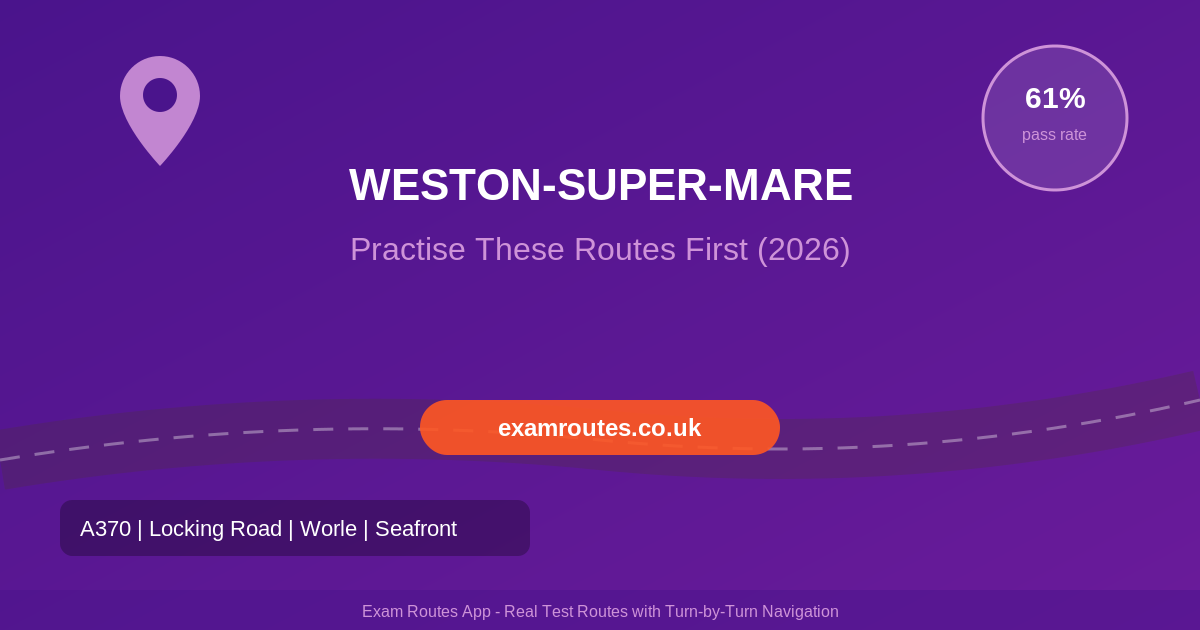
Weston-super-Mare looks like a gift on paper. A 61% pass rate in the DVSA year to March 2026 — nearly eleven points above the 50.1% national average — and an average wait of just 5 weeks when the rest of Great Britain queues for 12.8. Learners from Bristol, Bridgwater and even south Wales spot those numbers and book immediately. Plenty of them then fail, because they turned up having never driven the seafront in August, never met the Worle roundabouts at rush hour, and never practised the long 40mph stretches where speed creeps without you noticing. Do not book Weston until you have practised these routes.
About Weston-super-Mare Test Centre
The centre serves a seaside town of roughly 80,000 people on the Somerset coast, with the M5 running down its eastern edge at junctions 21 and 22. The road network splits neatly into three characters: the old seafront and town centre, the newer Worle and Locking suburbs to the east, and the fast A-road links out towards the motorway. A test route usually samples all three.
Before test day:
- Arrive early. Parking near the centre is workable but not generous, and summer traffic in Weston is a genuine variable.
- Bring your photocard licence and a car that satisfies DVSA rules — legal tyres, working lights, no warning lights showing, an extra interior mirror and L plates front and rear.
- Check the season. Weston in February and Weston in August are different towns. If your test is in the summer holidays, practise in the summer holidays.
The Routes You Actually Need to Practise
DVSA does not publish route lists any more, but the town’s layout makes the likely ground obvious.
The Locking Road / Hutton Moor corridor. Wide, busy, 30 and 40mph in stretches, with retail and leisure entrances, bus stops and a run of signalled junctions. This is the road most Weston candidates spend the largest share of their test on, and it is where speed control and lane discipline are judged.
Worle and the eastern suburbs. Queensway, Milton Hill, Worle High Street and the estate roads behind them. Residential 20 and 30mph limits, parked cars, side roads, mini-roundabouts and school-time congestion. Manoeuvres are frequently set here.
The A370 and Herluin Way. The main artery into and out of town, linking to the M5. Higher speeds, roundabouts, multiple lanes and merges. Learners who have only driven Weston’s back streets get caught out by how quickly this feels once you are on it.
The seafront. Beach Road and Marine Parade give you pedestrian crossings, parked cars pulling out, cyclists, coaches, and in season, holidaymakers walking into the road without looking. It is the single best test of anticipation in the town.
Uphill and the southern edge. Narrower lanes, a couple of steeper gradients and rural-feeling sections where national speed limit signs appear sooner than learners expect.
Tricky Spots and Common Challenges
- The M5 J21 roundabout area. Fast approaches, heavy commercial traffic and lane markings that demand an early decision. If your route touches this, know your lane before you can read the sign.
- Milton Hill. A genuine gradient with junctions on it. Hill starts, clutch control and holding position without rolling back all get examined.
- Worle mini-roundabouts. Small, close together and often approached at the same moment by two other cars. Give way to the right, signal clearly, and do not stop dead when the way is clear.
- Seafront pedestrian crossings. Zebras in a holiday town are unpredictable. Cover the brake, look at the pavement as well as the crossing, and be ready to stop early.
- Summer coach and caravan traffic. Meeting a coach on a narrow seafront side street is a real possibility from June to September.
- The 40mph stretches. Long, open and quiet enough that speed drifts to 45 without any sense of speeding. That is a fault, and an easy one to avoid.
- Low winter sun off the sea. West-facing roads in late afternoon can be blinding. Clean your windscreen inside and out and keep sunglasses to hand.
Practise Real Test Routes on Your Phone
The Exam Routes App gives you access to real driving test routes with turn-by-turn navigation. Practise at your own pace and build confidence before test day.
Pass Rates and Statistics
Weston-super-Mare’s numbers, from the DVSA data to March 2026:
- Pass rate: 61% — 10.9 points above the 50.1% national average
- Tests conducted: 4,443, of which 2,711 passed
- Most recent published month (March 2026): 64.9%
- Average wait: 5 weeks as of July 2026, against 12.8 weeks nationally
The rise is recent and real. Weston sat at 56.5% in 2024-25 and 56.1% in 2023-24, so 61% is a meaningful jump, with monthly rates in early 2026 running in the mid-60s. Compare that with the nearest alternatives: Bristol (Avonmouth) 55.5%, Barry 57%, Newport (Gwent) 48.9%, Cardiff (Llanishen) 46.5% and Gloucester 47.8% with a 19-week wait.
So yes — Weston is genuinely one of the better bets in the South West. The caveat is that a good pass rate reflects the roads and the local learners who practise on them, not a soft examiner. Book it because you have driven it, not because of the percentage.
Top Tips for Passing at Weston-super-Mare
- Drive the seafront at your test time. If your slot is 2pm in August, a quiet 8am practice run tells you nothing useful.
- Nail the 40mph limits. Set your speed and check it. Drifting to 45 on Herluin Way or Locking Road is the most avoidable fault in town.
- Practise hill starts on Milton Hill. Not on a gentle slope — on the real thing, with a car behind you.
- Learn the mini-roundabout etiquette in Worle. Approach at a speed that lets you actually give way, signal your exit, and go decisively when it is clear.
- Watch for pedestrians everywhere near the beach. Anticipation faults on the seafront are common and entirely preventable.
- Do one route in bad weather. Coastal rain and wind here are not gentle, and tests are rarely cancelled for either.
- Book early in the day if you can. Lighter traffic, fewer holidaymakers, and you spend less of the morning getting nervous.
How the Exam Routes App Can Help
The gap between “I have driven around Weston” and “I know the roads on the test” is where most avoidable fails live. The Exam Routes App puts real driving test routes on your phone with turn-by-turn navigation, so your practice covers the specific roundabouts, hills and seafront stretches that come up rather than whatever roads felt convenient. Repeat the sections you find hardest until they stop being hard, then book with confidence.
Frequently Asked Questions
What is the pass rate at Weston-super-Mare?
61% for the DVSA year to March 2026, from 4,443 car tests — 10.9 points above the 50.1% national average. The most recent published month, March 2026, was 64.9%.
How long will I wait for a test at Weston-super-Mare?
Around 5 weeks on the July 2026 DVSA figures, compared with 12.8 weeks nationally. It is one of the shorter waits in the South West, though availability moves week to week.
Is it worth travelling to Weston-super-Mare for a driving test?
Only if you will practise there. The high pass rate reflects road conditions that local learners have trained on. Turning up cold to the seafront, the Worle mini-roundabouts and the M5 approaches is how a “easy” centre becomes an expensive lesson.
Does the test go on the seafront?
Often, yes. Beach Road and the Marine Parade area appear regularly on routes because they test observation and anticipation so well. Expect pedestrians, crossings and parked cars pulling out.
Which manoeuvre is most likely at Weston?
Any of the four can come up. Residential Worle streets suit a pull-up on the right or a parallel park, while bay parking is likely if your route returns to a car park. Practise all four rather than gambling.
Don’t Leave Your Test to Chance
Know the roundabouts, junctions and streets before the examiner names them. Practise real routes with the Exam Routes App.