St Austell gives learner drivers a test that is genuinely varied. Within a single route you can find yourself on a busy A-road, threading through a Victorian town centre, climbing a steep residential hill, and then out on a narrow lane with high Cornish hedges on both sides. It is a good test of all-round driving, which is exactly what the DVSA is looking for — and it means preparing only in one type of environment will let you down.
Here is what to expect if you are taking your practical at St Austell in 2026, from the roads examiners favour to the local hazards that produce most of the faults.
About St Austell Driving Test Centre
The centre serves mid-Cornwall, covering St Austell, Par, Bugle, Roche, Fowey, Mevagissey and the villages of the clay country to the north. Like most Cornish centres it is small, with a limited number of examiners, so slots go quickly — particularly over the summer when the county’s population swells.
Confirm the address on your DVSA booking confirmation, allow extra time for traffic on the A390 approach, and arrive about ten minutes before your slot. Bring your provisional licence. If you are using your own vehicle, check tyres, lights and the MOT beforehand: a car fault found at the test centre can get your test cancelled and cost you the fee.
The Routes: Roads You Can Expect
Official DVSA routes are no longer published, but the local road network limits the realistic options, and instructors report a consistent pattern.
- The A390 — the main east-west route through St Austell, with heavy traffic, multiple roundabouts and frequent speed limit changes.
- The A391 towards Bugle and the clay country — faster, more open, with long gradients and sweeping bends.
- Town centre and Mount Charles — one-way sections, bus movements, pedestrian crossings and tight parking.
- Residential areas at Boscoppa, Carclaze, Sandy Hill and Trewoon — hill starts, junction practice and manoeuvre territory.
- Charlestown and Duporth roads — narrow, popular with visitors, and a genuine test of meeting traffic.
- Country lanes towards Trethurgy and the clay tips — single track in places, blind bends, mud on the road and slow-moving farm or lorry traffic.
Tricky Spots and Common Challenges
The A390 roundabouts. Traffic is steady all day and heavy at school-run times. Lane discipline, correct signalling on exit and confident but safe gap acceptance are all under the microscope here.
Hills, and lots of them. St Austell is built on slopes. Expect at least one hill start where a rollback would be obvious to the examiner, and expect downhill approaches to junctions where a gear that is too high leaves you coasting.
High Cornish hedges. On lanes towards Trethurgy and Bugle, visibility at junctions is genuinely restricted. Creeping forward to a position where you can actually see, rather than emerging on hope, is what examiners want.
Mud and loose surfaces. Clay lorries and farm traffic leave the lanes slippery. Reduce your speed on approach to bends and increase your following distance.
Seasonal tourist traffic. From late spring the Charlestown and Eden Project roads fill with unfamiliar drivers, motorhomes and cyclists. Expect the unexpected and give plenty of room.
Parked cars in the older streets. Meeting traffic is a constant around Mount Charles and Holmbush. Plan early and hold back where the obstruction is on your side.
Pass Rates and Statistics
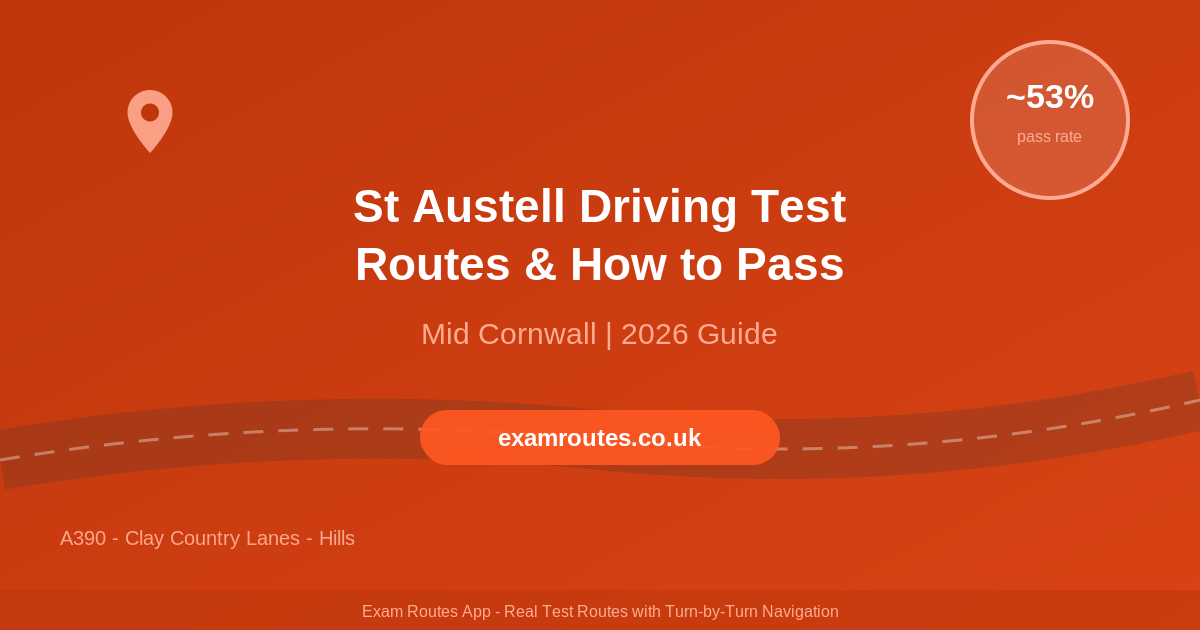
St Austell tends to sit at or above the national average, with recent DVSA figures in the low-to-mid 50s percent against a UK average of roughly 50 percent. Cornish centres generally do well, mostly because traffic volumes are lower than in urban England — but the variety of the roads means a candidate who has only practised in town can still come unstuck on the rural sections.
Do not be lulled by a favourable headline number. The faults recorded here cluster around observation at rural junctions, steering on narrow lanes and speed on unfamiliar bends — all things you can fix with the right practice.
Practise Real Test Routes on Your Phone
The Exam Routes App gives you access to real driving test routes with turn-by-turn navigation. Practise at your own pace and build confidence before test day.
Top Tips for Passing at St Austell
- Split your practice. Half urban, half rural. If you can drive the A390 at 4pm and a clay-country lane at dusk, you are ready.
- Practise emerging from restricted-visibility junctions. Slow, creep, look properly, then go. Rushing this is the classic Cornish serious fault.
- Get your gears right on descents. Coasting downhill towards a junction is an easy fault to pick up and an easy one to eliminate.
- Learn where the speed limit changes on the A390. They come up faster than you think when traffic is flowing.
- Practise meeting traffic on narrow roads. Decide early and use a gap that already exists rather than one you hope will appear.
- Book realistically. If you can, avoid the busiest holiday weeks for your first attempt.
- Do a full mock test. Forty minutes of continuous driving with no coaching tells you far more than another lesson.
How the Exam Routes App Can Help
Variety is St Austell’s defining feature, and you cannot prepare for variety by accident. The Exam Routes App gives you real test routes with turn-by-turn navigation, so you can deliberately cover the A390, the clay-country lanes and the residential hills instead of hoping your lessons happened to include them. Drive them with your instructor, then repeat the difficult bits with a supervising driver until the roads feel routine.
Frequently Asked Questions
What is the pass rate at St Austell?
Recent DVSA figures put St Austell in the low-to-mid 50s percent, at or slightly above the UK average of around 50 percent. Rates are published quarterly and do move, so check the current data.
Will my test include country lanes?
Very likely. The rural roads around the clay country and towards Trethurgy are part of what makes a St Austell route representative, and they are where a lot of faults are recorded.
How busy does the A390 get?
Busy enough to matter, particularly at school times and through the summer holiday season. Practise it at the same time of day as your booked slot.
Which manoeuvre will I be asked to do?
One of the four DVSA manoeuvres: reverse bay park, forward bay park, parallel park, or pull up on the right and reverse. Sloping residential streets around St Austell make hill-based versions of these common.
Is St Austell a good centre for a first attempt?
It is a fair centre with a reasonable pass rate, but the mix of urban and rural driving means you need broad experience. Choose it because you have practised the roads, not because of the headline statistic.
Don’t Leave Your Test to Chance
From the A390 to the clay-country lanes, practise the real St Austell test routes with turn-by-turn navigation in the Exam Routes App.