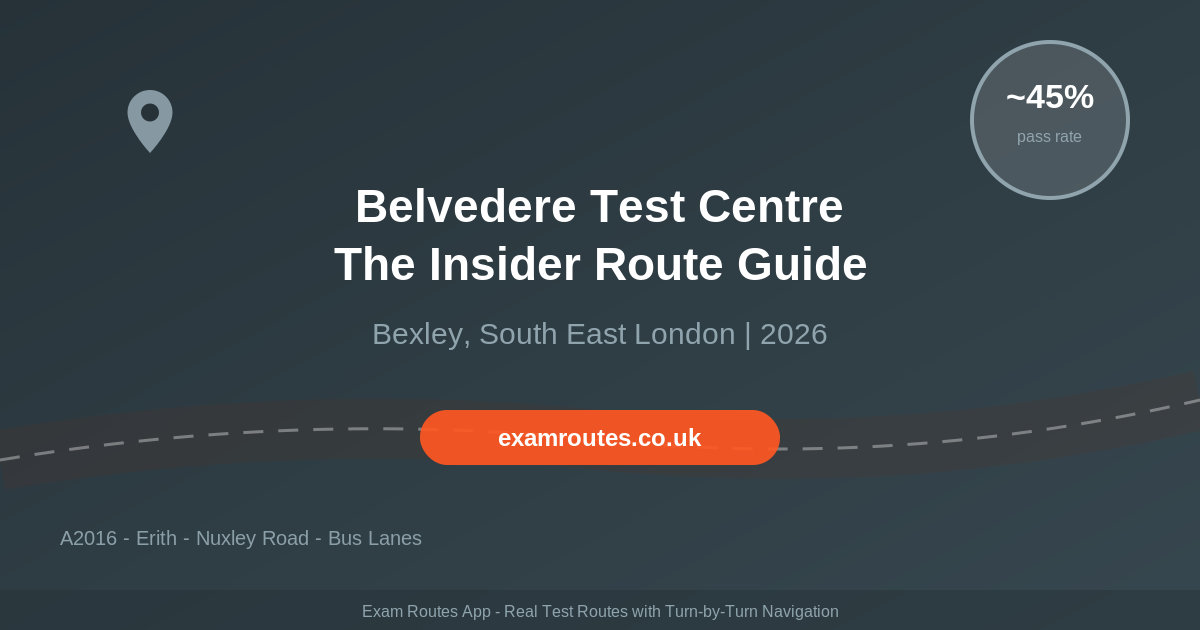
Belvedere is one of those south-east London test centres that quietly divides opinion. Some learners love it because the industrial roads around the centre are wide and quiet. Others come away shaken because the moment you leave that pocket, you are into Erith, Thamesmead and Bexleyheath traffic, with dual carriageways, bus lanes, box junctions and pedestrian crossings arriving in quick succession.
Both views are right. Belvedere is a test of two halves, and knowing that before you book is half the preparation. Here is the insider guide for 2026 — the roads, the traps and how to get ready.
About Belvedere Driving Test Centre
Belvedere sits in the London Borough of Bexley, on the industrial estate roads north of the town towards the Thames. It serves Belvedere, Erith, Abbey Wood, Thamesmead, Slade Green and the wider Bexley area, and it picks up plenty of candidates from Greenwich and Dartford too.
Confirm the address on your DVSA booking email and give yourself extra time on the approach — the industrial roads carry a steady flow of HGVs and delivery traffic, and a queue at the wrong moment can make you late. Arrive around ten minutes early with your provisional licence, and check your car is legal, roadworthy and displaying L plates.
The Routes: Roads You Can Expect
Official routes have not been published since 2010, but the local network makes the likely corridors clear.
- The A2016 Eastern Way / Bronze Age Way — the fast dual carriageway spine of the area, used for higher-speed sections and independent driving.
- Picardy Manorway and Yarnton Way — multi-lane roads with roundabouts and flyover junctions where lane discipline is everything.
- Nuxley Road and Belvedere village — a genuinely tight shopping street with parking on both sides and constant pedestrian activity.
- Erith town centre and Bexley Road — bus stops, crossings, box junctions and heavy queueing traffic.
- Thamesmead’s residential grid — wide estate roads, roundabouts and plenty of manoeuvre opportunities.
- The industrial estate roads near the centre — where reverse bay parks and controlled stops often happen.
Tricky Spots and Common Challenges
Joining and leaving the A2016. Traffic moves quickly and slip roads are short. You need to build speed on the slip road, pick your gap and merge without hesitating. Approaching a merge too slowly is one of the most common serious faults recorded on routes like this.
Lane discipline on the multi-lane approaches. Several junctions here mark lanes for specific destinations well in advance. Getting into the correct lane early — and not swapping at the last second — is exactly what examiners are watching.
Bus lanes. South-east London has plenty, with varying hours of operation. Entering one during its operating hours is both a driving fault and, in real life, a penalty charge. Read the signs on approach, not as you pass them.
Box junctions. Erith and Bexley Road have them, and they queue. You may only enter if your exit is clear, with the single exception of waiting to turn right when blocked only by oncoming traffic.
Nuxley Road parked cars. Narrow, busy, and full of meeting-traffic decisions. Plan early, hold back when the obstruction is on your side, and do not force your way through.
HGV traffic near the industrial estates. Lorries manoeuvring across the road, wide turns and blind spots. Give them space and expect them to need it.
Pass Rates and Statistics
London test centres sit below the national average almost without exception, and Belvedere follows that pattern — recent DVSA data has typically placed it in the mid-40s percent against a UK average of roughly 50 percent. That is not a mark against the centre; it is the arithmetic of testing in dense urban traffic, where there are simply more opportunities to record a fault in forty minutes.
The faults that show up most often here are junction observation, response to traffic signals, and use of mirrors when changing direction — all classic London faults, and all things that consistent practice on the actual roads fixes faster than anything else.
Practise Real Test Routes on Your Phone
The Exam Routes App gives you access to real driving test routes with turn-by-turn navigation. Practise at your own pace and build confidence before test day.
Top Tips for Passing at Belvedere
- Practise dual carriageway joins repeatedly. Slip road, build speed, mirror, blind spot, merge. Do it until it is automatic.
- Learn the bus lane hours on your likely routes. Then check the sign anyway, every time.
- Get your lane choice right early. On multi-lane approaches, look at the overhead and ground markings well before the junction.
- Practise box junctions in real queueing traffic. Reading a rule is not the same as holding your nerve while cars behind you edge forward.
- Nail your mirror routine. In dense traffic, examiners see every change of speed or direction. Mirrors before signalling, every time.
- Book a slot outside the school run if you can. Erith and Bexley Road at 3:30pm is a different road.
- Practise the reverse bay park properly. Industrial estate bays are wide but the traffic around them is not forgiving of a long, hesitant attempt.
How the Exam Routes App Can Help
Urban test centres punish unfamiliarity more than any other type, because you are making decisions constantly and there is no quiet stretch to recover on. The Exam Routes App gives you real driving test routes with turn-by-turn navigation, so you can drive the A2016 joins, the Nuxley Road pinch points and the Erith box junctions in advance. Repeat the sections that rattled you, and arrive on test day with the route already in your head.
Frequently Asked Questions
What is the pass rate at Belvedere?
Recent DVSA figures have put Belvedere in the mid-40s percent, below the UK average of around 50 percent – which is typical for London test centres. Check the latest quarterly data for current numbers.
Will I have to drive on a dual carriageway?
Very likely. The A2016 is a central part of the local network and is commonly used for higher-speed and independent driving sections.
Are there bus lanes on Belvedere test routes?
Yes, particularly around Erith and Bexley Road. Read the operating hours on the signs and stay out during those times.
Which manoeuvre is most common at Belvedere?
The reverse bay park is common because of the parking available on and near the industrial estate roads, but you could be asked for any of the four DVSA manoeuvres.
Is Belvedere easier than other London test centres?
It is not dramatically easier or harder than its neighbours. The quiet industrial roads near the centre are gentle, but the routes quickly reach busy urban traffic, so prepare for both.
Ready to Pass? Download Exam Routes Now
Practise Belvedere’s dual carriageway joins, box junctions and bus-lane sections on real test routes with turn-by-turn navigation.