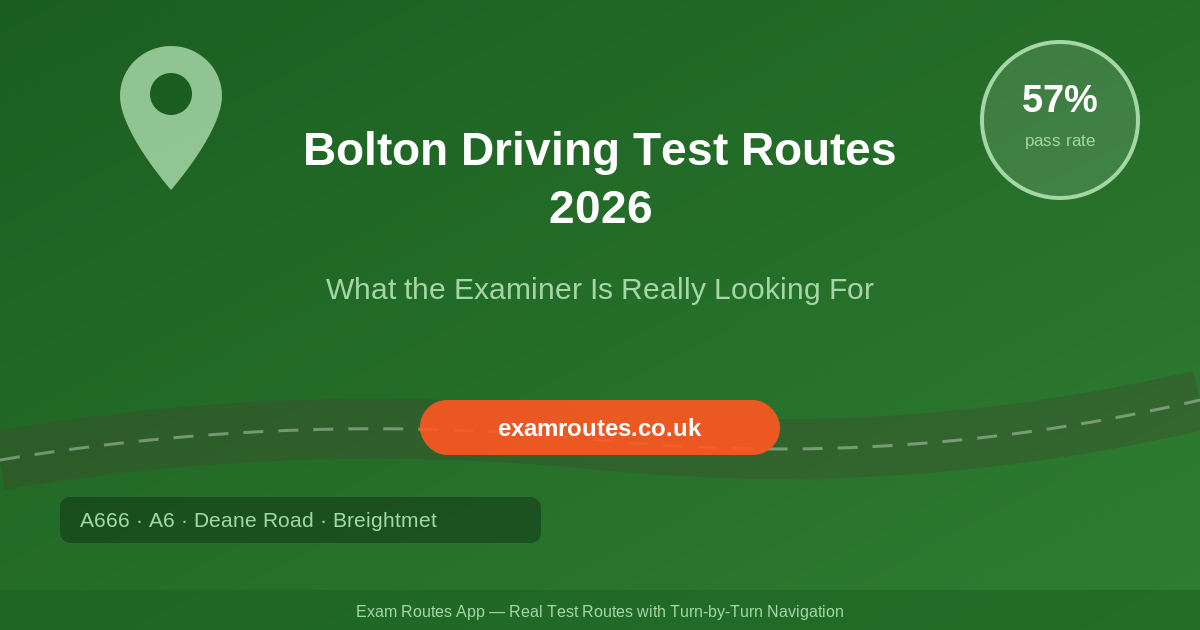
Bolton has one of the healthier pass rates in Greater Manchester – around 57% in recent DVSA data, comfortably above the national average of roughly 50%. That is not because the roads are easy. Bolton throws a genuine mix at you: tight terraced streets, fast urban dual carriageway, big signalised junctions and open moorland-edge roads to the north. It is because the mix is fair. Nothing on a Bolton route is designed to trip you up; it is designed to show whether you can drive.
This guide flips the usual angle. Instead of listing roads and hoping you memorise them, it walks through what the examiner is marking on each part of a typical Bolton route – and what a clean drive actually looks like there.
About Bolton Driving Test Centre
The Bolton driving test centre is on Weston Street, Bolton, BL3 2AW, just south of the town centre in the Great Lever area. It sits within a couple of minutes of both quiet residential streets and the A579 / A666 corridors, which is why routes here escalate in difficulty so quickly.
The Routes: What Bolton Examiners Use
Great Lever and the terraced grid
The streets immediately around Weston Street – Rupert Street, Kirkhope Drive, the roads off Lever Street – are narrow, densely parked and full of unmarked crossroads. This is the opening act on almost every Bolton route.
The A579 and Manchester Road
Manchester Road takes you south towards Farnworth and Moses Gate. Bus lanes, side-road junctions every few hundred metres, and traffic that moves in bursts. A staple of Bolton routes.
The A666 St Peter’s Way
Bolton’s urban dual carriageway. Fast, multi-lane, with slip roads and heavy lane-changing. Longer routes use it for the independent-driving section.
Deane Road and Chorley New Road
West of the centre, the A676 Deane Road and the A673 Chorley New Road give you wide tree-lined roads, big signalised junctions and a very different rhythm from the terraced grid.
Breightmet, Tonge Moor and Astley Bridge
North and east, these areas supply hills, mini-roundabouts, 20mph zones and awkward angled junctions. Manoeuvres are often carried out here.
Practise Real Test Routes on Your Phone
The Exam Routes App gives you access to real driving test routes with turn-by-turn navigation. Practise at your own pace and build confidence before test day.
What the Examiner Is Actually Marking
On the terraced streets: observation and planning
Unmarked crossroads are everywhere in Great Lever. The examiner is watching whether you slow down and look, or whether you sail through because nothing came last time. They are also watching your position – too close to parked cars and you cannot see a child stepping out; too far out and you are in the path of oncoming traffic. Aim for a door’s width and adjust as the road allows.
On Manchester Road: use of mirrors and progress
Every side road is a decision. Mirrors before you slow, mirrors before you change position, mirrors before you signal. Equally, examiners record “undue hesitation” when learners sit at a T-junction waiting for a gap that would fit a bus. If it is safe and legal, go.
On the A666: lane discipline and joining
The single most common serious fault on Bolton’s dual carriageway sections is joining too slowly. Build speed on the slip road, check your right mirror and blind spot, and merge at the pace of the traffic. Once you are on, hold the left lane unless you are overtaking.
At the big junctions: lane choice and signalling
Bolton has several multi-lane signalised junctions with painted arrows. The examiner marks lane choice at the point you commit, not when you correct it. Read the markings and the overhead signs early.
On the hills: control
Tonge Moor and Astley Bridge are properly hilly. Rolling back on a hill start, riding the clutch to hold position, or coasting downhill in neutral will all be recorded. Handbrake on, find the biting point, release smoothly.
Throughout: response to signs and signals
Bolton has a lot of 20mph zones and a lot of bus lanes with time restrictions. Read the plates. Driving in an active bus lane is a straightforward serious fault.
Pass Rates & Statistics
At roughly 57%, Bolton sits well above the national average and above several neighbouring Greater Manchester centres. Instructors in the area generally describe examiners at Bolton as fair and consistent – you get marked on what you do, and there is no reputation for “catch-out” routes.
That said, a higher pass rate does not mean an easy test. It means candidates arriving at Bolton tend to be well prepared for the roads they will meet. The lesson is straightforward: prepare for the specific mix Bolton uses, and the number works in your favour.
Top Tips for Passing at Bolton
- Do a full session on unmarked crossroads in the Great Lever grid until approaching them slowly is a reflex.
- Practise joining and leaving the A666 at a busy time, not just on a quiet evening.
- Learn the bus lane restrictions on Manchester Road and Deane Road. Read the plates, not the paint.
- Get hill starts done on real gradients around Tonge Moor and Astley Bridge.
- Rehearse all four manoeuvres on residential streets with parked cars, not in an empty car park.
- Practise following a sat nav while making your own decisions about safety – the sat nav is not in charge.
- Slow down for the 20mph zones and stay there. Creeping to 26mph is a fault waiting to be written down.
How the Exam Routes App Can Help
The reason Bolton candidates do well is preparation on the right roads. The Exam Routes App gives you real test routes with turn-by-turn navigation so you can drive the actual corridors examiners use – the terraced grid, the A-road runs and the dual carriageway joins – in your own time. Repeating a route until the junctions feel routine is the closest thing to a shortcut that exists.
Frequently Asked Questions
Where is the Bolton driving test centre?
Weston Street, Bolton, Greater Manchester, BL3 2AW, in the Great Lever area just south of the town centre.
What is Bolton’s driving test pass rate?
Around 57% in recent DVSA data, above the national average of roughly 50%. It is one of the stronger centres in Greater Manchester.
Will I go on the A666 during my test?
Very possibly. The A666 St Peter’s Way is an urban dual carriageway used on many Bolton routes, particularly for the independent-driving section. Practise joining it at speed.
Are Bolton examiners strict?
They apply the same national marking standard as everywhere else. Bolton has no local reputation for unusually harsh marking – the higher pass rate suggests the opposite.
How long is the Bolton driving test?
About 38 to 40 minutes of driving, plus the eyesight check, the show me tell me questions and the debrief at the end. Budget around an hour in total.
Get the Edge on Test Day
Download the Exam Routes App and practise the real Bolton corridors – terraced streets, A-roads and dual carriageway joins – before your examiner sees them.