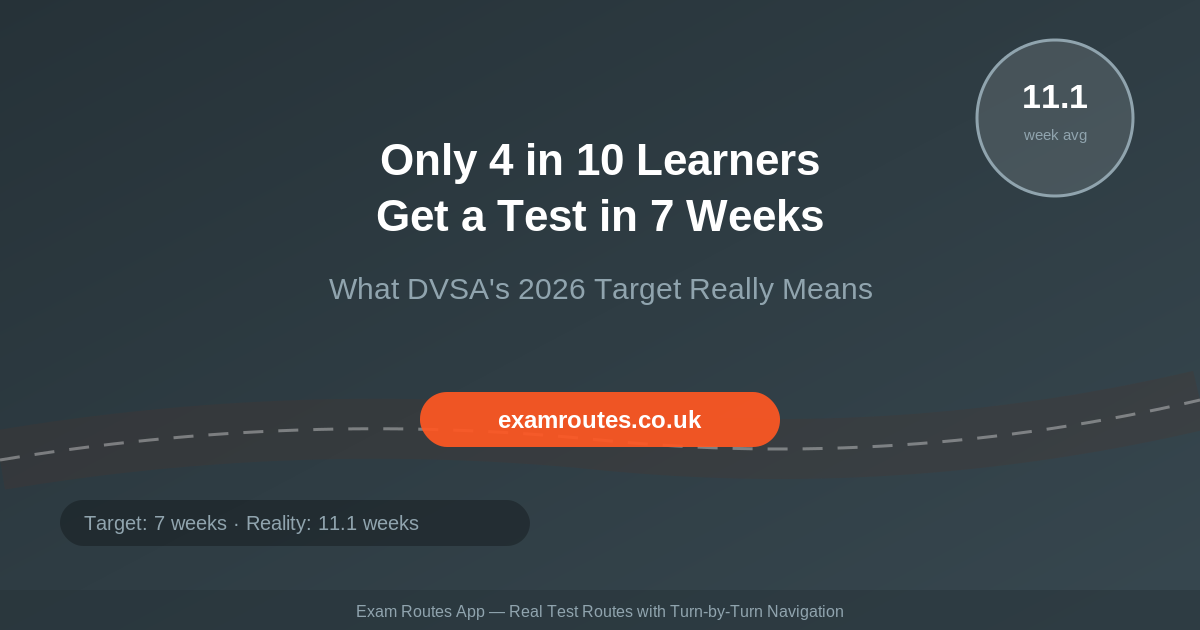
DVSA has a stated target for how long a learner should wait between booking a practical driving test and taking it: seven weeks. In August 2026, roughly 40% of candidates met it. Six in ten waited longer.
That single statistic explains more about the learner experience in 2026 than almost any other figure, and it sits awkwardly alongside a genuinely strong year for test delivery. Both things are true at once: DVSA is running more tests than ever, and most learners are still waiting longer than the agency’s own benchmark.
The Numbers, Side by Side
Why More Tests Has Not Meant Shorter Waits Everywhere
The intuitive expectation is that record test volumes should collapse the queue. It has not worked that way, for three reasons.
1. Demand grew alongside supply
Every month that waits stayed long, more learners joined the queue. Clearing a backlog while new candidates keep arriving is like bailing a boat that is still taking on water — you can be making real progress and still be sitting in a lot of water.
2. The national average hides enormous local variation
An 11.1-week average is the midpoint of a very wide spread. Some centres, particularly in smaller towns and parts of Scotland, have had waits of just a few weeks during 2026. Others — concentrated in London, the South East and major urban areas — have exceeded 24 weeks. A learner in one postcode and a learner sixty miles away are having completely different experiences of the same system.
3. Booking behaviour changed
When waits are long, people book earlier and less ready, hold slots defensively, and rebook rather than cancel. That behaviour is entirely rational for the individual and collectively makes the queue less efficient. DVSA’s rule changes through 2025 and 2026 — including tightening how instructors and third parties can book — were aimed squarely at this.
Practise Real Test Routes on Your Phone
The Exam Routes App gives you access to real driving test routes with turn-by-turn navigation. Practise at your own pace and build confidence before test day.
What the Seven-Week Target Is Actually For
It is worth understanding why seven weeks is the benchmark rather than, say, two. The figure is meant to represent a healthy system: long enough that DVSA can plan examiner capacity and candidates can prepare properly, short enough that a learner’s skills do not decay between booking and driving.
That second point is the one learners feel. A 20-week wait means you either keep paying for lessons you may not need, or you stop and arrive at your test rusty. Neither is good for pass rates, and it is one reason the relationship between waiting times and outcomes matters beyond the inconvenience.
The Good News in the Same Data
It would be misleading to read 2026 as a bad year for learners. The underlying delivery numbers are the strongest on record:
- More than 2.13 million practical tests delivered in the 12 months to August 2026.
- Over 906,000 tests between April and August 2026, a 15.5% increase year on year.
- 50,000 more tests available at the start of September 2026 than a year earlier.
- Examiner numbers at their highest since November 2017.
- A pass rate of 52.1% in August 2026, above 50% for nine consecutive months and the best since April 2021.
Rising pass rates matter to the queue as well as to individuals. Every learner who passes first time takes one test slot instead of two or three, which is the most effective way to shorten waits that exists.
What This Means for Your Booking
- Assume 11 weeks, not 7. Plan your lessons and your budget around the realistic average rather than the target.
- Check waits at more than one centre. The spread between centres is enormous. Travelling 30 minutes can save months.
- Book as soon as you have a realistic date in mind. You can move a booking later. You cannot conjure a slot that has gone.
- Watch for cancellations yourself. Slots appear throughout the day on the official DVSA service. Checking costs nothing.
- Never use bot services or third-party sellers. They breach DVSA rules, you risk losing your booking, and several have turned out to be outright scams.
- Do not book before you are ready. Taking a test early to secure a slot, then failing, puts you back in the queue and pushes the whole system further behind.
- Keep driving during the wait. Private practice with a supervising driver is the cheapest way to stop your skills going stale.
Where the Numbers Go Next
DVSA’s own framing is that recruitment is done and the effect is working through the system. With examiner numbers at a nine-year high and monthly test volumes at record levels, the arithmetic should push average waits down through the rest of 2026 — provided demand does not rise to meet it again.
The number to watch is not the headline average. It is the proportion of candidates getting a test inside seven weeks. When that figure moves meaningfully above 40%, the backlog is genuinely clearing. Until then, the average is telling you about the middle of the queue while the tail end waits six months.
How the Exam Routes App Can Help
The single biggest risk of a long wait is arriving at your test having not driven the right roads recently. The Exam Routes App gives you real driving test routes with turn-by-turn navigation so you can practise around your test centre with a supervising driver during the wait — and walk in on the day knowing exactly where the examiner is likely to take you.
Frequently Asked Questions
What is DVSA’s driving test waiting time target?
Seven weeks between booking and taking the test. About 40% of candidates met it in August 2026.
What is the average driving test wait in 2026?
Around 11.1 weeks nationally, though some centres have exceeded 24 weeks.
Is the driving test backlog getting better?
Delivery is at record levels — over 2.13 million tests in the 12 months to August 2026 and examiner numbers at a nine-year high — but average waits remain above target because demand has kept pace.
Why do waits vary so much between test centres?
Local demand, examiner availability and centre capacity all differ. Checking several centres within travelling distance is the most effective thing a learner can do.
Are driving test cancellation services worth using?
Bot services and third-party sellers breach DVSA rules and you risk losing your booking. Check the official DVSA service yourself instead — slots appear throughout the day.
What is the current pass rate?
52.1% in August 2026, the highest monthly figure since April 2021, and above 50% for nine consecutive months.
Get the Edge on Test Day
A long wait does not have to mean rusty driving. Practise real test routes with turn-by-turn navigation from the Exam Routes App.